Weyermann Floor-Malted Bohemian Pilsner malt: the old way of malting
Floor malting is slower, less uniform and harder work than a modern germination box. Brewers pay for it because the malt tastes different. Here is what the spec sheet says and how to brew with it.

How floor malting works
In a modern maltings the steeped barley germinates in large boxes or drums, with conditioned air pushed through a deep bed. In floor malting the wet grain is spread in a shallow layer across a floor and turned at intervals, traditionally by hand, to control temperature and keep the rootlets from matting. The maltster reads the floor and adjusts. It is slower and the result is less uniform from corner to corner.
Weyermann makes this malt in Bohemia from the same Czech barley varieties used for its Bohemian Pilsner malt, Bojos and Malz. The intended beers are Czech pale, amber and dark lager and Bohemian bock, with saison, wheat wine and some historical styles (gose, Lichtenhainer, gruit) on the list too. The Weyermann range guide shows the whole family.
What the spec sheet tells you
The 2025 crop datasheet gives:
- Colour 2.5 to 5 EBC (1.4 to 2.3 °L), boiled wort colour 3.5 to 6.5 EBC. A wider window than box-malted Pilsner malt, which is what floor malting does.
- Extract at least 79%, moisture at most 5.5%. Lower extract and a looser moisture ceiling than modern Pilsner malt. Budget a few per cent more malt for the same gravity.
- Kolbach index 36 to 44%, protein 9 to 12%. Again a broad range. One lot can be noticeably more modified than the next.
- Saccharification time up to 20 minutes, enzyme activity high.
- Friability at least 80%, glassy kernels at most 3%, viscosity at most 1.62 mPa s. Slightly harder to mill and lauter than a box-malted Pilsner.
The ranges are the honest story of the process. Read the certificate of analysis for each lot rather than the sheet alone.
What it tastes like
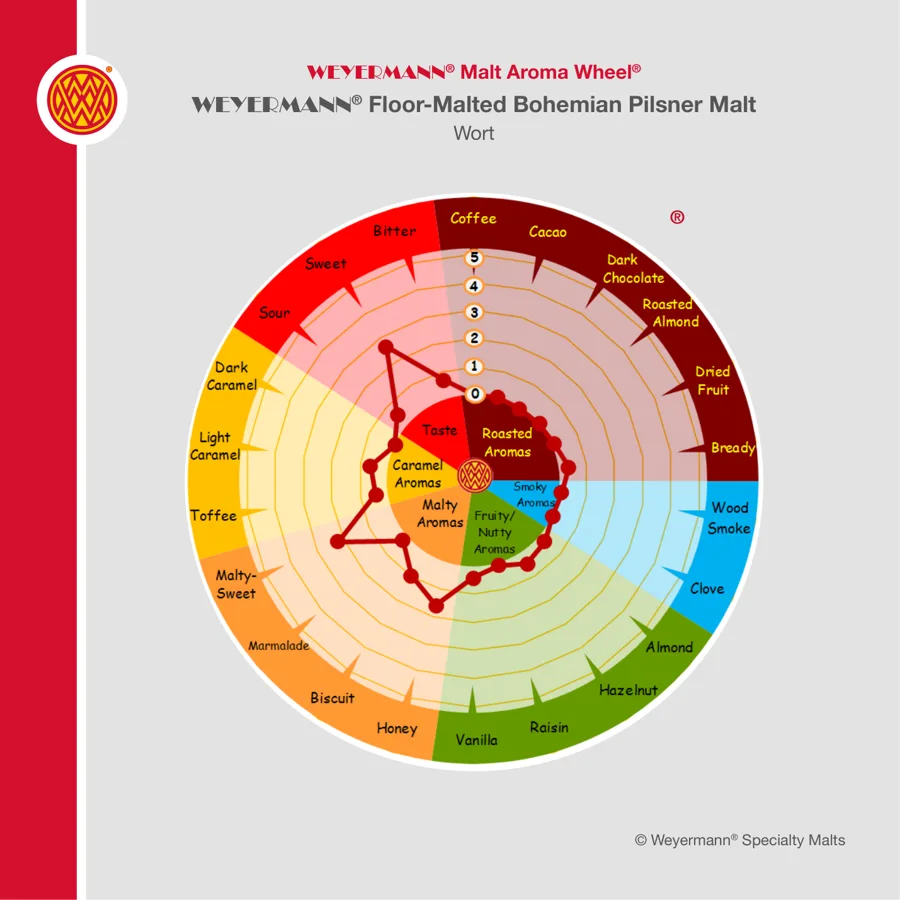
Weyermann's description: an intense malt aroma, honey and biscuit. The wheel below, scored on wort by a trained panel, reaches out on sweet taste and malty-sweet, with a fuller showing in honey and biscuit than the standard Pilsner malts.
In a pale lager this reads as more grain and more bread crust, with a soft sweetness under the hops. Brewers who try it in a side-by-side usually describe the beer as rounder and more Czech, even at the same gravity and bitterness.
How much to use and how to mash it
Up to 100% of the grist. Enzyme activity is high.
Lot variation decides the mash. With a Kolbach near the top of the range, a simple infusion at 63 to 65 °C, then 72 °C, is enough. Near 36%, some brewers add a short rest at 50 to 52 °C for ten minutes. Keep it short or foam suffers. A single decoction suits the style and the malt.
The viscosity ceiling of 1.62 mPa s means run-off can be slower than you are used to. Vorlauf until the wort runs clear, start the run-off gently and raise the rakes rather than the pump speed if the bed tightens. A stuck lauter costs more time than the floor malt saved you in flavour.
A Czech pale lager for 20 litres
For 20 litres at about 12 °P on a homebrew system with roughly 70% efficiency:
- Weyermann Floor-Malted Bohemian Pilsner malt: 4.32 kg (96%)
- Weyermann CARAHELL: 0.18 kg (4%)
Total 4.5 kg. Bitter to 35 to 40 IBU with Saaz-type hops, ferment at 8 to 10 °C with a Czech lager yeast and lager cold for at least four weeks.
Scale it to a brewpub and the questions change. How much more malt does the lower extract cost you per brew? Does the slower lauter fit your brewing day? That arithmetic is part of grist design, not an afterthought.
Using it in India
The sheet allows up to 5.5% moisture from the maltings and promises at least 24 months shelf life unopened if stored dry between 0 and 30 °C. Starting with a little more water means less headroom before the malt goes slack in a humid store. Keep it in the coolest dry room, off the floor. Use it before your box-malted stock.
Floor malt costs more and imported lots can take weeks to arrive, so it is worth keeping a fallback. Bohemian Pilsner malt is the nearest swap, with a decoction to recover some depth. Expect a cleaner, less honeyed beer.
Common questions
What is floor-malted malt?
Malt germinated in a shallow layer on a malting floor and turned at intervals, rather than in a mechanised box. It is slower, less uniform and gives a distinct malt character.
Does floor-malted Pilsner malt need decoction?
No. Its enzyme activity is high and it converts in an infusion mash. Decoction is a flavour choice that suits Czech styles.
Why does my lauter run slower with it?
Its viscosity ceiling is a little higher than modern Pilsner malt. Vorlauf until clear, start the run-off gently and use the rakes before the pump.