Weyermann Pilsner malt: the base for clean, pale lagers
Pilsner malt is the quiet majority of most grists. We read Weyermann's sheet line by line, show what each number changes on brew day and give a worked German Pilsner for a 1,000 litre brewpub.

What Pilsner malt is
Weyermann Pilsner malt is made from German brewing barley that is steeped, germinated and then kilned gently. The low curing temperature keeps the colour down and leaves the enzymes intact, which is the whole job of a base malt: give you extract and the means to convert it.
It was built with bottom-fermented beer in mind, but Weyermann's own style list runs far wider. Helles, Festbier and Kellerbier sit on it, so do Belgian Tripel, hazy IPA, Hefeweizen (alongside wheat malt) and Berliner Weisse. If you keep only one pale base in the cold room, this is a sensible one. Our guide to the whole Weyermann range shows where it sits among the other base malts.
The spec sheet, line by line
These are the figures on the current (2025 crop) brewery datasheet.
- Colour 2.5 to 4.5 EBC (1.4 to 2.1 °L). Pale enough for a straw-gold Pilsner. Boiled wort colour is given as 4 to 5.5 EBC, because the kettle always adds a little.
- Extract at least 80.5% on dry matter. This is a fine-grind laboratory mash. Your brewhouse will recover less.
- Moisture at most 5%. At 5% moisture, every 25 kg bag holds 23.75 kg of dry malt, so the extract you can count on as delivered is about 80.5 x 0.95 = 76.5% before brewhouse losses.
- Kolbach index 36 to 42.5%, protein 9 to 12%. Well modified. A protein rest is not needed and can thin the body and foam.
- Saccharification time 15 minutes at most, enzyme activity high. Plenty of amylase, with room to carry some unmalted adjunct.
- Friability at least 84%, glassy kernels at most 2.5%, viscosity at most 1.58 mPa s. It mills cleanly and lauters without drama.
What it tastes like
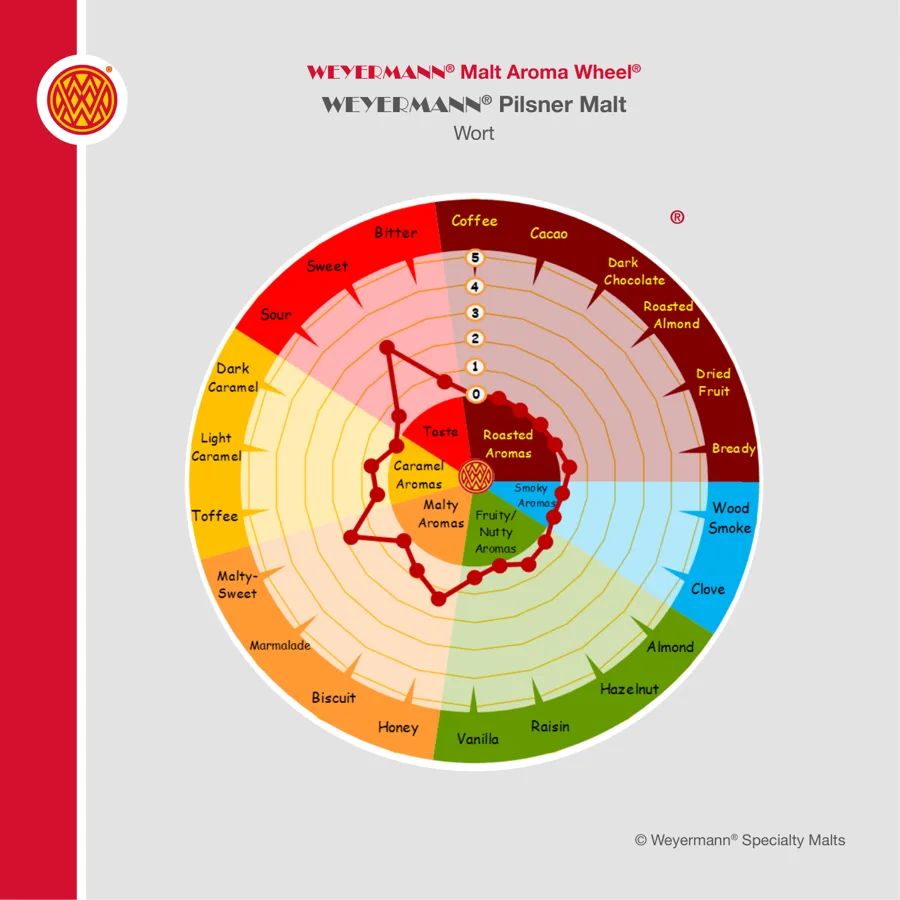
Weyermann describes the sensory profile as malty-sweet with light honey. The aroma wheel below was scored on wort by a trained panel, so read it as raw material rather than finished beer. The trace pushes out furthest on sweet taste and the malty-sweet sector, with a modest reach toward honey and biscuit. The roasted and smoky sectors stay near zero, as they should.
In a lager that comes through as clean bread-and-cracker malt that lets the hops speak. It is not neutral, though. Put it next to a beer brewed on a rice-heavy grist and the difference in mid-palate is obvious.
How much to use and how to mash it
Weyermann allows up to 100% of the grist. Its high enzyme activity means it will convert itself and a share of rice, maize or other unmalted grain.
For a dry, crisp Pilsner, a single infusion at 63 to 65 °C gives a fermentable wort. If you have steps, a beta rest at 63 °C followed by an alpha rest at 72 °C and mash-out at 76 to 78 °C gives you control over body. Keep mash pH between 5.2 and 5.6. For a lager, aim for the lower half.
Pale malt kilned this gently carries more of the precursor that becomes DMS (the cooked sweetcorn note). On our kit that means a 90 minute rolling boil with the lid off and the hot wort through the heat exchanger without a long whirlpool stand. Cut either short and the beer tells you.
A German Pilsner for a 1,000 litre brewpub
For 1,000 litres of cast wort at about 12 °P, assuming a typical brewpub brewhouse yield:
- Weyermann Pilsner malt: 181.3 kg (98%)
- Weyermann Acidulated malt: 3.7 kg (2%)
Total 185 kg. The acid malt is there to pull mash pH down without mineral acid, which matters with alkaline borewell water. Our guide to Acidulated malt covers how far 1% moves it. Bitter to roughly 30 to 35 IBU with German aroma hops, ferment at 9 to 11 °C and lager cold for several weeks.
This grist works because the water and the pH are right. Change the water source and the same 2% may no longer be enough. Knowing why is the difference between following a recipe and designing one.
Using it in India
The datasheet promises at least 24 months of shelf life unopened, provided the bags are stored dry between 0 and 30 °C. A godown in Nagpur in May is well past 30 °C. A Mumbai monsoon brings humidity the bag cannot fully keep out. Store bags on pallets away from walls in the coolest room you have, reseal opened bags tightly and use the oldest lot first.
Malt that picks up moisture goes slack. It mills into flour instead of cracking cleanly, yields less extract and stales faster. Bite a kernel: fresh malt snaps, slack malt chews. Check your mill gap whenever you change lots.
If it is out of stock, another pale Pilsner malt is the obvious swap. Within Weyermann, Extra Pale Premium Pilsner is lighter still and Barke or Bohemian Pilsner bring more malt. Our piece on sourcing malt and hops in India covers lead times. Ask for the certificate of analysis on whatever you buy and compare it with the figures above.
Common questions
Can I brew an IPA on Pilsner malt?
Yes. Weyermann lists American, hazy and double IPA among its uses. It gives a paler, cleaner base than pale ale malt, so you may want a little caramel or Vienna malt if you like more malt depth.
Does Weyermann Pilsner malt need a protein rest?
No. With a Kolbach index of 36 to 42.5% it is well modified. A long protein rest can thin the body and hurt foam.
Why does my Pilsner taste of sweetcorn?
That is DMS. Pale malt carries its precursor, so give the wort a vigorous lid-off boil of 60 to 90 minutes and cool it quickly.
How long can I store it?
Weyermann gives at least 24 months unopened if kept dry between 0 and 30 °C. In Indian summers that means the coolest, driest room you have and opened bags used promptly.