Weyermann Abbey malt: biscuit and honey for Belgian ales
Abbey Malt is a dry, crunchy speciality kilned malt, sometimes sold as a biscuit malt. It can go up to half the grist. Here is what its spec means and how to use it without losing control of colour.

A kilned malt, not a caramel one
Abbey Malt is made by Weyermann from European brewing barley. Its special process leaves an extra crunchy kernel with a complex aroma. It is often labelled a biscuit malt. It intensifies and steadies the malt flavour in a beer, adding colour and a copper-gold shine.
Unlike caramel malts it keeps a little enzyme activity. It is also very dry. Both facts change how you use it. If you want the background on base and kilned malts, see our base malts explainer.
The spec sheet, translated
- Colour: 40 to 50 EBC (15.5 to 19.3 Lovibond). Amber territory. At high rates it carries a beer to copper on its own.
- Extract: 75% minimum, dry basis. Close to a base malt, so it pulls its weight in gravity.
- Moisture: 4.5% maximum. Very dry. This is why it is crunchy and why it shatters in the mill.
- Maximum addition: up to 50%. Unusually high for a speciality malt.
- Enzyme activity: low. It can help a little with conversion, but do not count on it to convert itself at high rates.
What it tastes like
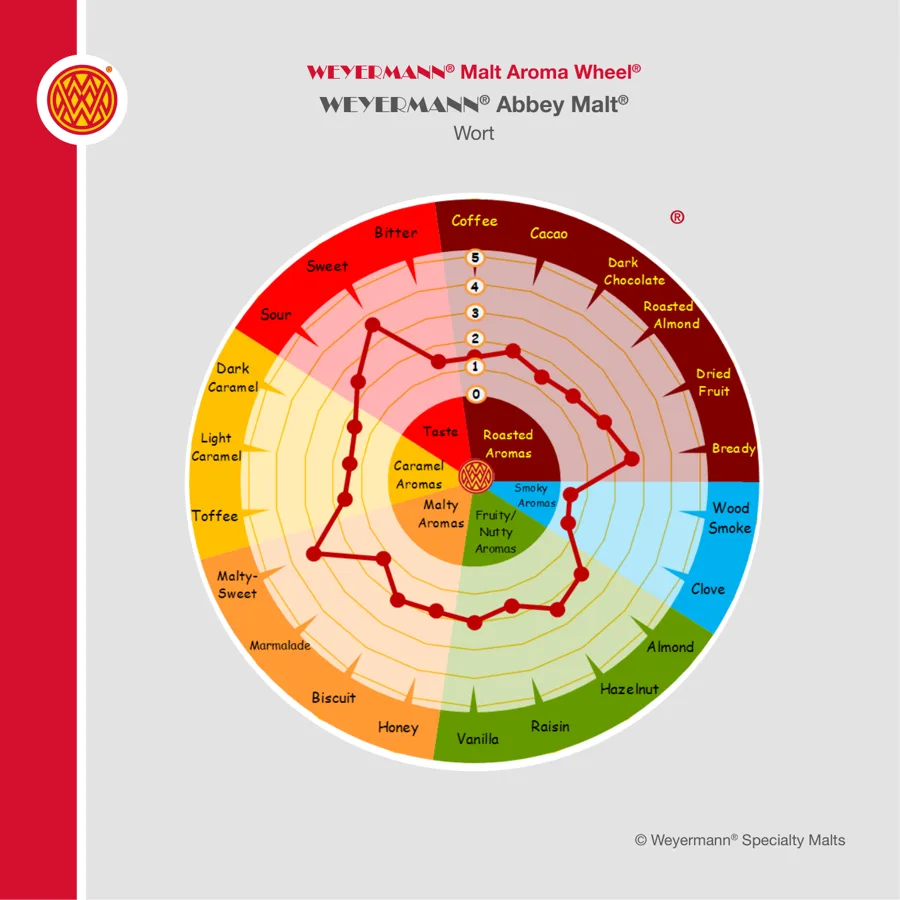
The aroma wheel above lays out a complex malt profile. Weyermann names intense notes of biscuit and honey, plus nuts and chocolate. In practice the biscuit leads, honey follows and a light nut and cocoa note shows at higher doses.
It is drier and less sticky than a caramel malt of similar colour. That is the reason Belgian brewers like it: a tripel or a dubbel gets a big malt flavour without the sweetness that would fight a dry finish.
It also suits British styles. An extra special bitter with a few percent of Abbey Malt picks up a biscuit note that sits well under earthy English hops.
How much to use and how to mash it
Abbey Malt is mashed with the base malt. Its low enzyme activity means it should always sit alongside a well-modified base malt that does the converting.
- 5 to 10%: biscuit depth in a blond, a single or a Belgian IPA.
- 10 to 25%: amber and dubbel territory, with clear honey and biscuit.
- 25 to 50%: strong dark ales and barley wine, where the malt carries the beer. At these rates check conversion with an iodine test before you run off.
The brewhouse detail: because it is so dry, Abbey Malt breaks into fine flour more readily than a base malt. At high rates that flour can tighten the lauter bed. Mill it with the base malt at your normal gap and watch for a slower run-off when the dose climbs above about a quarter of the grist.
A worked grist: Belgian pale ale, 1,000 litres
For a 1,000 litre brewpub batch at around 12 °P and a brewhouse yield near 75%.
- Pilsner malt: 168 kg (80%)
- Abbey Malt: 31.5 kg (15%)
- Munich malt: 10.5 kg (5%)
- Total: 210 kg (100%)
Ferment with a Belgian ale yeast and keep the hops in the background. You get a copper-gold beer with biscuit and honey on the nose. To push it towards a dubbel, add a dark caramel malt such as Special W at a few percent and raise the gravity.
The interesting question is what happens at 25%, or if you trade some Abbey Malt for CARABELGE. Thinking through those swaps before brew day is the grist design work that separates a recipe you copied from one you built.
Using Abbey Malt in India
At 4.5% maximum moisture, Abbey Malt is the driest malt in a typical store. Indian air will try to change that. Unopened, Weyermann gives at least 24 months of shelf life in dry storage between 0 and 30 °C. Once a sack is open in humid weather, the crunch fades within weeks and the biscuit aroma dulls. Decant opened sacks into sealed bins and use them first.
If you are out of stock, a lighter caramel malt plus a little Munich malt gets close on colour, but you lose the dry biscuit character. A kilned amber or biscuit-type malt from another maltster is a closer match. For the rest of the range, see the Weyermann malts guide.
Common questions
Is Abbey Malt a caramel malt?
No. It is a speciality kilned malt with a dry, crunchy kernel and a little enzyme activity. It gives biscuit and honey rather than toffee sweetness.
How much Abbey Malt can I use?
Weyermann allows up to 50%. Most Belgian pale ales use 5 to 15%, with higher rates kept for dubbel, strong dark ales and barley wine.
Does Abbey Malt convert itself?
Its enzyme activity is low, so always pair it with a base malt. At high rates, check conversion with iodine before running off.
What colour is Abbey Malt?
40 to 50 EBC, which is 15.5 to 19.3 Lovibond. It adds amber colour and a copper-gold shine.