Weyermann Bohemian Pilsner malt: Czech character in the grist
Bohemian Pilsner malt is made from Czech barley varieties and tastes like it. We go through the spec sheet, the decoction question and a Czech pale lager grist for a brewpub.

Malt with an address
Weyermann files this one under its terroir and heirloom malts. It is made from Bohemian brewing barley, the varieties Bojos and Malz. The idea is that the barley's own character carries into the beer. That is the same logic winemakers apply to grapes. It holds up better for malt than sceptics expect.
The styles it is meant for are Bohemian: Czech pale, amber and dark lager, Bohemian bock, with saison and gose as outliers. The Weyermann malts guide lists its siblings, including a floor-malted version of the same malt.
The spec sheet and what it means
From the 2025 crop datasheet:
- Colour 3 to 5 EBC (1.6 to 2.3 °L). A touch darker than standard Pilsner malt, which suits the deeper gold of a Czech pale lager.
- Extract at least 80%, moisture at most 5%. Half a point less extract than Weyermann's standard Pilsner malt. On a 185 kg grist that is roughly 1 kg of malt more for the same gravity.
- Kolbach index 38 to 42%, protein 9 to 12%. Well modified by modern standards.
- Saccharification time up to 20 minutes, enzyme activity high.
- Friability at least 82%, glassy kernels at most 2.5%, viscosity at most 1.59 mPa s. Mills and lauters normally.
What it tastes like
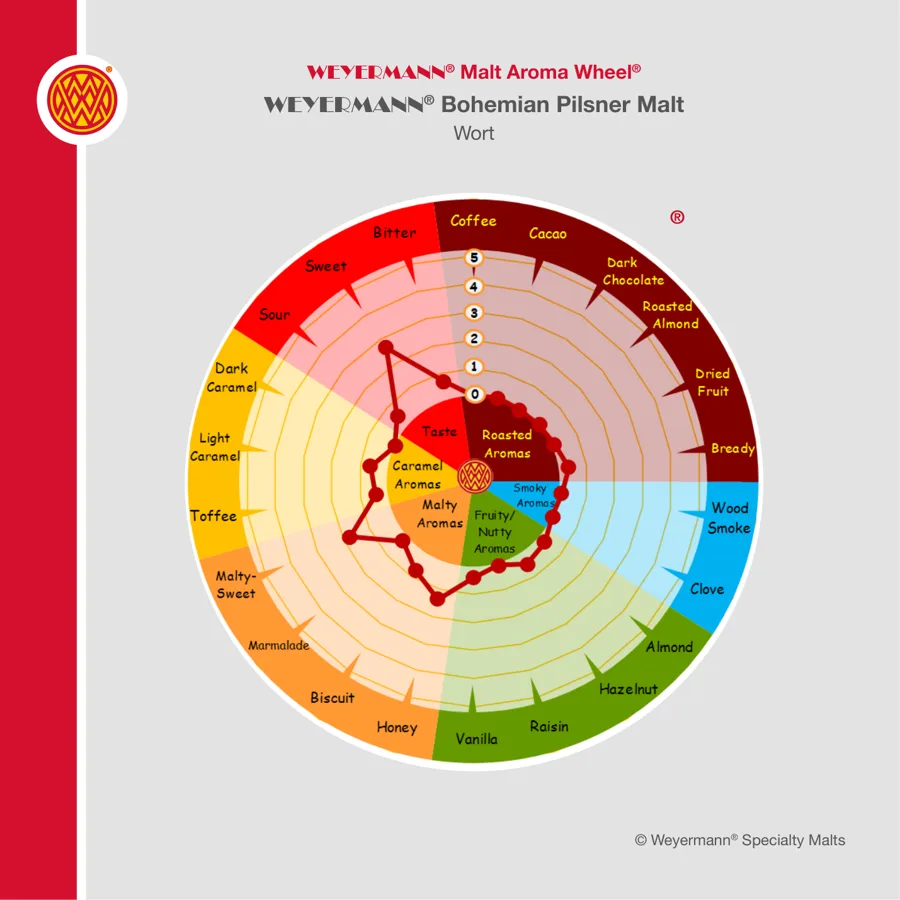
Weyermann's sensory words are nutty malt aroma and malty-sweet. On the aroma wheel below, which a trained panel scored on wort, the trace has its longest reach on sweet taste and malty-sweet, with the fruity and nutty sector a little fuller than on the German Pilsner malts.
In the glass this shows up as a rounder, slightly richer malt that sits under the spicy bitterness of Czech hops. A Czech pale lager brewed on it tends to taste fuller than its gravity suggests.
How much to use and how to mash it
Up to 100% of the grist. In a Czech pale lager it is usually close to that. Enzyme activity is high, so conversion is never the issue.
The real question is decoction. Czech brewers traditionally boil part of the mash, which deepens colour and builds melanoidin flavour, the bready, toasted depth that Maillard reactions create in the boiling portion. This malt is well modified and does not need decoction to convert. Brewers still use it for the flavour. A single decoction is a reasonable compromise on a brewpub system: rest the main mash at 63 °C, pull about a third of the thickest mash, heat it through 72 °C to a boil for 10 to 15 minutes and return it to lift the main mash toward 72 °C. Our decoction mashing guide walks through the steps and the tun capacity you need.
No decoction kit? A step infusion at 63 °C and 72 °C with a 90 minute boil still gives a good beer. It will be a little paler and less layered.
A Czech pale lager for a 1,000 litre brewpub
For 1,000 litres of cast wort at about 12 °P:
- Weyermann Bohemian Pilsner malt: 179.5 kg (97%)
- Weyermann CARAPILS: 5.5 kg (3%)
Total 185 kg. Bitter to around 35 to 40 IBU with Saaz-type hops, ferment cool at 8 to 10 °C and lager long. A low level of diacetyl is accepted in the Czech tradition, but make it a choice rather than an accident.
This is the kind of beer where the base malt, the mash schedule and the water all show. Change one and you taste it. That is why we brew a pilot batch on any new lot before it goes into a full 1,000 litre brew.
Using it in India
Weyermann's shelf life of at least 24 months assumes dry storage between 0 and 30 °C. In most Indian cities that means a cool, dry storeroom, bags on pallets and opened bags resealed. Moisture pickup softens the kernel, so it crushes to flour and costs extract.
Czech pale lager wants soft water. Hard borewell water flattens the hop character and pushes mash pH up, so treat or dilute it before blaming the malt. If the malt is out of stock, the floor-malted version is the closest swap. Standard Pilsner malt also works with a decoction to bring back some depth. Expect a slightly cleaner, less nutty beer.
Common questions
Is Bohemian Pilsner malt only for Czech lagers?
No, but that is where it shows best. Weyermann also lists saison, wheat wine and gose.
Do I have to decoct with it?
No. It is well modified and converts in a simple infusion. Decoction is a flavour and colour choice, not a requirement.
How is it different from the floor-malted version?
Both use the same Bohemian barley varieties. The floor-malted version is germinated on a malting floor and gives a more intense, honey and biscuit malt character, with slightly lower extract.