Weyermann Barke Pilsner malt: a heritage barley in a modern lager
Barke Pilsner malt reads almost identically to standard Pilsner malt on paper. In the beer it does not. We look at what the sheet shows, what it cannot show and how to brew a Helles on it.

A heritage barley in a modern lager
Barke is a two-row summer brewing barley that Weyermann describes as historical. The name Barke is a registered trademark of the maltster. Weyermann values it for its characteristic malt aroma and malts it as a Pilsner, a Vienna and a Munich malt, so you can build a whole grist on the one barley.
The use list leans malt-forward: Helles, Festbier, Dortmunder Export, Kellerbier, German Pilsner, bocks, Franconian red beer, plus British mild, Belgian blond and Scottish ales. The Weyermann malts guide lists the Barke Vienna and Munich versions alongside it.
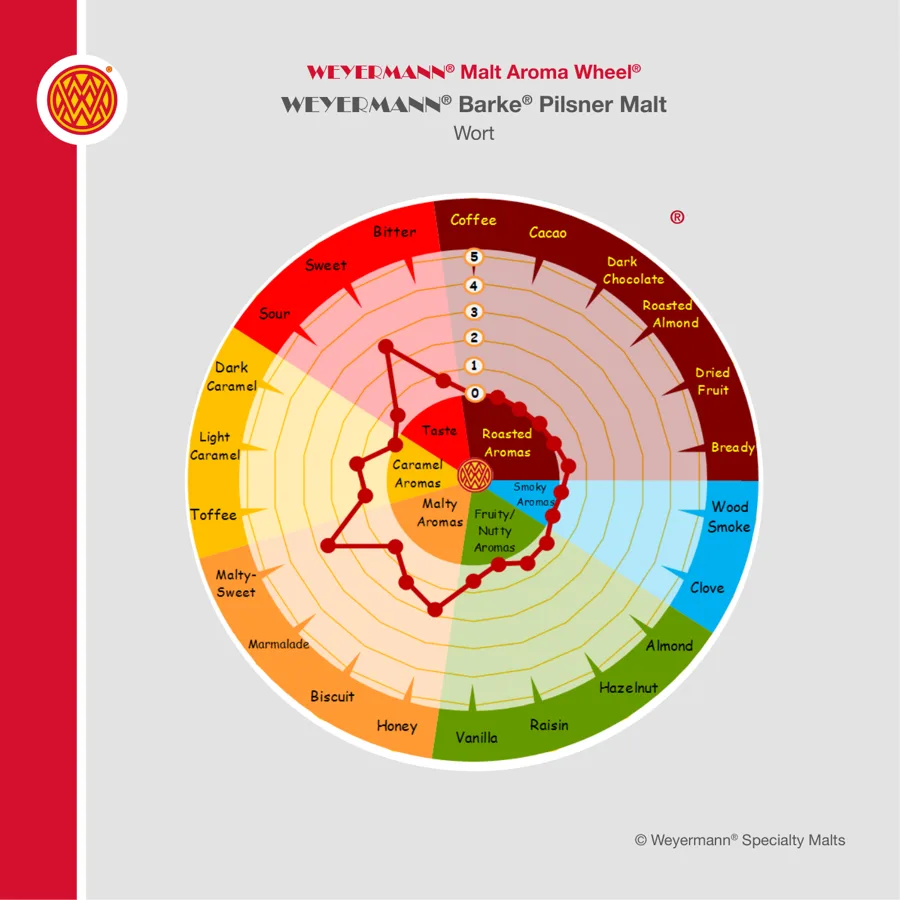
The spec sheet, and what it hides
From the 2025 crop datasheet:
- Colour 2.5 to 4.5 EBC (1.4 to 2.1 °L), boiled wort colour 4 to 5.5 EBC. Identical to standard Pilsner malt.
- Extract at least 80.5%, moisture at most 5%. Also identical.
- Protein 9.5 to 11.5%, Kolbach index 36 to 41.5%. A narrower protein window with a slightly higher floor. Well modified.
- Saccharification up to 15 minutes, enzyme activity high.
- Friability at least 84%, glassy kernels at most 2.5%, viscosity at most 1.58 mPa s. It mills and lauters like any good Pilsner malt.
That is the useful lesson. Two malts with the same analysis can brew different beers, because a spec sheet measures what can be measured cheaply, not everything a panel can taste. Variety matters.
What it tastes like
Weyermann describes marked malt aromas with a layer of toffee underneath and a soft mouthfeel. The sheet also claims excellent body. On the wheel below, scored on wort by a trained panel, the trace reaches well out on sweet taste and malty-sweet, with toffee and light caramel sitting higher than on standard Pilsner malt.
In a Helles that means more bread, a faint toffee roundness and a fuller middle at the same gravity. In a Pilsner it softens the hop edge slightly, which some brewers like and others do not. If you run a taproom with a Helles and a Pilsner on the same base, try Barke in the Helles only for one batch. Your regulars will tell you whether the difference is worth the extra cost.
How much to use and how to mash it
Up to 100% of the grist, with high enzyme activity to carry it. Many brewers who switch to Barke run it as the whole base and drop the caramel malt they were using to prop up body. Try that before adding anything.
Body is the point of this malt, so do not mash it away. A step mash with a 63 °C rest of about 30 minutes and a 72 °C rest of 20 to 30 minutes gives a balanced, drinkable wort. The longer 72 °C hold favours dextrins and the proteins that build foam. Mash-out at 76 to 78 °C. Skip any protein rest: with a Kolbach of 36 to 41.5% the malt does not need it.
A Munich Helles for a 1,000 litre brewpub
For 1,000 litres of cast wort at about 11.5 °P:
- Weyermann Barke Pilsner malt: 172.8 kg (96%)
- Weyermann CARAHELL: 7.2 kg (4%)
Total 180 kg. Bitter to 18 to 22 IBU with German aroma hops, ferment at 9 to 11 °C and lager cold for four weeks or more.
A Helles has nowhere to hide. Oxygen at transfer, a short lager or a high mash pH all show up long before the malt does. Choosing a heritage base is worth it only once the process is under control.
Using it in India
The shelf life on the sheet, at least 24 months unopened, assumes dry storage between 0 and 30 °C. Few Indian warehouses manage that in May. Store bags on pallets in the coolest room, keep them sealed and use them in order. A heritage malt that has gone slack in a hot store will taste like any other tired malt, which wastes the premium.
If Barke Pilsner is out of stock, standard Pilsner malt is the obvious swap. To bring back some body, raise the 72 °C rest by ten minutes or add 2 to 3% CARAPILS. The beer will taste a little leaner. Plan imports with the monsoon in mind, since shipments in humid months need extra care at the port and in transit. Ask your importer how long the container sat at the port and in what conditions. A malt that waited three weeks in a hot yard has already used part of its shelf life.
Common questions
Is Barke Pilsner malt different from standard Pilsner malt on the spec sheet?
Barely. Colour, extract and moisture are the same. The difference is the barley variety, which shows up in flavour and body rather than in the analysis.
What beers suit Barke Pilsner malt best?
Malt-forward pale lagers such as Helles, Festbier, Dortmunder Export and Kellerbier, plus German Pilsner if you like a softer one.
Does it need a protein rest?
No. With a Kolbach index of 36 to 41.5% it is well modified.