Weyermann Barke Vienna malt: heritage barley, kilned for Vienna lager
Barke Vienna is Weyermann's Vienna malt made from one older German barley variety. On paper it looks almost identical to the standard malt. In the glass it is not. That is the reason to buy it.

Why the barley variety matters
Most base malt is made from whichever modern malting barley varieties the region grows that year. Farmers and maltsters choose them for yield per hectare, disease resistance and a predictable malting performance. Flavour comes further down the list.
Barke is a two-row summer barley that German brewers valued for its malt aroma. Like many older varieties it fell out of wide use as higher-yielding barleys arrived. Weyermann sells it in its heirloom range as a single-variety malt, so every kernel in the bag is Barke. That is the whole difference between this malt and the standard Weyermann Vienna malt: the kilning is the same idea, the grain is different.
Barke Vienna against standard Vienna, number by number
Lay the two datasheets (crop 2025) next to each other and most lines match:
- Colour: both 6 to 9 EBC (2.7 to 3.8 °L).
- Extract: both at least 79% dry basis.
- Moisture: both 5.5% maximum.
- Enzyme activity: both high; both up to 100% of the grist.
The differences are small but they tell you something:
- Protein: 9.5 to 11.5% for Barke, against 9 to 12.5%. A narrower band means fewer surprises from lot to lot in foam, haze and body.
- Friability: at least 80%, against 75%. Barke Vienna is more evenly modified, so it mills cleaner and lauters more predictably.
- Kolbach index: 37 to 44.5%, against 37 to 45.5%. Slightly less soluble protein at the top end, which helps keep a lager bright.
None of those numbers explains the flavour. That is the point: the spec sheet tells you how the malt will behave in the brewhouse, while the variety decides how it tastes.
What it tastes like
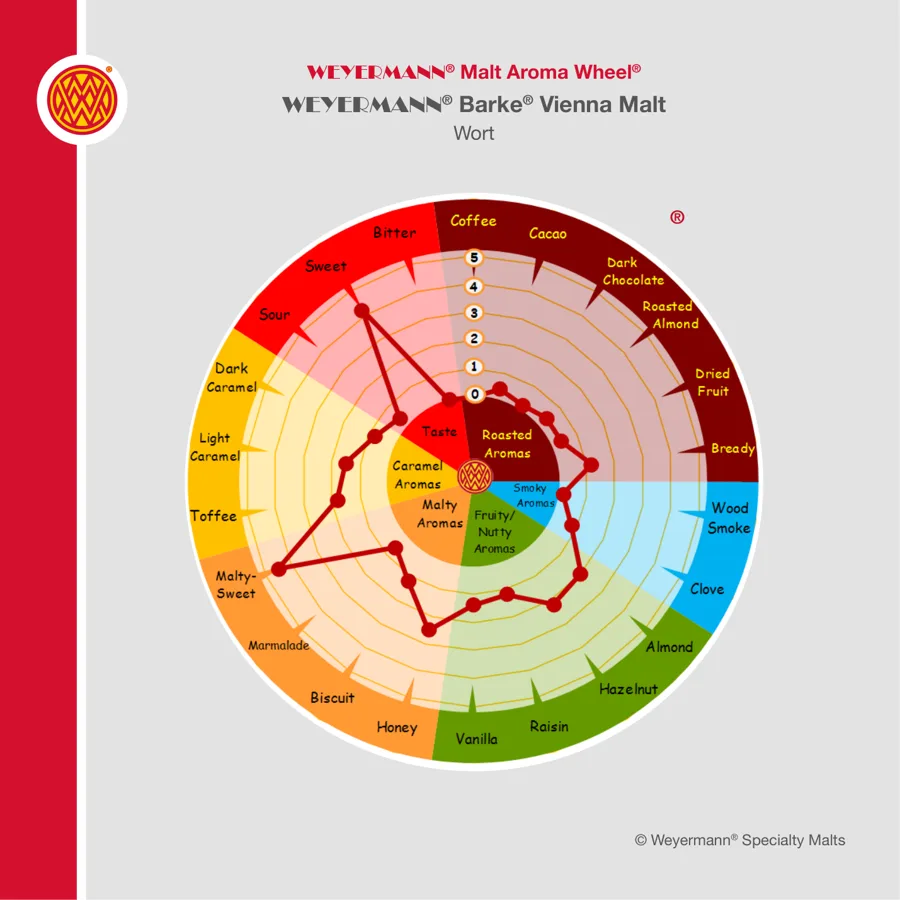
Weyermann's sensory notes read intense malt-sweet with light toffee, honey and nut, plus a soft mouthfeel. Compare that with the standard Vienna description and the new word is toffee. On the aroma wheel on this page the sweet and nutty groups sit further out than they do on the standard Vienna wheel.
In practice a Barke Vienna lager tastes of malt in a way that reminds people of fresh bread crust, with a smooth finish rather than a sharp grainy one. That is why we treat it as a flavour malt that happens to be a base malt, not a straight swap.
When it is worth using
Barke Vienna costs more to grow and to buy than a commodity base malt, so spend it where the drinker will notice:
- Single-malt lagers, where there is nothing else to carry the flavour. A Festbier or Vienna lager on 85 to 100% Barke Vienna is the classic showcase.
- Low-hop beers: Märzen, Helles Bock, Rotbier. Malt is the main act.
- British-leaning ales: the datasheet lists Scottish Ale, ESB and English mild. Here it adds a toffee depth that standard pale ale malt lacks.
In a heavily dry-hopped IPA, most of what you paid for disappears under the hops. Use the standard malt there.
Mash it like any well-modified base malt: a single infusion at 64 to 67 °C for 60 minutes, pH 5.2 to 5.6. Its high enzyme activity means conversion is quick.
A worked grist: Festbier, 20 litres
For about 14 °P (OG 1.057) into the fermenter at typical homebrew efficiency:
- Barke Vienna malt: 4.50 kg (90%)
- CARAHELL: 0.35 kg (7%)
- Acidulated malt: 0.15 kg (3%)
- Total: 5.00 kg (100%)
The CARAHELL adds a little body and foam. The acidulated malt pulls mash pH down when your water is hard. Hop lightly with a German noble variety to about 22 IBU. Ferment cold with a clean lager yeast and lager it for at least four weeks.
The interesting work starts when you scale this to a 1,000 litre brewpub batch. Your brewhouse yield, your water and your boil-off change the balance. Adjusting a grist on purpose rather than by trial is what separates a recipe from a guess.
Barke Vienna in Indian conditions
The storage rule is the same as for any imported malt: Weyermann gives 24 months unopened when kept dry between 0 and 30 °C. A warm, humid store room shortens that. The malt's honeyed aroma is the first thing to fade. Because aroma is the reason you bought Barke, order it in quantities you will use within a few months and keep it in the coolest dry corner you have.
The higher friability helps in Indian brewpubs where the mill gap is set for one base malt and rarely touched. Barke Vienna shatters cleanly at a normal two-roller setting. If your malt has picked up moisture in the monsoon, that advantage goes, so check a sample by biting it before milling a full batch.
If it runs out, standard Vienna malt is the obvious swap. You keep the colour and the brewhouse numbers; you lose some of the toffee. Adding 5% Barke Munich to a standard Vienna grist brings back part of that depth.
Common questions
What is Barke barley?
Barke is an older German two-row summer barley variety that brewers valued for its malt aroma. Weyermann malts it as a single variety in its heirloom range.
Is Barke Vienna darker than regular Vienna malt?
No. Both are 6 to 9 EBC on the current datasheets. The difference is in flavour and in tighter protein and friability figures.
Can Barke Vienna be my only base malt?
Yes. It has high enzyme activity and Weyermann lists additions up to 100%, which makes it a good choice for single-malt lagers.
Is it worth using Barke Vienna in an IPA?
Usually not. Heavy hopping hides most of the extra malt character, so standard Vienna or pale malt does the same job for less.