Weyermann Extra Pale Premium Pilsner malt: for the palest beers
Extra Pale Premium Pilsner is Weyermann's answer to the brewer who wants the lightest possible colour without giving up an all-malt grist. We compare its numbers with standard Pilsner malt and show where it earns its place.

A Pilsner malt pushed paler
Weyermann makes Extra Pale Premium Pilsner from German brewing barley, chosen for the job and malted so that both the malt and the boiled wort come out lighter than standard Pilsner malt. Raw material selection and the malting regime do the work. There is nothing added to it.
The use list reads like a tour of the palest beers in the world: Kölsch-style ale, Japanese and Mexican lager, Bavarian Helles, blonde ale, Belgian Tripel and witbier. The point is not a different flavour. It is the same clean base with less colour pickup, so a low-gravity or very pale beer stays bright in the glass. See where it sits in the Weyermann range.
The numbers, against standard Pilsner malt
From the 2025 crop datasheet, with Weyermann's standard Pilsner malt for comparison:
- Colour 2.0 to 3.5 EBC (1.2 to 1.8 °L), against 2.5 to 4.5 EBC.
- Boiled wort colour 3.8 to 4.5 EBC, against 4 to 5.5. This is the figure that matters, because colour climbs in the kettle.
- Extract at least 80.5%, moisture at most 5%, the same as standard Pilsner.
- Kolbach index 37.5 to 40%, protein 9 to 11.5%. A tighter, slightly lower protein window, which helps clarity and colloidal stability in a bright beer.
- Saccharification time up to 20 minutes, friability at least 80%, glassy kernels at most 2.5%, viscosity at most 1.55 mPa s.
Enzyme activity is rated high, so conversion is not a worry. The slightly longer saccharification ceiling simply means you should run an iodine test rather than assume.
What it tastes like
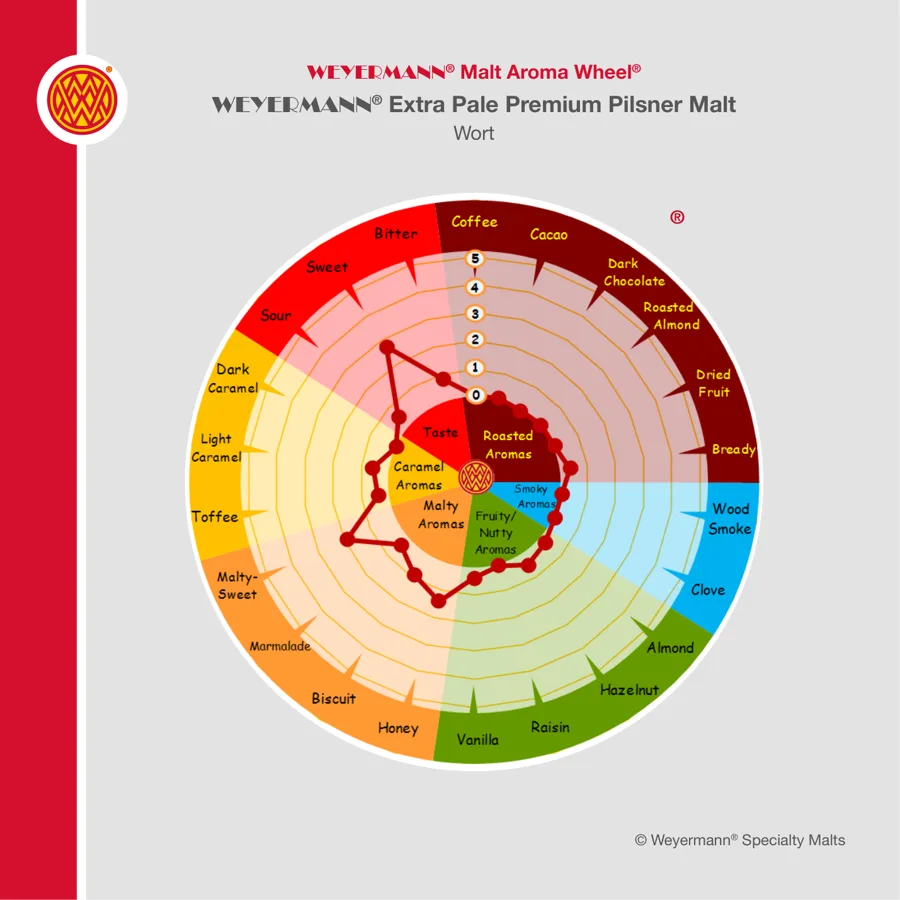
The sensory note on the sheet is malty-sweet with light honey, the same words Weyermann uses for its Pilsner malt. On the wheel below, scored on wort, the trace reaches out on sweet taste and malty-sweet, with honey and biscuit modest and the roast, smoke and fruit sectors close to the centre.
In finished beer it reads as soft cracker and a touch of honey sweetness. In a Helles that is exactly the brief: malt you notice, colour you do not.
How much to use and how to mash it
Up to 100% of the grist. A single infusion at 64 to 66 °C suits Helles and blonde ale. For a drier lager, rest at 63 °C before raising to 72 °C. Mash-out at 76 to 78 °C.
Colour is won or lost after the mash. Long boils, long hot stands and high pH all darken wort. A pale beer that sits an hour in the whirlpool before the plate heat exchanger will pick up colour this malt was paid to avoid. Keep the boil vigorous but no longer than the hops and DMS need, usually 60 to 75 minutes. Then get the wort cold promptly.
A pale Helles for a 1,000 litre brewpub
For 1,000 litres of cast wort at about 11.5 °P:
- Weyermann Extra Pale Premium Pilsner malt: 174.6 kg (97%)
- Weyermann CARAFOAM: 5.4 kg (3%)
Total 180 kg. CARAFOAM adds body and foam with almost no colour. Bitter lightly, to around 18 to 22 IBU, ferment at 9 to 11 °C and lager cold. The beer should land a shade paler than the same grist on standard Pilsner malt, which you will see side by side in two glasses even if a colour meter barely separates them.
Whether that shade is worth the premium is a business call as much as a brewing one. Knowing how much colour each malt and each process step contributes is what lets you make it on purpose.
Using it in India
The 24 month shelf life on the sheet assumes dry storage between 0 and 30 °C. Indian summers break that ceiling in most cities, so keep bags off the floor in the coolest dry room you have. Malt that takes on moisture mills to flour, lowers extract and darkens faster in the kettle, which defeats the purpose of buying the palest malt.
Many Indian lagers use rice to lighten colour and body. This malt lets you get close on an all-malt grist, or use less rice for the same look. If it is out of stock, standard Pilsner malt is the swap. Expect a slightly deeper colour and compensate with a shorter boil and quicker cooling rather than adding adjunct you had not planned for.
Common questions
Is Extra Pale Premium Pilsner malt the same as standard Pilsner malt?
No. It is made from selected barley under a malting regime that gives lighter malt and boiled wort colour (2.0 to 3.5 EBC against 2.5 to 4.5 EBC). Extract and moisture specs are the same.
Does it taste different?
Very little. Weyermann describes both as malty-sweet with light honey. The difference is colour, plus a slightly tighter protein range.
Can I use it for a light lager with rice?
Yes. It has high enzyme activity, so it can convert a share of cooked rice. Its low colour helps a very pale result.