Weyermann Floor-Malted Bohemian Dark malt: for Czech dark lagers
Czech dark lager should taste of malt first and roast a distant second. Floor-Malted Bohemian Dark malt is built for that. We read its spec sheet and give a 1,000 litre grist.

A dark base malt, floor malted
This is a kilned base malt, not a roasted one. Weyermann makes it in Bohemia from the Czech barley varieties Bojos and Malz, germinated on a malting floor, then kilned hotter than a Pilsner malt to develop colour and malt flavour. The pale floor-malted sibling explains the floor process in more detail.
The use list is short and specific: Czech dark lager, Bohemian bock and gruit. It sits between a Munich malt and a caramel malt in what it brings. The Weyermann malts guide shows where each of those lives.
The spec sheet and what it means
From the 2025 crop datasheet:
- Colour 12 to 20 EBC (5 to 8 °L). Used at a high share, this alone takes wort into deep amber. Roasted malt does the rest of the job in a dark lager.
- Extract at least 78%, moisture at most 4.5%. Lower extract than pale base malt, partly because of the hotter kilning. Allow more malt per hectolitre.
- Enzyme activity medium. Enough to convert itself, with less to spare for adjuncts or other malts.
- Kolbach index 36.5 to 45.5%, protein 9 to 12%. A wide range. Check the lot certificate.
- Saccharification up to 20 minutes, viscosity at most 1.69 mPa s, friability at least 75%, glassy kernels at most 3.5%. The higher viscosity and lower friability mean slower milling and lautering than pale malt.
What it tastes like
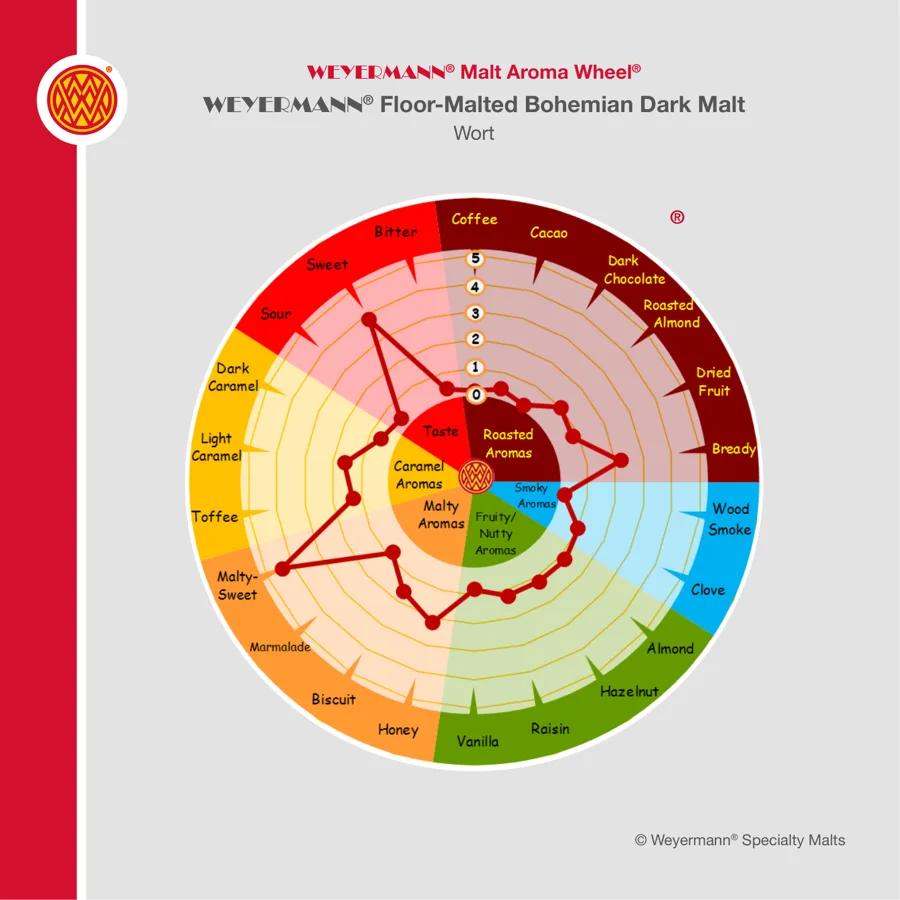
Weyermann's sensory note promises an intense malt aroma carrying toffee and dark caramel, plus full body and a marked malt sweetness. The wheel below makes that plain. On wort, the panel scored malty-sweet highest of any sector, with bread crust, toffee and light caramel well out from the centre and sweet taste high. Roast stays low.
In a dark lager that becomes the backbone: bread crust and toffee carrying a little roast from a dehusked dark malt on top. Pour a Czech dark lager brewed on it next to one brewed on pale malt plus colour. The first tastes of malt while the second tastes of roast and water. That gap is what you are paying for.
How much to use and how to mash it
Weyermann allows up to 100%. In practice most brewers blend it with a pale base for extra enzymes and a lighter extract cost, using it at 50 to 80% of the grist.
Medium enzyme activity means do not rush the mash. Rest at 63 °C and then 72 °C for long enough that an iodine test comes back clean, which may take longer than a pale grist. Its Kolbach range is wide, so read the certificate before you decide on any protein rest. Above about 40%, skip it. Darker malt also lowers mash pH, so check it before adding acid you might not need. Our guide to mash pH explains why 5.2 to 5.6 matters.
A Czech dark lager for a 1,000 litre brewpub
For 1,000 litres of cast wort at about 12.5 °P:
- Weyermann Floor-Malted Bohemian Dark malt: 140 kg (70%)
- Weyermann Bohemian Pilsner malt: 50 kg (25%)
- Weyermann CARAFA SPECIAL Type 2: 6 kg (3%)
- Weyermann CARAMUNICH Type 2: 4 kg (2%)
Total 200 kg. The pale malt adds enzymes and extract, the CARAFA SPECIAL gives colour with little harshness and the CARAMUNICH rounds the finish. Bitter to around 25 IBU, ferment at 9 to 10 °C and lager cold.
The grist is mostly about colour and sweetness pulling in different directions. Getting both right on purpose, instead of by trial and error over six batches, is the skill.
Using it in India
At 4.5% moisture this malt leaves the maltings drier than the pale base malts, so it has a little more headroom before it goes slack. The 24 month shelf life still assumes dry storage between 0 and 30 °C. Keep it cool and sealed, because stale kilned malt loses the toffee and bread notes you bought it for.
The lower friability means set your mill for this malt rather than the pale one, or mill them separately. If it is out of stock, a Munich malt with a little more caramel malt is the closest swap. It will taste cleaner and less intense.
Common questions
Is Bohemian Dark malt a roasted malt?
No. It is a kilned base malt with a colour of 12 to 20 EBC. Dark lagers still need a little roasted malt for their final colour.
Can it be used at 100%?
Weyermann allows up to 100%. Its medium enzyme activity can convert itself. Most brewers blend it with pale malt for a faster, more reliable conversion.
What does it taste like?
Weyermann describes an intense malt aroma carrying toffee and dark caramel, plus full body and marked sweetness.