Weyermann CARARED: red colour without roast
CARARED brings an orange-red shine and honey and pastry notes, with no roast. We cover the numbers, the dose and a 1,000 litre red ale.

What CARARED is and how it is made
CARARED is a caramel malt from German brewing barley, made so it builds colour towards red rather than brown. As with every caramel malt, the starch is converted and caramelised inside the kernel before kilning, so there are no enzymes left.
On its own it pushes a beer to an orange-red shine. Weyermann says plainly that for a deep red you should combine it with Melanoidin malt. Red colour in beer is hard to get without a touch of roast. That pairing is the cleanest route we know.
The numbers on the spec sheet
- Colour: 40 to 60 EBC (15.5 to 23.1 °L).
- Extract: 74% minimum, dry basis.
- Moisture: 8% maximum.
- Enzyme activity: none.
- Recommended addition: up to 25%, a high ceiling for a malt of this colour.
The high ceiling tells you something. At 40 to 60 EBC, CARARED adds colour gently, so you can use a lot of it before the beer turns brown. That is how Vienna lager and Irish red get their colour from malt rather than from a sprinkle of roast.
What it tastes like
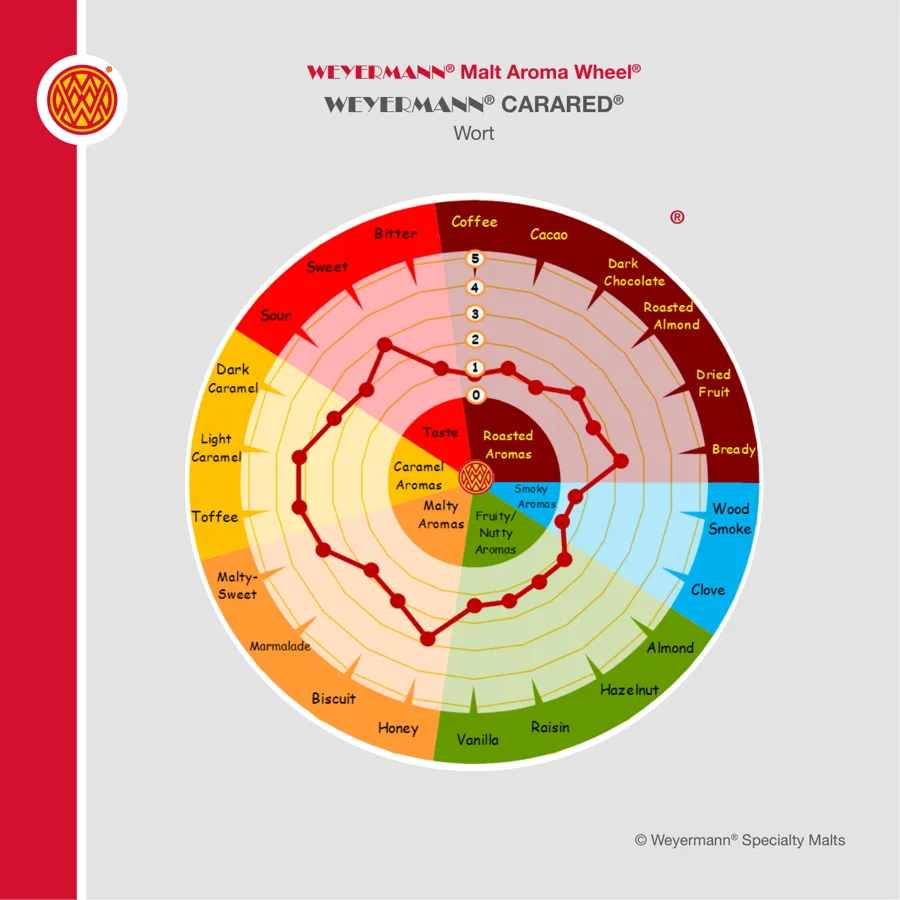
Weyermann's sensory note is malty-sweet with caramel, honey and pastry. The aroma wheel below the first section reflects it. There is no roast and no dried fruit. In a red ale it gives a soft, honeyed middle; in a Vienna lager it reads as bready sweetness.
Next to CARAAMBER it is paler and sweeter, with less bread.
A word on what "red" means in a glass. Beer colour scales such as EBC measure how much light a sample absorbs, not its hue, so two beers with the same EBC can look amber and ruby side by side. CARARED and Melanoidin push the hue towards red; a dark crystal of the same EBC pushes it towards brown. Judge red beers by eye against a white card in daylight, not by the number alone. Our guide to beer colour, SRM and EBC explains the scales.
How much to use and how to mash it
Mill it with the base malt and add it to the mash. Typical ranges we use: 5 to 10% in a red IPA or American pale ale, 10 to 20% in Vienna lager, Irish red or American red ale. Go up to 25% where a big malt body is wanted, as in Imperial Red Ale or Flanders red.
Above 15% the beer becomes noticeably sweeter. Balance it with firmer bitterness or a slightly lower mash temperature so the yeast has more to ferment.
A worked grist: red ale for 1,000 litres
An Irish-style red ale of about 12 °P near 75% efficiency:
- Pale ale malt: 150 kg (75%)
- CARARED: 30 kg (15%)
- Melanoidin malt: 16 kg (8%)
- Roasted barley: 4 kg (2%)
Total 200 kg. The roasted barley at 2% deepens the red and dries the finish; CARARED and Melanoidin carry the colour and the malt. Expect a ruby beer with no burnt taste. Mash at about 66 °C for a medium body; drop to 65 °C if the first batch tastes too sweet with this much CARARED.
Shift any of those four numbers and the red can tip to brown fast. Learning how each malt moves colour and flavour, so you hit ruby on purpose, is what grist design covers.
Using CARARED in India
An 8% moisture ceiling means opened bags pick up humidity quickly. Soft, stale caramel malt tastes flat and mills unevenly. A red ale has nowhere to hide either fault. First in, first out, every time.
The datasheet promises at least 24 months of shelf life for an unopened bag kept dry between 0 and 30 °C. Plenty of Indian godowns pass 30 °C from March to June, so treat that promise as conditional. Keep pallets off the floor and away from the roof sheet, in the coolest room you have.
Out of stock? A crystal of 40 to 60 EBC from another maltster is the nearest swap; brew a small test first, as colour tone varies between maltsters. Adding a little more Melanoidin helps hold the colour. The Weyermann malts guide lists the alternatives.
Common questions
Will CARARED alone make my beer red?
It gives an orange-red shine. For a deep red, Weyermann recommends combining it with Melanoidin malt; a small amount of roasted barley helps too.
How much CARARED can I use?
Up to 25% of the grist. Most red ales and Vienna lagers sit between 10 and 20%.
Does CARARED taste roasted?
No. Its flavour is malty-sweet with caramel, honey and pastry notes, with no roast.