Weyermann CARAAROMA: the darkest caramel for big malt aroma
CARAAROMA is the darkest caramel malt Weyermann makes, with the most complex flavour of the family. We cover its numbers, how to dose it and where it shines.

What CARAAROMA is and how it is made
CARAAROMA is a very dark caramel malt from German brewing barley. The kernel is converted and caramelised like any caramel malt, then taken much further, to the point where the first roasted flavours appear. Weyermann describes it as having the greatest aroma complexity of its caramel range.
It sits on the border between two families. It tastes partly of caramel and partly of roast, but it is still a caramel malt: glassy inside, no enzymes and far gentler than true roasted malts. If you want proper coffee and chocolate, see our roasted malts guide.
The numbers on the spec sheet
- Colour: 350 to 450 EBC (132.4 to 170.1 °L), the darkest of the caramel malts here.
- Extract: 74% minimum, dry basis.
- Moisture: 7% maximum.
- Enzyme activity: none.
- Recommended addition: up to 15%.
Colour is the number to watch. At 400 EBC, one kilo of CARAAROMA carries roughly the colour of a hundred kilos of Pilsner malt. Weigh it on a scale you trust; a bucket by eye is how amber ales become brown ales.
What it tastes like
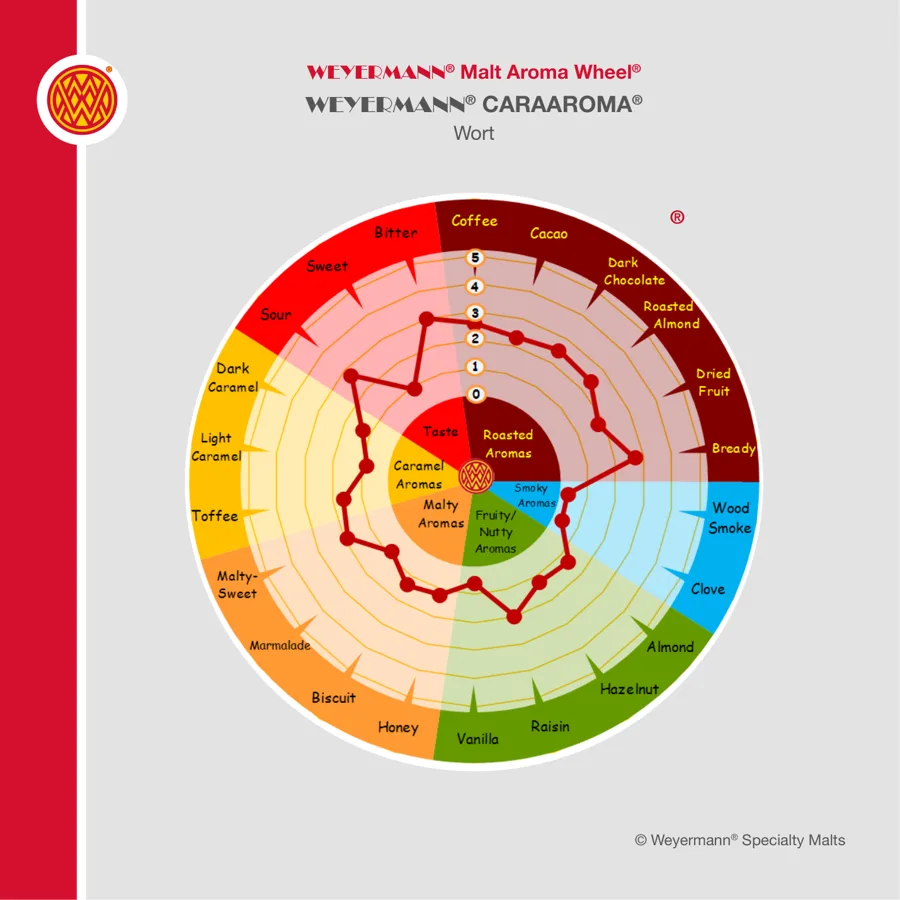
Weyermann's sensory notes are first hints of roast, roasted nuts, dark caramel and dried fruit. The aroma wheel below the first section spreads wider than for any paler caramel malt, which is the point. Think raisins, toasted hazelnut and burnt sugar.
In a brown ale or porter that complexity fills the gap between the base malt and the roast. In a dark lager a small amount adds depth without the dryness of a roasted malt.
Weyermann lists it for dark lager, Brown IPA, Scottish ales, American red ale, Bière de Garde, every shade of brown ale, a long run of porters, oatmeal, American and imperial stouts, Old Ale and barley wine. Read that list as a rule: CARAAROMA belongs wherever a beer is meant to taste of malt first. It is out of place in anything pale and crisp, where even 1% will show as a brown tint and a raisin note.
How much to use and how to mash it
No enzymes, so mill it with the base malt and add it to the mash. Our working ranges: 2 to 5% to give an amber or red ale more depth, 5 to 10% for brown ale, porter, Scottish export and Old Ale. Go up to 15% only in barley wine or imperial stout, where there is enough alcohol and body to carry it.
Even small doses change colour a lot. A 3% addition can be the difference between copper and chestnut.
A worked grist: American brown ale, 20 litre homebrew
An American brown ale of about 13 °P at typical homebrew efficiency:
- Pale ale malt: 4.0 kg (80%)
- Munich malt: 0.5 kg (10%)
- CARAAROMA: 0.4 kg (8%)
- CARAFA SPECIAL: 0.1 kg (2%)
Total 5.0 kg. CARAAROMA gives the nutty, dried-fruit middle; the small dose of dehusked roasted malt adds colour and a dry chocolate edge without harshness. Hop it with American varieties to around 30 IBU.
When to reach for CARAAROMA and when for a roasted malt (and in what ratio) is where most brown ales and porters go right or wrong. That balance is the heart of grist design. For a gentler caramel step, compare CARAMUNICH Type 3.
Using CARAAROMA in India
Dark caramel malt that has gone stale loses its dried fruit first and tastes flat and papery. With a 7% moisture ceiling, opened bags in a humid store will soften within weeks. Buy it in quantities you will use, reseal every bag and keep it away from the brewhouse steam.
The datasheet promises at least 24 months of shelf life for an unopened bag kept dry between 0 and 30 °C. Plenty of Indian godowns pass 30 °C from March to June, so treat that promise as conditional. Keep pallets off the floor and away from the roof sheet, in the coolest room you have.
If it is out of stock, a dark crystal of 300 to 400 EBC from another maltster is the nearest swap. A blend of CARAMUNICH Type 3 with a little roasted malt can also get close, with a little less dried fruit. The Weyermann malts guide covers the full range.
Common questions
Is CARAAROMA a roasted malt?
No. It is a caramel malt taken very dark, so it shows the first nuances of roast alongside dark caramel, roasted nuts and dried fruit, but it is far gentler than roasted malts.
How much CARAAROMA should I use?
Weyermann allows up to 15%. Most brown ales and porters sit around 5 to 10%; 2 to 5% adds depth to amber and red beers.
Why did my amber ale come out brown?
At 350 to 450 EBC, small changes in CARAAROMA weight shift the colour a lot. Weigh it precisely and run the colour calculation before brew day.