Weyermann CARAHELL: light caramel for pale beers
CARAHELL is a pale, fully caramelised malt that adds sweetness and body without dragging a pale beer towards amber. We cover the numbers, the dose and a helles grist.

What CARAHELL is and how it is made
CARAHELL is a light caramel malt. Weyermann takes germinated barley, converts the starch to sugar inside the husk and then caramelises it almost completely before kilning. The result is a glassy kernel full of sugars and colour compounds, with no enzymes left to speak of.
It sits one clear step above CARAPILS. CARAPILS is about body and foam with no flavour; CARAHELL gives body and foam plus a noticeable light caramel sweetness and a golden tint. The name comes from German hell, pale. That is the family of beers it was made for.
The numbers on the spec sheet
- Colour: 20 to 30 EBC (8 to 11.8 °L). Enough to move a Pilsner from straw to gold at 10%.
- Extract: 74% minimum, dry basis.
- Moisture: 9% maximum, the highest in this group of caramel malts.
- Enzyme activity: none.
- Recommended addition: 10 to 15%, up to 30% for specialty beers.
The colour figure is the one to respect. Run your recipe software before you brew: a helles brewer who adds CARAHELL by feel tends to end up with an export lager.
What it tastes like
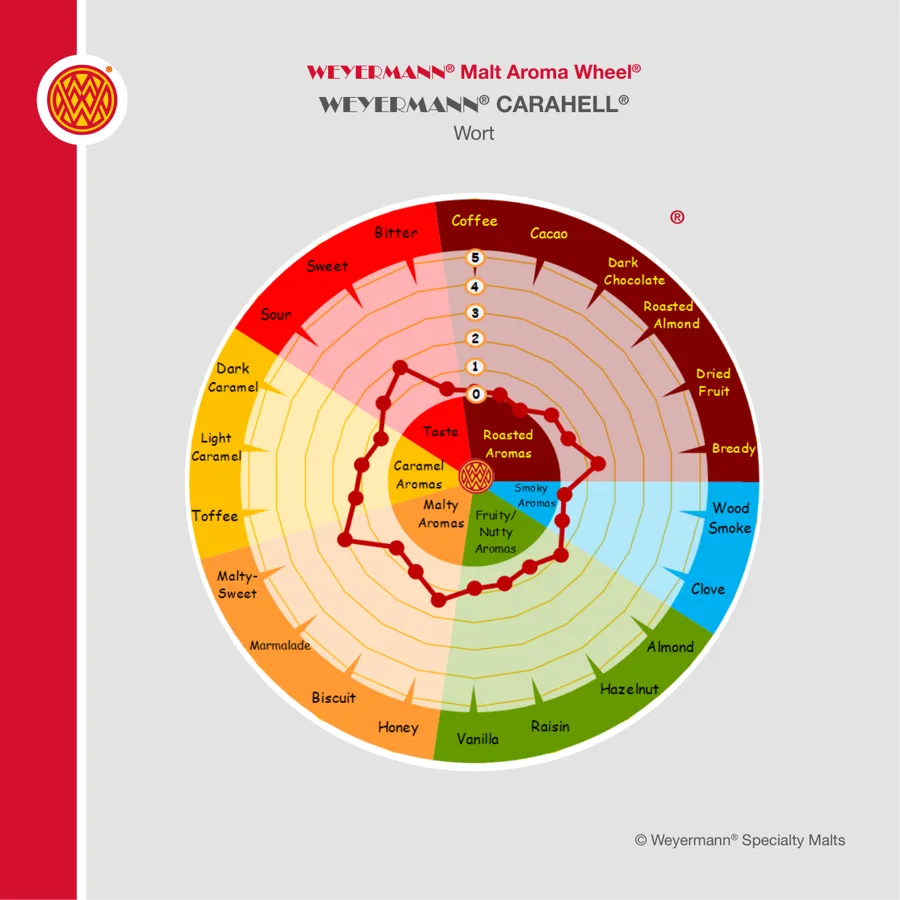
Weyermann's sensory note is malty-sweet with fine caramel. On the aroma wheel below the first section, the sweet and caramel spokes lead, with no roast or dried fruit. In the glass that reads as honey and fresh bread crust at 10%. Nearer 15% it turns to clear toffee.
It also improves foam and mouthfeel, which is why it turns up in hefeweizen and pale ale as often as in lager.
A useful side-by-side test before you commit a whole batch: steep 50 g each of CARAPILS, CARAHELL and a darker crystal in 500 ml of water at 65 °C for twenty minutes, strain and taste the three warm teas next to each other. CARAPILS tastes of very little. CARAHELL tastes of honey and light toast. The darker malt tastes of toffee and raisin. Ten minutes of tasting tells your team more about the caramel range than any spec sheet.
How much to use and how to mash it
CARAHELL has no enzymes, but it does not need any: its starch is already sugar. Mill it with the base malt and add it to the mash. In a single infusion it goes in with everything else. In a decoction, keep it in the main mash rather than the decoction portion, so you do not stack boiled caramel on boiled caramel.
At 10 to 15% it shows itself. Under 5% it mostly adds body. Past 15% in a pale lager you are writing a different beer, which is fine if that is the plan.
A worked grist: Munich helles for a 1,000 litre batch
A soft, malty helles of about 11.5 to 12 °P on a brewhouse near 75% efficiency:
- Pilsner malt: 170 kg (85%)
- CARAHELL: 20 kg (10%)
- Munich malt: 10 kg (5%)
Total 200 kg. Bitter gently, around 18 to 22 IBU, so the malt leads. If your water is a hard borewell supply, cut it with RO water first; a helles shows harsh water faster than any other beer.
Choosing between 8% CARAHELL plus 5% Munich or 12% CARAHELL alone, then predicting the colour and sweetness of each, is the core of grist design. It is easy to guess and hard to get right twice.
Using CARAHELL in India
With a 9% moisture ceiling, CARAHELL is the thirstiest malt in the caramel range. An open bag left by the mill through a Mumbai or Kochi monsoon will be chewy within a week. Soft kernels mill into paste rather than grits. Seal opened bags, use them quickly and check a few kernels between your teeth: they should crack, not bend.
The datasheet promises at least 24 months of shelf life for an unopened bag kept dry between 0 and 30 °C. Plenty of Indian godowns pass 30 °C from March to June, so treat that promise as conditional. Keep pallets off the floor and away from the roof sheet, in the coolest room you have.
If it runs out, another maltster's light crystal of 20 to 30 EBC is the closest swap. CARAPILS keeps the body but loses the caramel. See the Weyermann malts guide for the rest of the family.
Common questions
Is CARAHELL the same as CARAPILS?
No. CARAPILS is 2.5 to 6.5 EBC and adds body with little flavour. CARAHELL is 20 to 30 EBC and adds visible gold colour and light caramel sweetness.
Can I use CARAHELL in a hefeweizen?
Yes. Weissbier and Hefeweizen are on Weyermann's style list for it. A small addition gives a fuller body and slightly deeper colour.
Does CARAHELL need mashing?
It has no enzymes and its starch is already converted, so it can be steeped. In an all-grain brew, simply add it to the mash with the base malt.