Weyermann CARAAMBER: amber colour with a bready finish
CARAAMBER sits between the gold and the copper caramel malts and leans bready rather than sweet. We cover its numbers, the dose and a best bitter grist.

What CARAAMBER is and how it is made
CARAAMBER is a mid-coloured caramel malt from German brewing barley. Like the rest of the family, its starch is turned to sugar inside the kernel and then caramelised and kilned, leaving no working enzymes. Weyermann says it steadies and refines the flavour, deepens the colour and gives the beer a dark red shine.
What sets it apart is the bread in the flavour. Lighter caramel malts taste of honey; CARAAMBER tastes of toffee on toast.
The numbers on the spec sheet
- Colour: 60 to 80 EBC (23.1 to 30.6 °L).
- Extract: 75% minimum, dry basis, at the top of this caramel group.
- Moisture: 4.5% maximum, the driest malt in this caramel group by a distance.
- Enzyme activity: none.
- Recommended addition: up to 20%.
Two numbers matter on brew day. The 75% extract means it costs you little gravity, so you rarely need to adjust the base malt. The 4.5% moisture means it arrives crisp and stays crisp longer than its siblings, which helps in India.
What it tastes like
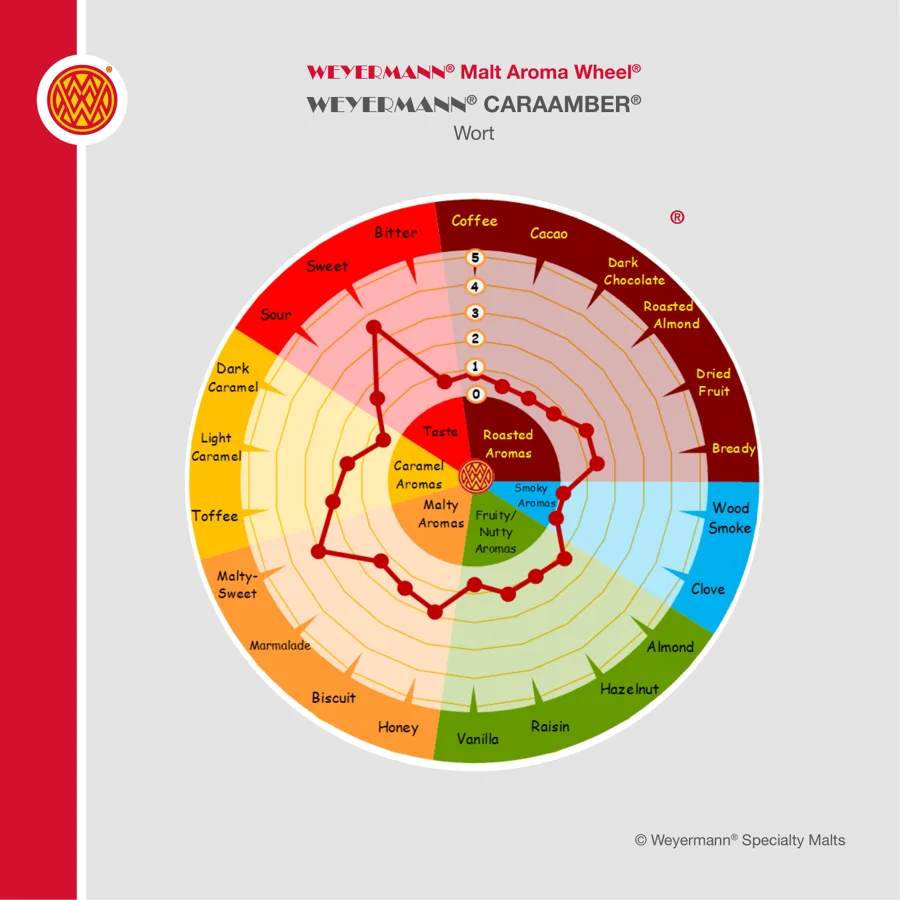
Toffee, caramel and bread are Weyermann's sensory words. The aroma wheel below the first section shows that balance. The bread note is what makes it useful: it keeps an amber beer from tasting like a sweet shop and gives the finish some dryness.
Compare it with CARARED, which is paler and leans honey and pastry. Also try CARAMUNICH Type 1, which is darker and more purely caramel.
Weyermann's style list for it runs from Franconian red beer and International Amber Lager through best and strong bitter, red and session IPA, the brown ale family, Baltic porter and Scotch ale, to the sour reds of Flanders and Oud Bruin. That last pair is a clue: its bready, toffee depth stands up to long ageing and acidity, where a sweeter crystal can taste cloying once the sourness arrives.
How much to use and how to mash it
Mill it with the base malt and add it to the mash; no special rest needed. Start around 5 to 10% for best bitter, session pale ale and red IPA. Go towards 15 to 20% for Scotch ale, Imperial Red Ale, Baltic porter or Flanders red, where a big, complex malt body is the point.
In hop-forward red IPA, keep it nearer 8%. Caramel and late hops both claim the middle of the palate. Too much of either makes the beer muddy.
A worked grist: best bitter, 20 litre homebrew
A best bitter of about 10 to 10.5 °P at typical homebrew efficiency:
- Pale ale malt: 3.4 kg (85%)
- CARAAMBER: 0.4 kg (10%)
- Munich malt: 0.2 kg (5%)
Total 4.0 kg. Bitter to around 30 to 35 IBU with English hops, ferment with an English ale yeast and serve at low carbonation. Scale by 50 for a 1,000 litre batch and recheck against your brewhouse efficiency.
Moving from that bitter to a red IPA is not just more hops. The caramel share, the colour target and the bitterness all have to move together. Learning to move them as a set is grist design.
Using CARAAMBER in India
That 4.5% moisture figure is a gift in a humid climate, but it also means the malt has more room to absorb water once opened. A kernel that started at 4% and has crept towards 8% in a damp store will taste flat and mill soft. Reseal bags and keep a cheap hygrometer in the malt store so you know when the room, not the malt, is the problem. Above about 70% relative humidity, assume an opened bag is gaining water.
The datasheet promises at least 24 months of shelf life for an unopened bag kept dry between 0 and 30 °C. Plenty of Indian godowns pass 30 °C from March to June, so treat that promise as conditional. Keep pallets off the floor and away from the roof sheet, in the coolest room you have.
If it runs out, a crystal of 60 to 80 EBC from another maltster is the closest swap, though it may be sweeter and less bready. A small addition of Munich malt alongside helps bring the bread back. See the Weyermann malts guide for neighbouring malts.
Common questions
What does CARAAMBER taste like?
Toffee, caramel and bread. The bread note gives it a drier, more rounded finish than lighter caramel malts.
How much CARAAMBER can I use?
Weyermann recommends up to 20%. Around 5 to 10% suits bitters and red IPAs; the higher end suits Scotch ale, Baltic porter and Flanders red.
Why is CARAAMBER moisture so low?
Its datasheet maximum is 4.5%, much drier than the paler caramel malts. It still absorbs humidity once opened, so store it sealed.