Weyermann Melanoidin malt: decoction-style depth without the decoction
Melanoidin Malt is a strongly kilned speciality malt that brings honey, biscuit and a red tint. Here is what its spec means, how much to use and why it saves a brewpub hours on brew day.

What melanoidins are and why this malt exists
Melanoidins are the brown, flavour-rich compounds that form when sugars and amino acids react under heat, the Maillard reaction. A decoction mash makes plenty of them by boiling part of the mash. Weyermann's Melanoidin Malt, made from German brewing barley, builds them into the malt during production.
The point is to intensify and steady the malt flavour in a beer and to deepen its colour with a red shine. It does not replace every effect of decoction, but it gets surprisingly close on flavour. Our decoction mashing guide explains what the full process adds.
The spec sheet and what it means
- Colour: 60 to 80 EBC (23.1 to 30.6 Lovibond). Strongly coloured for a kilned malt. Small doses push a pale beer towards amber with red highlights.
- Extract: 75% minimum, dry basis. Near a base malt, so it contributes gravity properly.
- Moisture: 4.5% maximum. Very dry and crunchy.
- Maximum addition: up to 20%.
- Enzyme activity: low. It needs a base malt alongside it.
The colour spread of 20 EBC matters at the top of the dosing range. If you hold a colour specification, check each lot's certificate and adjust.
What it tastes like
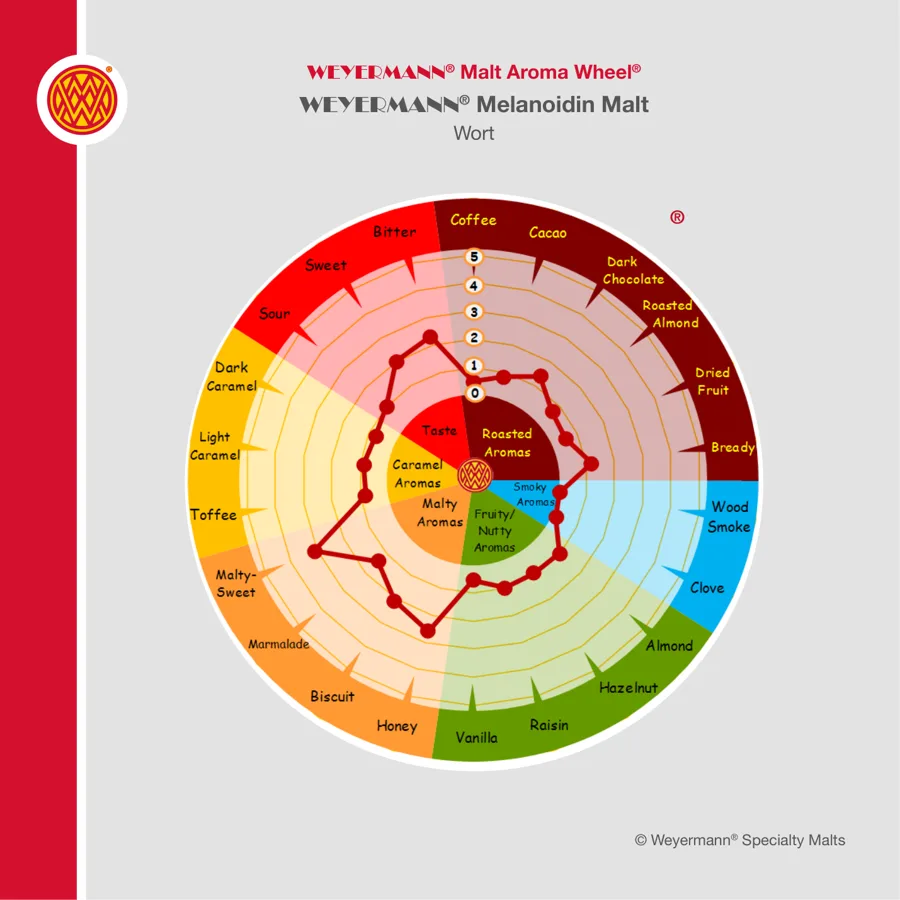
The aroma wheel above shows the profile. Weyermann sums it up as pronounced honey and biscuit notes. We would add a bread crust quality that reminds you of a Märzen or a Franconian lager. It is rich without being sweet. It fills out the middle of a beer.
At high doses the honey can become cloying, so taste as you climb. In most beers it does its best work in the background. Drinkers rarely name it. They just say the beer tastes fuller.
How much to use and how to mash it
Melanoidin Malt is mashed with the base malt. Its low enzyme activity is not enough to convert it alone, so it always needs company.
- 1 to 3%: extra flavour and colour in a light lager, including adjunct lagers.
- 3 to 10%: amber lager, Märzen, Vienna lager, dunkel and Irish red.
- 10 to 20%: bocks, barley wines and Flanders-style reds.
Here is the brew day case for it. A double decoction on a 10 hl brewhouse can add a couple of hours to the mash and ties up the kettle or a second vessel. A single infusion at about 65 °C with 5 to 8% Melanoidin Malt finishes far sooner and gives much of the same malt depth. For a brewpub brewing three times a week, those hours are real.
A worked grist: amber lager, 1,000 litres
For a 1,000 litre brewpub batch at about 12.5 °P with a brewhouse yield near 75%.
- Pilsner malt: 107.5 kg (50%)
- Vienna malt: 90.3 kg (42%)
- Melanoidin Malt: 17.2 kg (8%)
- Total: 215 kg (100%)
Ferment cold with a clean lager yeast, around 9 to 12 °C, then lager well. You get an amber beer with a red glow and a honeyed bread finish, from a single infusion.
The judgement here is in the balance between Vienna and Melanoidin. Push Melanoidin higher and you gain depth but risk sweetness. That trade-off is the core of grist design. It is easier to learn when someone walks through the reasons with you.
Using Melanoidin Malt in India
Unopened, Weyermann gives at least 24 months of shelf life in dry storage between 0 and 30 °C. Many Indian stores are hotter than that for months of the year. Keep sacks raised, shaded and sealed. At 4.5% maximum moisture this malt is very dry, so humid air will soften it quickly once a bag is open.
There is a useful Indian angle. Many Indian lagers use rice or maize adjuncts, which thin out malt character. A small dose of Melanoidin Malt, 1 to 3%, puts some of it back without darkening the beer much. Test it on a pilot batch first. Compare colour and flavour against your current beer before you change the main recipe.
If you are out of stock, a little more Munich malt plus a touch of a mid caramel malt gets close, but with less honey. The Weyermann malts guide covers the alternatives. CARAHELL is a gentler option for colour.
Common questions
Can Melanoidin Malt replace a decoction mash?
It gives much of the flavour and colour of a decoction from a single infusion. It does not reproduce every effect, but many brewers find it close enough.
How much Melanoidin Malt should I use?
Up to 20% is Weyermann's limit. Most amber lagers use 3 to 10%, light lagers 1 to 3%.
What does Melanoidin Malt taste like?
Pronounced honey and biscuit, with a bread crust quality. It adds a red tint to the beer.
Does it need a base malt?
Yes. Its enzyme activity is low, so always mash it with a base malt that can do the converting.