Weyermann CARAPILS: body and foam without colour
CARAPILS is a dextrin malt: almost no colour, plenty of body and a firmer head. We cover the spec sheet, the dose and where it earns its place in an Indian brewpub.

What CARAPILS is and how it is made
CARAPILS is the palest malt in Weyermann's caramel family. It is made from German brewing barley in a process that leaves a high share of dextrins and large proteins in the kernel, then dried gently so the colour stays close to Pilsner malt.
Dextrins are chains of glucose too long for brewing yeast to ferment. They stay in the beer as body. The big proteins help bubbles hold together, so the head lasts longer. That is the whole job: more mouthfeel and better foam, with almost nothing added to colour or flavour.
Weyermann also sells a malt called CARAFOAM. Its datasheet carries the same numbers, the same styles and the same description, word for word. We give it a separate guide, CARAFOAM and the foam question. The short version is below.
The numbers on the spec sheet
- Colour: 2.5 to 6.5 EBC (1.4 to 2.9 °L). At normal doses you will not see it in the glass.
- Extract: 75% minimum, dry basis. Slightly below a good Pilsner malt, so a 10% addition costs you very little gravity.
- Moisture: 8% maximum. Higher than a base malt, which matters for storage in India.
- Enzyme activity: low. It will not convert starch on its own, so it always rides with a base malt.
- Recommended addition: 5 to 10%, rising to 40% in special formulations such as alcohol-free beer.
On brew day the extract figure is the one to plug into your recipe software. The colour figure is the reason you can use it anywhere.
What it tastes like
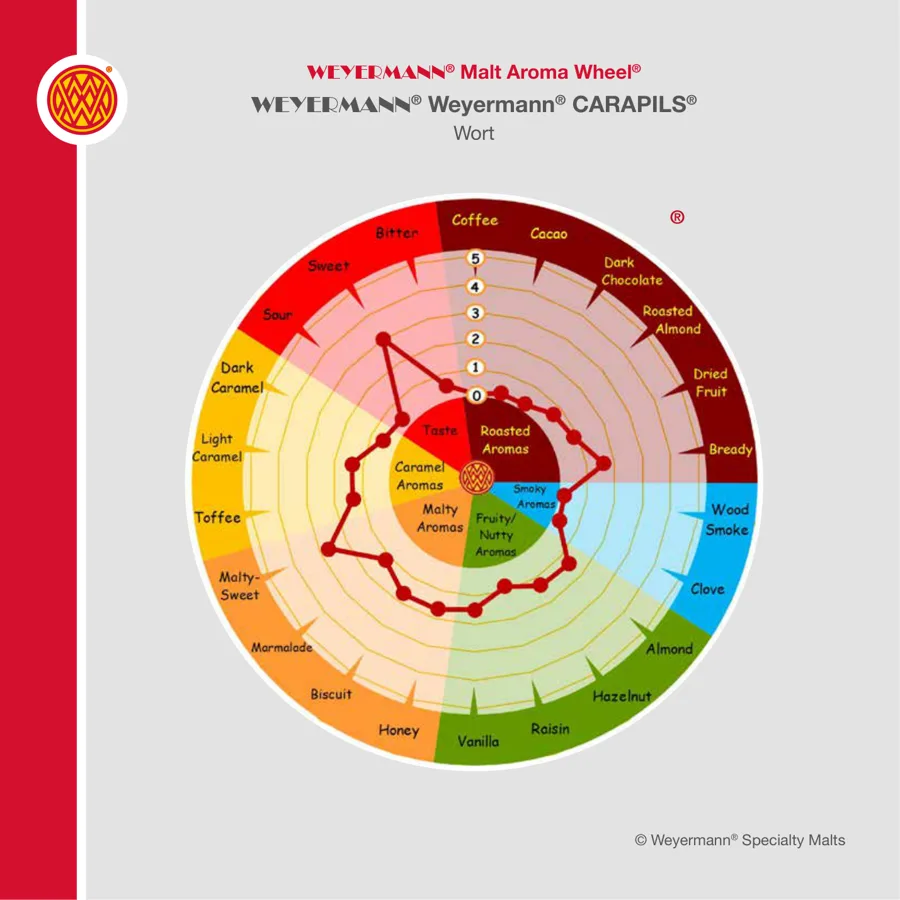
Look at the aroma wheel below the first section. Weyermann describes CARAPILS as malty-sweet with light caramel notes. The wheel sits close to the wort-like, sweet end. In a finished Pilsner at 5% you will struggle to pick it out by taste. You notice it in the mouth: the beer feels rounder and the finish is less watery.
Push it towards 10% in a delicate lager and some tasters will call the beer slightly sweet or heavy. That is the cue to drop back, not to add more hops.
How much to use and how to mash it
Mill it with the base malt and put it straight into the mash. Because its enzymes are weak, the base malt does the conversion, so keep CARAPILS within the dose on the sheet unless you have a reason not to.
The interesting use in India is the rice-adjunct lager. Broken rice or rice flakes give a clean, dry, light-bodied beer, which is what the market wants, but at 25% or more the beer can taste thin. Raising the mash temperature restores some body, but it also leaves more fermentable sugar behind and you lose attenuation. A 5 to 7% CARAPILS addition adds dextrin body directly and leaves your mash schedule alone.
The 40% ceiling exists for alcohol-free and low-alcohol beers, where there is little alcohol left to carry the body. That is a specialist recipe; get the base beer right first.
A worked grist: rice lager for a 1,000 litre brewpub batch
A crisp pale lager of about 11.5 °P, for a brewhouse running near 75% efficiency:
- Pilsner malt: 136 kg (68%)
- Broken rice, cooked in the cereal cooker: 50 kg (25%)
- CARAPILS: 14 kg (7%)
Total 200 kg. Boil the rice with a handful of the Pilsner malt in the cereal cooker and add it to the main mash so the combined mash lands in the saccharification range. If your rice arrives as flakes, it can go straight into the mash tun.
Getting that rice and dextrin balance right first time, without three trial batches, is grist design. It is the kind of thing a recipe calculator will not explain to you.
Using CARAPILS in India
That 8% moisture ceiling makes CARAPILS more hygroscopic than base malt. Once a bag is open in the monsoon it starts pulling water from the air, the kernels go soft and the mill crushes them unevenly. Fold and clip opened bags, or decant into sealed drums. Use the bag within a few weeks.
The datasheet promises at least 24 months of shelf life for an unopened bag kept dry between 0 and 30 °C. Plenty of Indian godowns pass 30 °C from March to June, so treat that promise as conditional. Keep pallets off the floor and away from the roof sheet, in the coolest room you have.
Out of stock? Another maltster's dextrin malt of similar colour is the closest swap; check its extract and dose before you use it. CARAFOAM is a straight swap on paper. In a pinch, a rest a couple of degrees higher in the mash gives you some body back, at the cost of attenuation. The Weyermann malts guide lists the other options.
Common questions
Does CARAPILS need to be mashed?
Yes. It goes into the mash with the base malt. Its own enzyme activity is low, so it relies on the base malt to convert.
Will CARAPILS darken my Pilsner?
Not noticeably. Its colour is 2.5 to 6.5 EBC, close to Pilsner malt, so at 5 to 10% the change is too small to see.
What is the difference between CARAPILS and CARAFOAM?
On the Weyermann datasheets, nothing: both list the same colour, extract, moisture, dose and description. Use whichever your importer stocks.
Can I use CARAPILS in an alcohol-free beer?
Yes. Weyermann allows up to 40% in special formulations such as alcohol-free beer, where dextrins replace some of the body that alcohol would normally carry.