Weyermann CARAMUNICH Type 1, 2 and 3: amber caramel, three depths
CARAMUNICH comes in three colour grades that share almost everything else. We put them side by side and say when each one earns its place in the grist.

What CARAMUNICH is and how it is made
CARAMUNICH is Weyermann's workhorse amber caramel malt, made from German brewing barley. The starch is converted to sugar inside the wet kernel and then caramelised all the way through before kilning, so you get a glassy, fully caramelised grain with no enzymes left.
Weyermann sells it in three grades. The process is the same; what changes is how far the colour is taken. That one variable shifts the flavour from pastry and caramel towards deeper, darker caramel. It also decides which beers each grade suits.
The three types side by side
- Type 1: 80 to 100 EBC (30.6 to 38.2 °L). Sensory note: pronounced caramel with fine pastry.
- Type 2: 110 to 130 EBC (41.9 to 49.5 °L). Pronounced caramel with pastry notes.
- Type 3: 140 to 160 EBC (53.2 to 60.8 °L). Pronounced caramel with clear pastry notes.
Everything else on the three sheets is the same: extract 73% minimum on a dry basis, moisture 8% maximum, enzyme activity none and a recommended addition of up to 10%.
So the choice is mostly about colour per kilo. At the same weight, Type 3 puts in about two thirds more colour than Type 1. If you need a set colour, you can use less Type 3 or more Type 1. The second option gives you more caramel sweetness for the same shade. That trade is the real decision.
What it tastes like
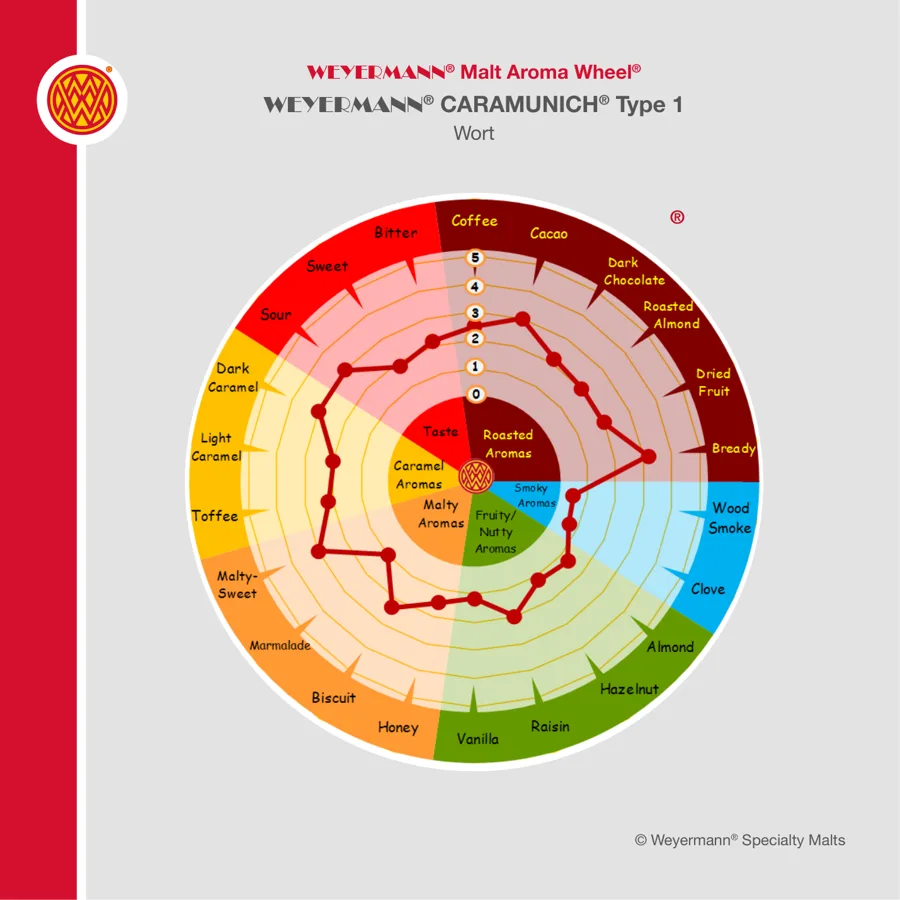
The aroma wheel below the first section covers the family. Caramel leads in all three, with a baked-pastry note behind it. In practice Type 1 tastes like the edge of a fresh croissant, Type 2 moves towards caramel sauce and Type 3 brings a darker, slightly drier caramel that sits well under roast.
None of the three is roasty. If you want dried fruit and a first hint of roast, you have moved past CARAMUNICH to CARAAROMA.
Which type to pick
Weyermann's own style lists point the way:
- Type 1 for amber and lighter malt-forward beers: Altbier, Munich Dunkel, Franconian red beer, American Pale Ale, Scottish ales, California Common and Bernsteinfarbenes Weissbier.
- Type 2 for the middle ground: Märzen, Kellerbier, festival beer, Schwarzbier, the bock family including Weizenbock, Brown IPA, Imperial Red Ale and most porters and stouts.
- Type 3 for British and darker beers: Ordinary Bitter, ESB, brown ales, porters, Irish Stout, Scotch Ale, Old Ale and barley wine.
Our rule of thumb: if the beer is lager and amber, start with Type 1 or 2. If it is a British ale or anything with roast in it, Type 3 holds its own better. For a deeper look at how caramel malts work generally, see crystal and caramel malts.
How much to use and a worked grist
No enzymes, so mill it with the base malt and add it to the mash. Keep within 10%; past that, any of the three makes a beer taste sticky.
A Märzen for a 1,000 litre brewpub batch, around 13 to 13.5 °P near 75% efficiency:
- Munich malt: 125 kg (50%)
- Pilsner malt: 110 kg (44%)
- CARAMUNICH Type 2: 15 kg (6%)
Total 250 kg. Swap in Type 1 at the same weight and the beer comes out lighter and a touch sweeter; swap in Type 3 and it turns deeper and drier. Predicting those shifts on paper, before 1,000 litres are committed, is the skill a good grist designer is paid for.
Using CARAMUNICH in India
All three types carry an 8% moisture ceiling and soak up humidity quickly once opened. On a brewpub mill set for base malt, a soft caramel kernel flattens instead of cracking; if your lauter starts running slower on amber brews, check the caramel malt before blaming the mill gap.
The datasheet promises at least 24 months of shelf life for an unopened bag kept dry between 0 and 30 °C. Plenty of Indian godowns pass 30 °C from March to June, so treat that promise as conditional. Keep pallets off the floor and away from the roof sheet, in the coolest room you have.
If one type is out of stock, blend the other two: equal parts Type 1 and Type 3 land close to Type 2 on colour. Failing that, another maltster's crystal of matching EBC will do, with some flavour shift. The Weyermann malts guide shows the rest of the caramel family.
Common questions
What is the difference between CARAMUNICH Type 1, 2 and 3?
Colour and depth of caramel. Type 1 is 80 to 100 EBC, Type 2 is 110 to 130 EBC and Type 3 is 140 to 160 EBC. Extract, moisture, dose and enzyme activity are the same.
Which CARAMUNICH should I use for a Märzen?
Type 2 is on Weyermann's list for Märzen and Kellerbier. Type 1 gives a lighter, sweeter result at the same weight.
How much CARAMUNICH can I use?
Up to 10% of the grist for all three types. Most amber beers sit comfortably at 4 to 8%.
Can I blend CARAMUNICH types?
Yes. Equal parts Type 1 and Type 3 give a colour close to Type 2, which is handy when one grade is out of stock.