Weyermann Barke Munich malt: deep malt flavour from a heritage barley
Barke Munich is a Munich malt made only from the Barke heritage barley. We look at it as a flavour tool: where 15 or 30% of it lifts a beer and where it is wasted.

Munich malt from one barley variety
Barke Munich goes through the same process as any Munich malt: high modification, then a long, hot kiln that builds colour and malt flavour at the cost of some enzyme power. What changes is the grain. Every kernel is Barke, an older two-row German barley that brewers prize for aroma and that modern farming largely set aside for higher-yielding varieties.
Weyermann's datasheet says the variety amplifies the aroma of the beer. That is the useful way to think about it. Standard Munich malt Type 1 or Type 2 gives you Munich character. Barke Munich gives you a louder version of it, so you can get the same impression from less malt or a bigger impression from the same amount.
The numbers and what they mean
From the Weyermann datasheet (crop 2025):
- Colour: 17 to 22 EBC (6.9 to 8.7 °L). Between standard Type 1 (12 to 18) and Type 2 (20 to 25). It gives amber to light brown at high use.
- Extract: at least 78% dry basis. The same as standard Munich.
- Moisture: 4% maximum. Dry enough to store well while the bag stays sealed.
- Protein: 9.5 to 11.5%. A tighter band than standard Munich's 9 to 12.5%.
- Kolbach index: 38 to 45%.
- Enzyme activity: medium. Recommended addition: up to 100%.
Medium enzymes mean the same caution as any Munich: at very high percentages, give the mash time and test with iodine before you move on.
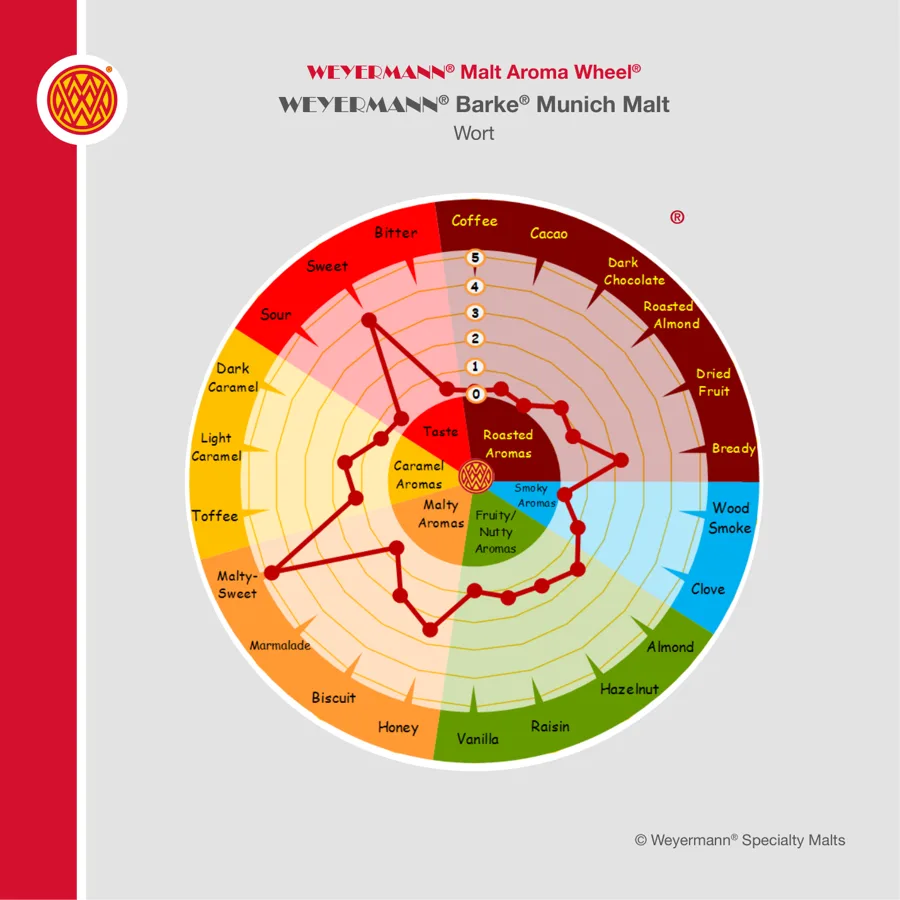
Honey and pastry on the aroma wheel
Weyermann's sensory note for Barke Munich is pronounced malt aroma with honey and pastries. The aroma wheel on this page places it in the sweet and baked groups, with less of the caramel that standard Munich shows. Think of a warm bakery rather than a toffee tin.
That pastry character is why it works so well in beers where malt has to hold its own against something else: hops in an IPA, roast in a porter or yeast phenols in a Dunkelweizen.
Three ways to use it
- As the backbone, 60 to 100%. Munich Dunkel, Dunkel Doppelbock, Bamberger Märzen. Single-variety malt gives a very coherent flavour. Mash with a long saccharification rest or a step mash.
- As an amplifier, 15 to 30%. Altbier, ESB, Kellerbier, Imperial Red. A pale base malt does the converting while Barke Munich adds depth that would otherwise need a pile of caramel malt.
- As a support act, 5 to 15%. American IPA, Brown IPA, Session IPA. Enough to stop a hoppy beer tasting thin, without much colour.
Pick standard Munich instead when cost matters and the malt is a minor note, or when you need the darker colour of Type 2 at high percentages. For a pale gold beer, use Barke Vienna instead.
A worked grist: Altbier, 1,000 litres
For about 12 °P, assuming your brewhouse yields around 68% of malt weight as extract:
- Pilsner malt: 108 kg (60%)
- Barke Munich malt: 54 kg (30%)
- CARAMUNICH Type 1: 14.4 kg (8%)
- CARAFA SPECIAL Type 1: 3.6 kg (2%)
- Total: 180 kg (100%)
Mash at 65 °C for 60 minutes, pH 5.2 to 5.4. Bitter firmly, around 35 to 45 IBU, with German hops. Ferment with an Altbier yeast in the cool ale range, about 15 to 17 °C, then condition cold for three to four weeks.
Swap the Barke Munich for standard Type 1 and the beer still works, but you will want more CARAMUNICH to hit the same malt intensity. The beer gets sweeter too. That trade between base malt flavour and caramel sweetness is the core of grist design.
Barke Munich in an Indian brewpub
At 4% maximum moisture, Barke Munich arrives dry. Keep it that way: pallets, sealed bags, the coolest dry corner of the store. Weyermann's 24 month shelf life assumes a dry place between 0 and 30 °C. In a 38 °C godown in May the aroma, the reason you paid for this malt, fades sooner.
The floor detail we would watch is the mill. Brewpubs usually set the gap for the main base malt. A 30% share of a dry, well-modified Munich mills fine at that setting. If the bag has sat open in monsoon humidity, the kernels go leathery and flatten instead of cracking. Your extract drops. Bite a few grains before you mill.
If it runs out, standard Munich Type 1 with a little Type 2 covers the colour. Add 2 to 3% extra caramel malt for intensity and accept a slightly sweeter beer.
Common questions
How dark is Barke Munich malt?
17 to 22 EBC, or 6.9 to 8.7 degrees Lovibond, which sits between Weyermann's Munich Type 1 and Type 2.
Can Barke Munich convert its own starch?
Yes, though its enzyme activity is medium. At high percentages allow a longer rest and check conversion with iodine.
Is Barke Munich good in an IPA?
In small amounts, 5 to 15%, it adds body and a bakery note that stops a hoppy beer tasting thin.
What should I use if Barke Munich is out of stock?
Standard Munich Type 1 with a little Type 2 matches the colour. You may need a touch more caramel malt to match the intensity.