Weyermann Brewing Malt Type Cologne: a base malt built for Kolsch
Brewing Malt Type Cologne is Weyermann's pale base malt for Kölsch. It sits between Pilsner and Vienna malt on colour and gives a medium-light body that suits clean, delicate beers.

A base malt built for one style
Kölsch is the top-fermented beer of Cologne: pale gold, about 4.8% ABV, fermented with an ale yeast at cool temperatures and then lagered cold for weeks. The malt has to be pale, clean and soft, with just enough bread and honey to stop the beer tasting thin. Hops stay in the background, so the malt cannot hide.
Weyermann's Type Cologne malt is made from German quality brewing barley and kilned for that job. It is a little darker than a Pilsner malt and a little lighter than Vienna malt. The datasheet also lists it for international pale lagers, Mexican and Japanese lagers, cream ale and British golden ale, so it is more versatile than the name suggests.
The numbers on brew day
From the Weyermann datasheet (crop 2025):
- Colour: 7 to 9 EBC (3.1 to 3.9 °L). Pale gold at 100%. Expect a beer a shade deeper than a Pilsner-malt beer at the same gravity.
- Extract: at least 79.5% dry basis. A touch above Vienna or Munich malt, so it gives a good brewhouse yield.
- Moisture: 5.5% maximum.
- Protein: 9 to 12%; Kolbach index 37 to 45%. Normal modification for a single infusion.
- Friability: at least 76%. Mills cleanly.
- Enzyme activity: high. Up to 100% of the grist is possible.
High enzymes plus good extract is the combination that makes it useful in India, as we explain below.
Flavour and the aroma wheel
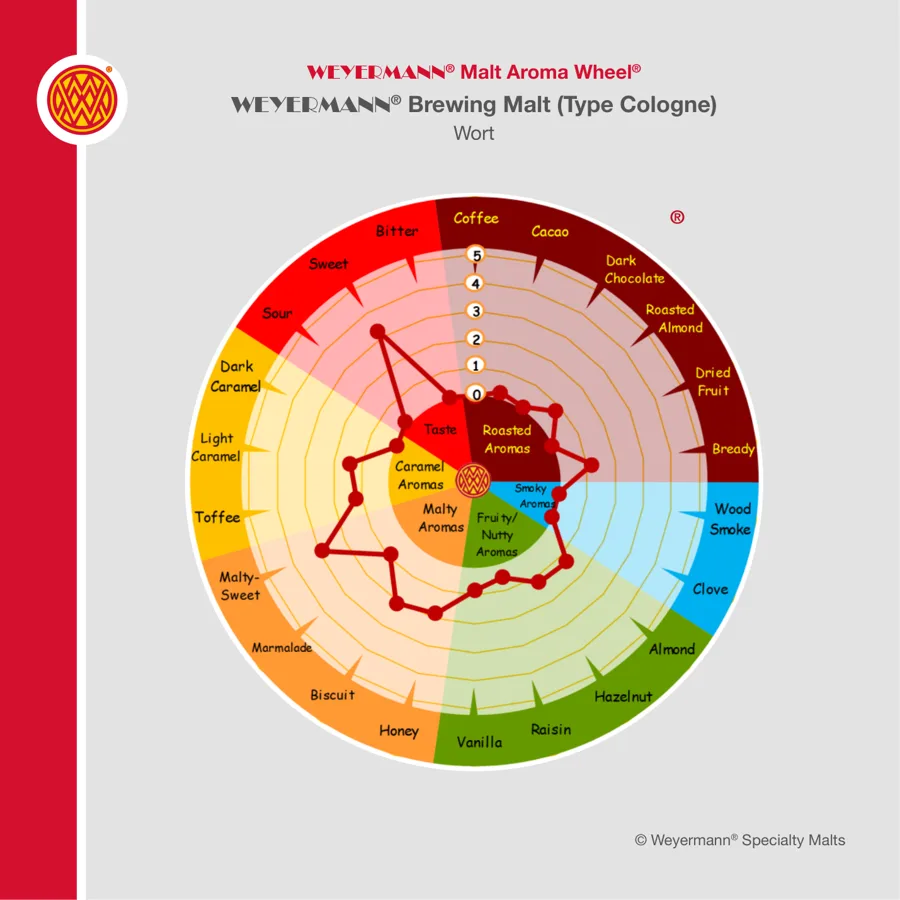
Weyermann describes it as malty-sweet with light honey and biscuit notes. It also promises a medium-light body. The aroma wheel on this page shows the sweet and bready groups without much in the toasted or caramel zones.
Biscuit is the word that separates it from Pilsner malt. A Pilsner base tastes of raw grain and white bread. Type Cologne has a faint baked crust, which is why a Kölsch made on it can taste rounder than its low gravity would suggest.
How to mash and how much to use
Use it as the whole base. Most Kölsch grists are 85 to 100% pale malt with a small share of wheat malt; Type Cologne can fill that pale malt role on its own.
A single infusion at 64 to 65 °C for 60 minutes gives a fermentable wort and a dry finish. Go up to 66 °C if you want a little more body. Keep mash pH at 5.2 to 5.4 for a crisp result; soft water helps. If your borewell water is hard, dilute it with RO water rather than piling in acid. Our guide to mash pH covers the arithmetic.
A worked grist: Kölsch, 1,000 litres
For about 11.5 °P, assuming roughly 68% of malt weight ends up as extract:
- Brewing Malt Type Cologne: 153 kg (90%)
- Pale wheat malt: 17 kg (10%)
- Total: 170 kg (100%)
Bitter to about 20 to 25 IBU with a German noble hop. Ferment with a Kölsch yeast at 14 to 16 °C, then lager near 0 °C for three to four weeks. The wheat adds foam and a softer palate; leave it out and the beer is a touch drier.
The floor detail that ruins Kölsch most often is sulphur. Kölsch yeast can throw it during fermentation. It clears with time in cold storage, so a brewpub that pulls the tank early to meet a tap date serves an eggy beer. Taste for it before you transfer.
Two malts sounds simple. The skill is knowing what each extra percent of wheat, or a 1 °C change in mash temperature, does to body and finish. That is grist design. It is learnable.
Type Cologne in Indian brewpubs
Most Indian brewpubs sell a light lager as their volume beer. Type Cologne suits that beer well: it brings more flavour than a Pilsner base while staying pale. Its high enzymes leave enough spare power to convert a portion of cooked rice or broken rice, a common local adjunct, so you can brew a crisp house lager with an Indian cereal and still taste the malt.
Storage follows the usual rule for imported malt. Weyermann quotes two years unopened if the bag stays dry between 0 and 30 °C. Indian store rooms often run hotter than that in summer. Keep bags off the floor, sealed and away from the brewhouse wall that takes the afternoon sun.
If Type Cologne runs out, a good German Pilsner malt with 5% Vienna gets you close on colour and flavour. See also Barke Vienna for a richer pale lager base.
Common questions
Do I have to use Type Cologne malt for Kölsch?
No. Pilsner malt works. Type Cologne gives a slightly deeper colour and a biscuit note that rounds out the beer.
What colour is Weyermann Brewing Malt Type Cologne?
7 to 9 EBC, or 3.1 to 3.9 degrees Lovibond, per the current datasheet.
Can I brew a lager with Type Cologne malt?
Yes. Weyermann lists international pale lager, Pilsner and Mexican and Japanese style lagers among its uses.
Can it convert a rice adjunct?
Its enzyme activity is high, so it can convert a moderate share of properly cooked rice in the mash.