Weyermann CARABOHEMIAN: the caramel malt behind Czech amber lagers
CARABOHEMIAN is a dark, intensely caramelised malt made from Bohemian barley. We cover its numbers, how hard to push it and a Czech amber lager grist for a brewpub.

What CARABOHEMIAN is and how it is made
Most of Weyermann's caramel malts start from German barley. CARABOHEMIAN starts from Bohemian brewing barley, the same regional raw material that gives Czech lagers their character. Weyermann files it with its terroir and heirloom malts.
The process is a longer, harder caramelisation than a light crystal. Starch is converted to sugar inside the kernel, then pushed further so the colour climbs and the caramel turns dark. What comes out is a glassy, deep brown kernel with no working enzymes and a lot of flavour.
The numbers on the spec sheet
- Colour: 170 to 220 EBC (64.5 to 83.4 °L). A little goes a long way.
- Extract: 73% minimum, dry basis.
- Moisture: 6.5% maximum, drier than the paler caramel malts.
- Enzyme activity: none.
- Recommended addition: up to 15%.
At 170 EBC and above, every extra kilo moves the colour visibly. Run the numbers before brew day; 15% is a ceiling for strong ales and dark lagers, not a target for an amber.
A quick way to see why: multiply each malt's kilos by its EBC and compare. In the grist below, 22 kg of CARABOHEMIAN at around 195 EBC carries far more colour than 154 kg of Pilsner malt at about 3.5 EBC. One tenth of the grist does most of the colouring, so a 2 kg weighing error on this malt shows in the glass.
What it tastes like
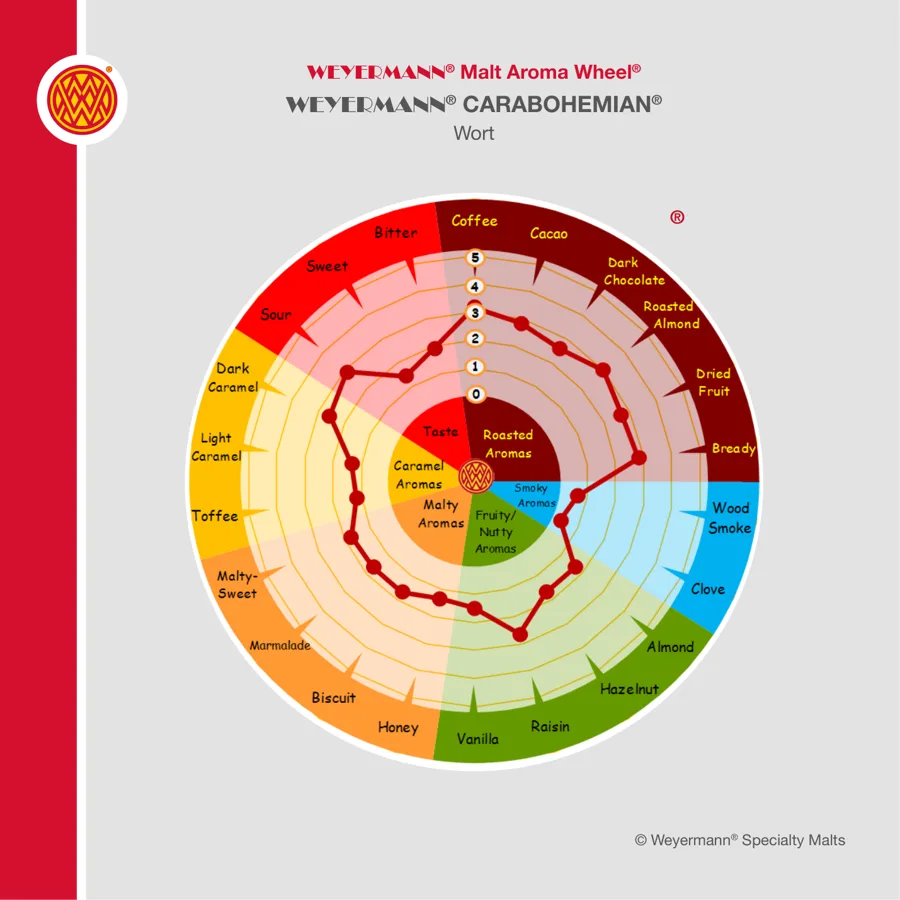
Weyermann's sensory words are bread, caramel and toffee. The aroma wheel below the first section leans heavily that way. Think of the crust of a dark loaf and the toffee of a burnt-sugar pudding, without the dried-fruit and roast notes of the darkest caramel malts.
In a Czech amber lager this is the flavour that sits between the malt and the Saaz-type hops. In a porter or old ale it adds a toffee layer under the roast.
Weyermann lists it for a wide spread of beers: Bohemian Pilsner, Czech amber and dark lagers, bock, Brown IPA, English porter, Foreign Extra Stout and strong ales up to barley wine. The common thread is malt-forward beer where colour is part of the point.
How much to use and how to mash it
No enzymes, so it relies on the base malt for nothing except company. Mill it with the base and add it to the mash. If you decoct, as many Czech lager brewers do, leave it in the rest mash; boiling a dark caramel malt again adds more colour and a cooked edge you may not want.
Rough guide: 3 to 5% for a Bohemian Pilsner with a little more depth, 8 to 12% for Czech amber, up to 15% for Czech dark lager, bock or barley wine.
A worked grist: Czech amber lager for 1,000 litres
A polotmavé-style amber of about 12 °P on a brewhouse near 75% efficiency:
- Bohemian Pilsner malt: 154 kg (70%)
- Munich malt: 44 kg (20%)
- CARABOHEMIAN: 22 kg (10%)
Total 220 kg. Expect a copper to amber beer. Bitter firmly with Saaz-type hops so the toffee does not cloy. Lager it long and cold.
Should that 10% be CARABOHEMIAN alone, or split with a paler caramel malt for a softer middle? That trade between colour, toffee and sweetness is what grist design is about. Our CARAMUNICH guide covers the German alternative.
Using CARABOHEMIAN in India
At 6.5% moisture it arrives drier than the light caramel malts, but it still picks up water once the bag is open. Dark caramel malts that go soft lose their crunch and mill unevenly; a few chewy kernels in the hopper are the early warning. Seal opened bags and keep them off the floor.
The datasheet promises at least 24 months of shelf life for an unopened bag kept dry between 0 and 30 °C. Plenty of Indian godowns pass 30 °C from March to June, so treat that promise as conditional. Keep pallets off the floor and away from the roof sheet, in the coolest room you have.
Supply of a speciality malt like this can be patchy. The closest swap is a German or English crystal of 150 to 200 EBC; you will lose some of the bready character, so taste and adjust. The Weyermann malts guide maps the full caramel range.
Common questions
What makes CARABOHEMIAN different from other caramel malts?
It is made from Bohemian barley and caramelised harder, giving 170 to 220 EBC and a bread, caramel and toffee profile suited to Czech lagers.
How much CARABOHEMIAN should I use in a Czech amber lager?
Around 8 to 12% is a sensible starting range. Weyermann's maximum is 15%, best kept for dark lagers and strong ales.
Does CARABOHEMIAN add enzymes to the mash?
No. Its enzyme activity is none, so the base malt must do all the conversion.