Weyermann CARABELGE: caramel for Belgian ales
CARABELGE sits at the pale end of the caramel family, gold to light amber. We cover what the spec sheet tells you, how much to use and why this malt in particular hates an open bag in the monsoon.

A pale caramel malt with a Belgian accent
CARABELGE is a caramel malt made by Weyermann in Bamberg from European brewing barley. Like every caramel malt, it is made by holding wet green malt warm so the starch inside each kernel turns to sugar while the husk is still on, then drying and roasting it so those sugars caramelise in place. The result has no working enzymes. It is there for colour, body and flavour, not for conversion.
It lands in the golden brown part of the caramel range. That makes it a natural fit for the pale and amber Belgian styles where a brewer wants a round malt middle without the toffee weight of a darker crystal malt. If you are new to the family, our guide to crystal and caramel malts explains the process in more depth.
The spec sheet, line by line
These are Weyermann's published figures for the current crop.
- Colour: 30 to 35 EBC (11.8 to 13.6 Lovibond). Light enough to use generously in a pale beer without dragging it into amber.
- Extract: 74% minimum, dry basis. Slightly below a pale base malt, so count it in your gravity sums but expect a little less from each kilo.
- Moisture: 9% maximum. That is high for a malt. It matters for storage, which we come back to below.
- Maximum addition: up to 30%. A ceiling, not a target.
- Enzyme activity: none. Every kilo needs a base malt to carry it.
On brew day the colour range is the number you use most. Put it into your recipe software and check the predicted wort colour before you commit. The EBC and SRM guide shows how those scales relate.
What it tastes like
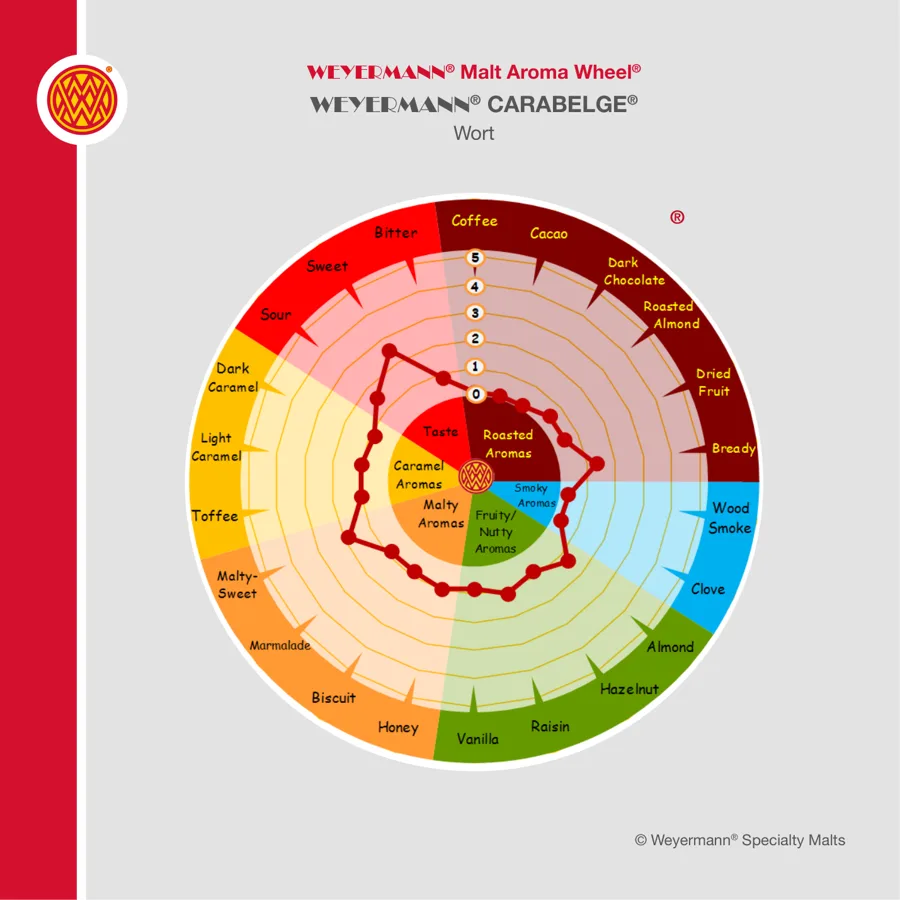
The aroma wheel above maps the profile. Weyermann describes caramel first, then dried fruit and nuts, with almond named as the nut. In the glass that reads as soft toffee at low rates and something closer to sultana and marzipan as the dose climbs.
It pairs well with expressive Belgian yeast because neither shouts over the other. A phenolic, fruity strain supplies the spice. CARABELGE fills the gap between the Pilsner malt and the yeast with a gentle sweetness that keeps a dry Belgian beer from feeling thin.
How much to use and how to mash it
With no enzymes of its own, CARABELGE simply goes into the mash tun with the base malt. Its sugars are already formed and dissolve readily, so mash temperature changes how fermentable the base malt wort is, not what this malt gives.
- 3 to 8%: a touch of colour and a rounder middle in a blond or golden ale.
- 8 to 15%: obvious caramel and nut, the zone for Belgian pale ale, amber ales and bière de garde.
- 15 to 30%: strong ales and Flanders-style reds, where a big malt frame has to stand up to high alcohol or acidity.
Remember that caramel sugars are partly unfermentable. Every percent you add raises the final gravity a little. In a tripel that you want bone dry, keep it low and let sugar in the kettle do the drying.
A worked grist: Belgian pale ale, 1,000 litres
For a 1,000 litre brewpub batch cast out at around 12 °P, with a brewhouse yield near 75%, we would start here.
- Pilsner malt: 178.5 kg (85%)
- Munich malt: 10.5 kg (5%)
- CARABELGE: 21 kg (10%)
- Total: 210 kg (100%)
Scale the total to your own yield. Hop it modestly, ferment with a Belgian ale strain and expect a copper-gold beer with a nutty finish. The Pilsner malt guide covers the base.
The hard part is not this recipe. It is knowing why 10% and not 14%. It is knowing what happens to body and colour when you swap one caramel malt for another. That judgement is grist design. It is learnt by building recipes on purpose and tasting the result.
Using CARABELGE in India
Imported malt arrives after weeks at sea and then sits in Indian storerooms. Unopened, Weyermann quotes at least 24 months of shelf life when kept dry between 0 and 30 °C. Many Indian stores pass 30 °C for months, so keep the bags off the floor, away from the roof sheet and in the coolest corner you have.
Here is the floor test we use. Bite a kernel. Good CARABELGE cracks cleanly. A sack left open through a Mumbai or Bengaluru monsoon picks up moisture and the kernels go chewy, then crush into flakes in the mill instead of breaking. Fold and clip opened bags or decant them into sealed bins.
Out of stock? Blend a lighter and a darker caramel malt to land on the same colour, such as CARAHELL with a little CARAMUNICH. The flavour will lean less towards almond. For the rest of the range, see the Weyermann malts guide.
Common questions
Does CARABELGE need to be mashed?
It has no enzymes, so it adds nothing to conversion. Mashing it with a base malt is the normal practice and extracts its sugars and colour fully.
How much CARABELGE can I use?
Weyermann sets the maximum at 30%. Most Belgian pale and amber ales sit between 5 and 15%, with the top of the range kept for strong and Flanders-style red ales.
What colour is CARABELGE?
30 to 35 EBC, which is 11.8 to 13.6 Lovibond. It is a pale caramel malt that adds gold to light amber.
Why does it matter where I store it?
Its spec allows up to 9% moisture and the kernels are soft. In humid Indian conditions an open bag picks up more moisture, goes chewy and mills badly, so keep it sealed and cool.