Weyermann Beech Smoked Barley malt: the Bamberg Rauchbier malt
Beech Smoked Barley malt is the malt of Bamberg Rauchbier. It is a full base malt with high enzymes, so the only real question is how much smoke you want.

Smoke from Bamberg
Bamberg in Franconia is the home of Rauchbier. Weyermann malts this barley there. The maltster dries the green malt over beechwood smoke, so the kernels take up smoky phenols as they dry. Before modern indirect kilns most malt picked up some smoke; Bamberg kept the style on purpose.
This is still a pale, fully modified base malt made from German quality brewing barley. It converts itself and can make up the whole grist. For the history and the wider style family, read our guide to smoked beer and Rauchbier.
The numbers
From the Weyermann datasheet (crop 2025):
- Colour: 4 to 8 EBC (2 to 3.5 °L). Pale. A Rauchbier gets its amber from other malts.
- Extract: at least 77% dry basis. A couple of points under Vienna or Pilsner malt, so increase grist weight slightly at high use.
- Moisture: 5% maximum.
- Protein: 9 to 13%; Kolbach index 38 to 45%.
- Saccharification time: 30 minutes. Longer than the 20 minutes typical for Weyermann base malts. Give the mash time.
- Enzyme activity: high.
- Maximum addition: the whole grist. The smoke level you want decides the real figure.
What it tastes like
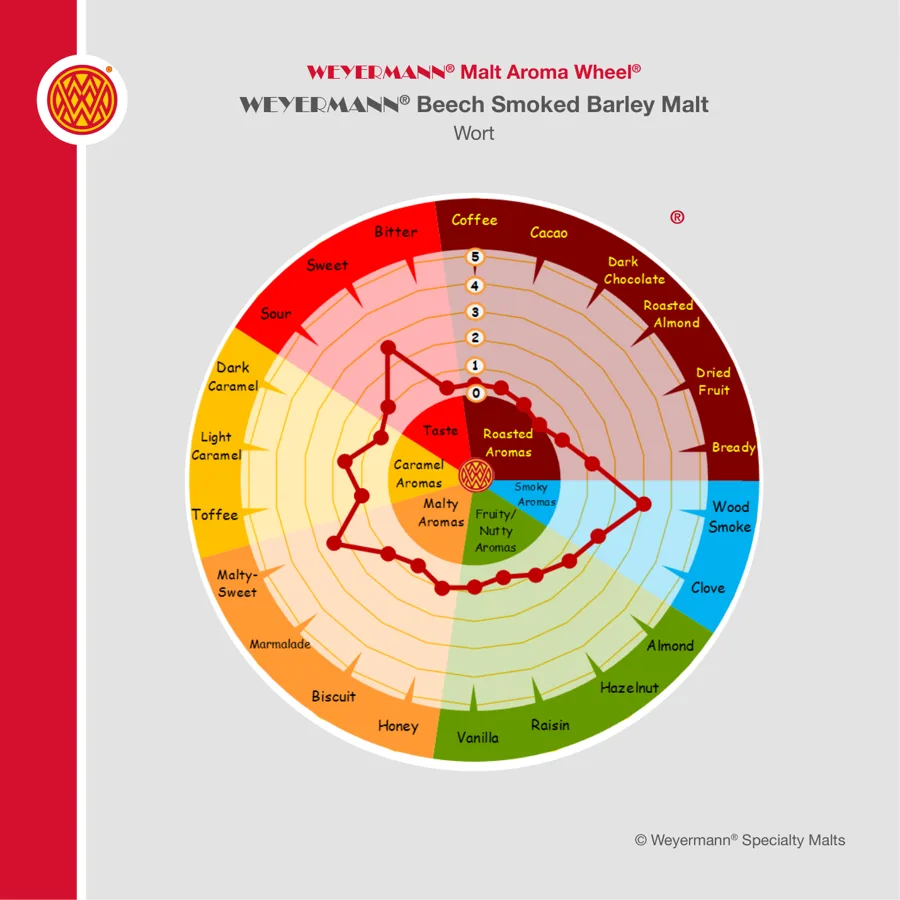
Weyermann describes a pronounced smoke aroma over malty sweetness, with vanilla and honey. On the aroma wheel on this page the smoky group dominates, with the sweet group close behind.
Dose decides which side you taste. According to Weyermann, 5 to 10% adds complexity: vanilla, honey and a faint campfire note most drinkers will not name as smoke. Push it higher and the smoke takes over, heading towards smoked ham and bacon. Beechwood smoke is cleaner and sweeter than the peat smoke in Scotch whisky; it should never taste medicinal.
How much to use
- 5 to 10%: background complexity in a Märzen, porter, Bock or brown ale.
- 20 to 40%: clearly smoked but drinkable for newcomers. A good first Rauchbier for an Indian taproom.
- 50 to 100%: classic Bamberg intensity. Not for everyone, which is the point.
Mash as you would a pale base malt: 64 to 67 °C, pH 5.2 to 5.6, with the iodine test confirming conversion after the longer saccharification time. Decoction suits a Rauchbier Märzen well.
Smoke intensity varies a little from lot to lot and fades in stored malt. Taste a few kernels from each new bag before deciding the percentage.
A worked grist: Rauchbier Märzen, 1,000 litres
For about 13.5 °P, assuming roughly 68% of malt weight as extract:
- Beech Smoked Barley malt: 126 kg (60%)
- Munich malt Type 1: 67.2 kg (32%)
- CARAMUNICH Type 2: 12.6 kg (6%)
- CARAFA SPECIAL Type 2: 4.2 kg (2%)
- Total: 210 kg (100%)
Bitter to about 25 IBU, ferment with a clean lager yeast at 9 to 12 °C and lager for at least six weeks; the smoke softens with time.
The floor detail that catches brewpubs: smoke phenols cling to soft parts. Rubber gaskets, silicone transfer hoses and plastic fittings can carry a smoky note into the next pale lager. Brew the Rauchbier at the end of a cycle, run a full caustic clean afterwards and smell the hoses before the next Helles goes through them.
Balancing 60% smoke against Munich and caramel so the beer reads as malt first and smoke second is a grist design problem. Many brewers get there by trial and error over several batches. Planning gets you much closer on the first.
Smoked malt in India
Smoke and Indian food are natural partners: tandoori chicken, seekh kebab, smoked Naga pork and the charred edge on a good naan all meet a Rauchbier halfway. A low-dose smoked lager (10 to 20%) is an easy way to introduce the idea to a taproom crowd.
Storage matters more than usual because the aroma you paid for is volatile. Keep bags sealed, cool and away from other malt so the smoke does not migrate; Weyermann's two-year shelf life assumes a dry store between 0 and 30 °C.
There is no real substitute. For a smoked wheat beer or a gentler smoke, look at Oak Smoked Wheat malt. Liquid smoke is not a substitute. It tastes harsh and artificial next to the real thing. Drinkers who know Rauchbier will notice.
Common questions
Can I brew with 100% Beech Smoked Barley malt?
Yes. It has high enzyme activity and Weyermann lists up to 100%, depending on the smoke intensity you want.
How much smoked malt should I use for a subtle smoke?
Weyermann notes that 5 to 10% already adds vanilla and honey complexity. Smoke becomes obvious from about 20%.
Is beechwood smoke like peat smoke?
No. Beech smoke is cleaner and sweeter, closer to smoked ham than to the medicinal edge of peated whisky.
Why does my next beer taste smoky?
Smoke compounds cling to gaskets and hoses. Clean thoroughly after a smoked batch and replace soft parts if the smell persists.