Weyermann Vienna malt: golden colour and a toasty backbone
Vienna malt is the quiet workhorse of amber lager. Here is what the Weyermann spec sheet tells you, how much to use and how to keep it in good shape through an Indian summer.

A pale malt that spent longer in the kiln
Vienna malt starts life exactly like a Pilsner malt: German brewing barley, steeped, germinated and then dried. The difference is the finish. The maltster kilns it a little hotter at the end, enough to build colour and a gentle toasty depth without cooking off the enzymes. The result sits one step darker than Pilsner malt and one step lighter than Munich.
That middle position is why brewers reach for it so often. Vienna can be the whole grist of a beer or it can be a quarter of a pale lager grist, quietly adding colour and body that Pilsner malt alone would not give you. Weyermann's version is made from German quality brewing barley and sold in 25 kg bags, which is how most Indian brewpubs receive it.
If you want the wider family first, our guide to the Weyermann malt range lays out where Vienna sits among the base, caramel and roasted malts.
What the spec sheet says
These are the figures from the current Weyermann datasheet (crop 2025). Each one changes something on brew day.
- Colour: 6 to 9 EBC (2.7 to 3.8 °L). Roughly twice the colour of a typical Pilsner malt. At 100% you get a gold beer. For a copper Vienna lager you need help from darker malts.
- Extract: at least 79% (dry basis). Plan your brewhouse yield as you would for a Pilsner base. It does not cost you much extract to swap it in.
- Moisture: 5.5% maximum. Higher than a Munich malt, so it has a little less margin before it goes slack in humid storage.
- Protein: 9 to 12.5%; Kolbach index 37 to 45.5%. Normal modification. A single infusion mash converts it without fuss.
- Enzyme activity: high. It converts itself and has power to spare.
- Recommended addition: up to 100%.
The saccharification time on the sheet is 20 minutes, the same as a standard base malt. In a well-run mash you will pass the iodine test well inside your normal rest.
How it tastes
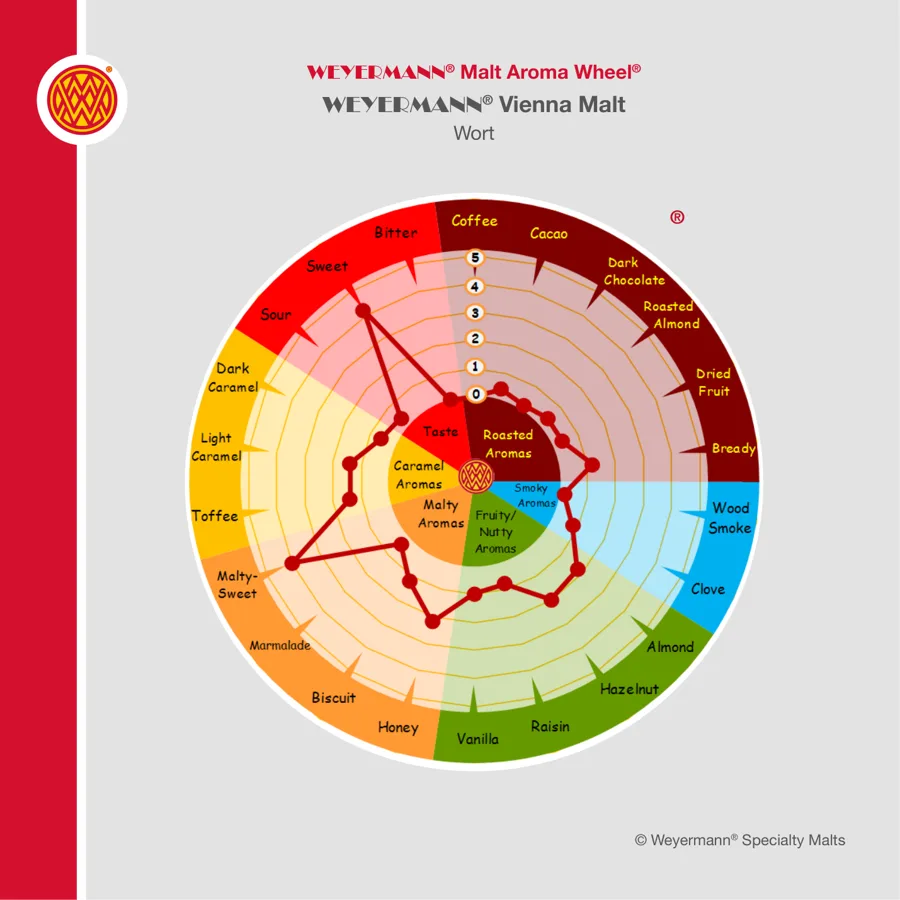
Weyermann describes the flavour as malty-sweet with light honey and nutty notes. On the aroma wheel on this page you will see those three groups standing out. What the wheel does not quite show is the texture: Vienna fills the middle of the palate, so a beer brewed on it feels fuller than its gravity suggests.
Chew a few kernels next to Pilsner malt and the difference is obvious. Pilsner is grainy and bready. Vienna is rounder, with a light toasted crust note and less raw grain.
How much to use and how to mash it
Because it carries high enzyme activity, Vienna can be your only base malt. Most brewers use it in one of three ways:
- 10 to 30% in a pale lager or Kellerbier, for depth and a deeper gold.
- 50 to 100% in a Vienna lager, Festbier or Märzen, where it is the backbone.
- A share of an adjunct lager grist. Its enzymes have enough spare capacity to help convert a cooked rice or maize adjunct, which matters for Indian house lagers built on local cereals.
A single infusion at 64 to 67 °C for 60 minutes suits it. Mash at the low end for a drier Festbier and nearer 67 °C if you want a fuller amber lager. Keep mash pH between 5.2 and 5.6 (our guide to mash pH covers how to check it). Decoction works well with Vienna if your brewhouse can do it, though it is not required.
A worked grist: Vienna lager, 1,000 litres
This targets about 13 °P in the fermenter and assumes your brewhouse turns roughly 68% of the malt weight into wort extract. Scale the total to your own yield.
- Vienna malt: 140 kg (70%)
- Munich malt Type 2: 40 kg (20%)
- CARAMUNICH Type 2: 18 kg (9%)
- CARAFA SPECIAL Type 2: 2 kg (1%)
- Total: 200 kg (100%)
The Munich deepens the malt flavour, the CARAMUNICH adds amber and a touch of caramel and the tiny CARAFA SPECIAL addition nudges the colour towards copper without any roast. Here is the gap most brewers feel: getting that copper colour without the beer turning sweet or toasty is a balancing act between four malts. A spec sheet only gives you one of them at a time.
Ferment with a clean lager yeast at 9 to 12 °C, give it a diacetyl rest near the end and lager it cold for four weeks or more.
Using Vienna malt in India
Weyermann gives unopened bags at least 24 months of shelf life when kept dry between 0 and 30 °C. Many Indian godowns pass 30 °C from March to June, so the stated shelf life assumes conditions you may not have. Keep bags off the floor on pallets, away from the outside wall and out of direct sun. An air-conditioned store room pays for itself in a brewpub that holds a few months of stock.
Monsoon humidity is the bigger risk once a bag is open. Vienna starts at up to 5.5% moisture. Slack malt crushes into a gummy mash instead of shattering cleanly in the mill. Fold the bag tight and clip it, or decant into a sealed food-grade bin. If a sample crumbles soft between your teeth instead of snapping, brew with it soon.
Out of stock? A blend of about 80% Pilsner malt and 20% Munich malt Type 1 gets you close on colour and much of the way on flavour. For the heritage-barley version with more toffee, see Barke Vienna.
Common questions
Can I brew with 100% Vienna malt?
Yes. It has high enzyme activity and Weyermann lists up to 100%. On its own it gives a gold, malty beer; for a classic copper Vienna lager add Munich and a little caramel malt.
What is the difference between Vienna and Munich malt?
Both are kilned base malts. Vienna is lighter, at 6 to 9 EBC with high enzymes, while Munich is darker and richer with medium enzyme activity.
What colour is Weyermann Vienna malt?
6 to 9 EBC, which is 2.7 to 3.8 degrees Lovibond, according to the current datasheet.
What can I use if Vienna malt is out of stock?
Blend roughly four parts Pilsner malt to one part Munich malt Type 1. It is close on colour, though slightly less rounded in flavour.