Weyermann Munich malt Type 1 and Type 2: choosing the right one
Weyermann sells Munich malt in two colours. They share a flavour profile but they do different jobs in the grist. The enzyme figure matters more than most brewers think.

What Munich malt is
Munich malt is barley malt that the maltster germinates to a high level of modification and then kilns hotter and longer than a pale malt. That kilning drives Maillard reactions between sugars and amino acids in the grain, which build colour and the deep bready, honeyed malt flavour Munich is known for.
The price of that flavour is enzyme activity. Heat damages the enzymes that convert starch, so Munich malt has less diastatic power than Pilsner or Vienna malt. Weyermann rates both types as medium. They can still convert their own starch, just more slowly.
Weyermann makes two versions from German quality brewing barley. Type 1 is the lighter one. Type 2 is kilned darker.
Type 1 and Type 2 side by side
From the current datasheets (crop 2025):
- Colour: Type 1 is 12 to 18 EBC (5 to 7.2 °L). Type 2 is 20 to 25 EBC (8 to 9.9 °L).
- Extract: both at least 78% dry basis, a point below Vienna.
- Moisture: Type 1 at 4.5% maximum, Type 2 at 4%. Hotter kilning leaves drier malt.
- Kolbach index: Type 1 is 37 to 46%; Type 2 is 38 to 47%.
- Protein: both 9 to 12.5%.
- Enzyme activity: both medium.
- Recommended addition: both up to 100%.
So the real difference is colour and how far the kilning has pushed the flavour. A 10 EBC gap does not sound like much on paper, but used as half or more of a grist it moves a beer from amber to brown.
How they taste
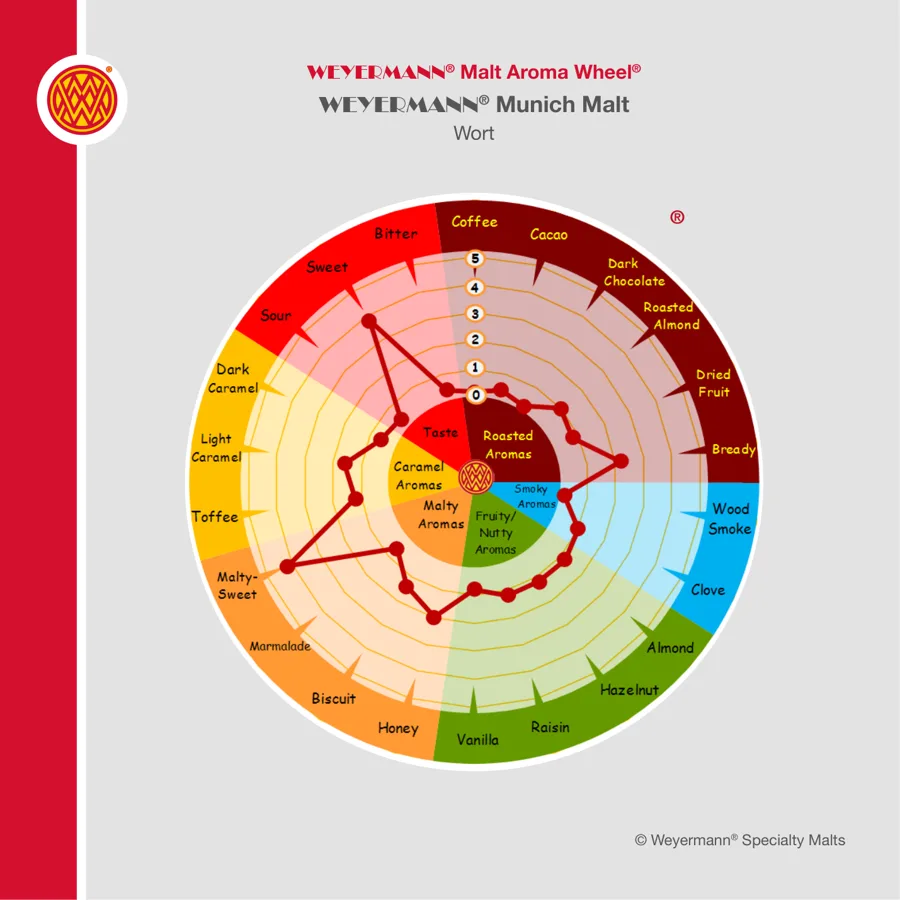
Weyermann gives both the same sensory note: pronounced malt aroma with caramel, honey and bread. The aroma wheel on this page shows that profile. In the glass, Type 1 leans towards honey and fresh bread. Type 2 pushes further into bread crust and a light caramel, with more weight on the palate.
Neither should taste roasted or burnt. If you want roast, that comes from a roasted malt, not from more Munich.
When to pick each
- Pick Type 1 for amber and gold beers where malt leads but colour must stay light: Märzen, Festbier, Bamberger Märzen, Altbier, Belgian pale ale. It also works at 10 to 20% in a pale lager or IPA to add depth without much colour.
- Pick Type 2 for brown and dark beers: Munich Dunkel, Schwarzbier, Czech dark lager, Doppelbock, Baltic porter. It gives you colour and malt depth in one malt, which keeps the caramel and roast additions small.
- Use both when you want the colour of Type 2 with a lighter flavour; a 3:1 or 2:1 blend is common in a Dunkel.
One rule matters more than the colour choice. At high percentages, Munich's medium enzyme activity means conversion takes longer. If your grist is more than about 70% Munich, extend the saccharification rest and check with iodine before you mash out, or add some Pilsner or Vienna malt for enzymes. A step mash or a decoction suits all-Munich beers well.
A worked grist: Munich Dunkel, 1,000 litres
For about 13 °P, assuming roughly 68% of the malt weight ends up as extract in the wort:
- Munich malt Type 2: 140 kg (70%)
- Munich malt Type 1: 50 kg (25%)
- CARAMUNICH Type 2: 4 kg (2%)
- CARAFA SPECIAL Type 2: 6 kg (3%)
- Total: 200 kg (100%)
Mash in at 62 °C for 30 minutes, raise to 72 °C until iodine-normal, then mash out at 78 °C. The dehusked CARAFA SPECIAL brings the colour into brown territory with little harshness. The Munich does the rest.
The trade-off in this grist is the one most brewers learn by brewing it twice: more Type 2 gives depth but dulls the finish; more Type 1 brightens it but loses colour. Balancing that on paper before brew day is a skill. It is the one our grist design module drills.
Munich malt in India
Low moisture is good news in a humid climate: Type 2 leaves the maltings at 4% or less, which gives it some margin. That margin disappears fast in an open bag during the monsoon. Store sealed, on pallets, below 30 °C where you can; Weyermann quotes 24 months unopened only within a dry 0 to 30 °C range.
Munich malt is also the one Indian brewpubs most often run short of, because it goes into the Dunkel and the seasonal Märzen in bulk. If Type 2 runs out, use Type 1 and add about 1% more CARAFA SPECIAL for colour. If Type 1 runs out, a blend of Vienna and Type 2 is close. For the heritage-barley alternative, see Barke Munich.
Common questions
How do Munich Type 1 and Type 2 differ?
Colour and depth. Type 1 is 12 to 18 EBC and suits amber beers; Type 2 is 20 to 25 EBC and suits brown and dark beers. Both share the same flavour family and medium enzyme activity.
Can I use 100% Munich malt?
Weyermann lists both types at up to 100%. With medium enzymes the mash converts more slowly, so lengthen the rest and confirm with an iodine test.
Is Munich malt a base malt or a specialty malt?
Both. It can carry the whole grist, but most brewers use it alongside a paler base malt for flavour and colour.
Which Munich malt is best for a Märzen?
Type 1 usually, often at 30 to 60% with Pilsner or Vienna. Type 2 can make a Märzen look too brown.