Weyermann Special W: dark caramel with a dried-fruit edge
Special W is Weyermann's darkest and most complex caramel malt. It can carry a dubbel or a porter on its own. Here is how to read its numbers and dose it without overshooting colour.

A dark caramel malt made all the way through
Special W is made from German brewing barley. Weyermann's caramelisation process transforms the whole kernel. The result is a dark brown malt that the maltster describes as the most complex in its caramel range. Like all caramel malts it has no enzymes. It is there for colour and flavour.
It is close in spirit to the dark Belgian caramel malts that give dubbels and quadrupels their raisin character. For the general theory, our crystal and caramel malt guide is the place to start.
The numbers, with colour the one to watch
- Colour: 280 to 320 EBC (106 to 121.1 Lovibond). Very dark for a caramel malt.
- Extract: 73% minimum, dry basis.
- Moisture: 6.5% maximum.
- Maximum addition: up to 30%. At 30% you are making a very dark, very rich beer.
- Enzyme activity: none.
At 300 EBC, every kilo matters. Going from 5% to 7% in a 1,000 litre batch is only a few kilos, but it is a visible shift in the glass. Weigh it on a scale you trust and put it into your recipe software before the brew, not after. The beer colour guide explains EBC.
What it tastes like
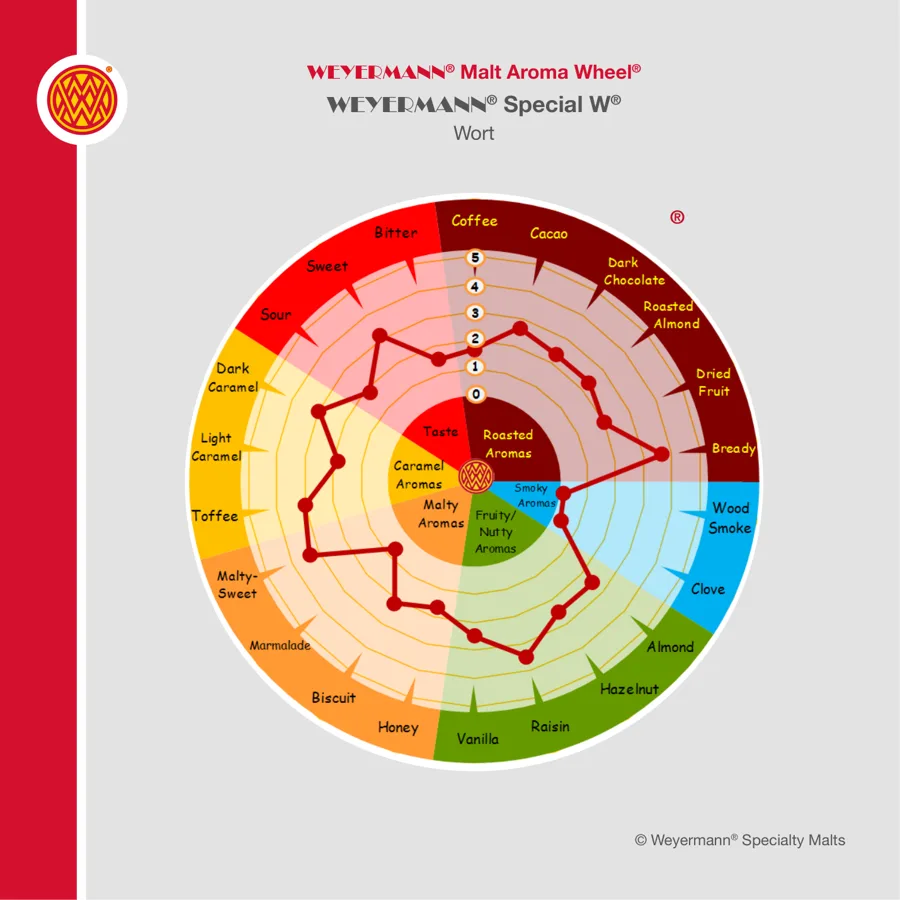
The aroma wheel above shows a wide profile. Weyermann describes raisins and dark caramel, with pronounced nut, pastry and bread aromas. In a dubbel that reads as fruit cake. In a porter it gives a sweet, dried fruit layer under the roast.
Here is a floor habit worth copying. Before you use a new lot, steep a spoonful of crushed Special W in a mug of hot water at mash temperature for ten minutes, then smell and taste the liquid. It tells you more about colour and flavour than the label does. It takes no lab.
How much to use and how to mash it
Special W goes into the mash with the base malt. With no enzymes and sugars already formed, mash temperature does not change what it contributes. Some brewers add dark caramel malts late in the mash to reduce harshness, but Special W is not harsh, so a normal infusion is fine.
- 1 to 3%: colour and a hint of raisin in amber lagers and brown ales.
- 3 to 8%: dubbel, brown IPA, porter and mild.
- 8 to 30%: quadrupel, old ale, barley wine and imperial stout. Taste carefully above about 10%.
Weyermann also lists wood and barrel aged beers. A strong ale built on Special W has the dried fruit and pastry depth that holds up to months in oak, where a thinner grist would let the wood take over.
Remember the unfermentable sugars. A big dose raises final gravity. Belgian brewers often balance that with sugar in the kettle to keep a strong beer from feeling heavy.
A worked grist: Belgian dubbel, 1,000 litres
For a 1,000 litre brewpub batch at around 16 °P and a brewhouse yield near 75%.
- Pilsner malt: 217.5 kg (75%)
- Munich malt: 34.8 kg (12%)
- Abbey Malt: 23.2 kg (8%)
- Special W: 14.5 kg (5%)
- Total: 290 kg (100%)
We have left out candi sugar so the arithmetic stays clean. If you use dark candi syrup, take its extract from the Pilsner malt. Ferment with a Belgian abbey strain. Expect a chestnut beer with raisin, biscuit and a dry finish.
Why 5% Special W with 8% Abbey Malt rather than the reverse? The answer depends on whether you want fruit or biscuit to lead. Working that out before brew day is grist design. It is also the gap most brewers notice only after a few batches miss.
Using Special W in India
Unopened, Weyermann gives at least 24 months of shelf life in dry storage between 0 and 30 °C. In an Indian summer, that upper limit is easy to pass. Keep sacks on pallets, out of the sun and closed. Dark caramel malt that picks up moisture loses its snap and its aroma flattens.
Dark, malty beers have a place on Indian taps in the cooler months and in air-conditioned taprooms. They also suit Indian food with smoke and spice, such as tandoori meats.
If you run out, another dark caramel malt in the same colour range is the nearest swap. A smaller dose of a darker caramel malt with a little chocolate malt is a fallback, though less fruity. The Weyermann malts guide lists the family.
Common questions
What colour is Special W?
280 to 320 EBC, which is 106 to 121.1 Lovibond. It is the darkest of Weyermann's caramel malts and colours a beer quickly.
How much Special W can I use?
Weyermann allows up to 30%. Most dubbels and porters use 3 to 8%, with higher rates for quadrupel and barley wine.
What does Special W taste like?
Raisin and dark caramel, with nut, pastry and bread. It gives a fruit cake quality in Belgian ales.
Does Special W need mashing?
It has no enzymes, so it needs no conversion. Mashing it with the base malt extracts its colour and sugars fully.