Weyermann Roasted Barley: the dry roast of a stout
Roasted barley is the grain that gives a dry stout its bite. Here is what Weyermann's version brings, how far to push it and how to keep the mash pH in line while you do.

What roasted barley is
Roasted barley is barley roasted without being malted first. That is the main difference from CARAFA, which is malted barley taken to a similar colour. Skipping the malting changes how the kernel roasts and leaves a sharper, drier roast character than a roasted malt of similar colour.
Weyermann describes it as having very strong colouring power and the most intense roast aroma in its range. It is the defining grain of the Irish dry stout. It also turns up in small amounts in Scottish ales and Irish red ales, where it adds colour and a dry finish rather than an obvious roast.
The numbers and what they mean on brew day
- Colour: 1,000 to 1,300 EBC (377.5 to 490.6 °L).
- Extract: at least 65%, dry basis.
- Moisture: 3.8% maximum.
- Recommended addition: up to 5%, with higher use possible for special recipes.
- Enzyme activity: none.
The colour band sits across CARAFA Type 1 to Type 3, overlapping Type 2. So one kilo of roasted barley colours about as much as one kilo of CARAFA Type 2, but tastes harder. The extract on an as-is basis is about 62.5% (65 x 0.962), which is worth entering correctly in your recipe software when you run roasted barley at 8% or more. With no enzymes, the base malt does all the converting.
What it tastes like
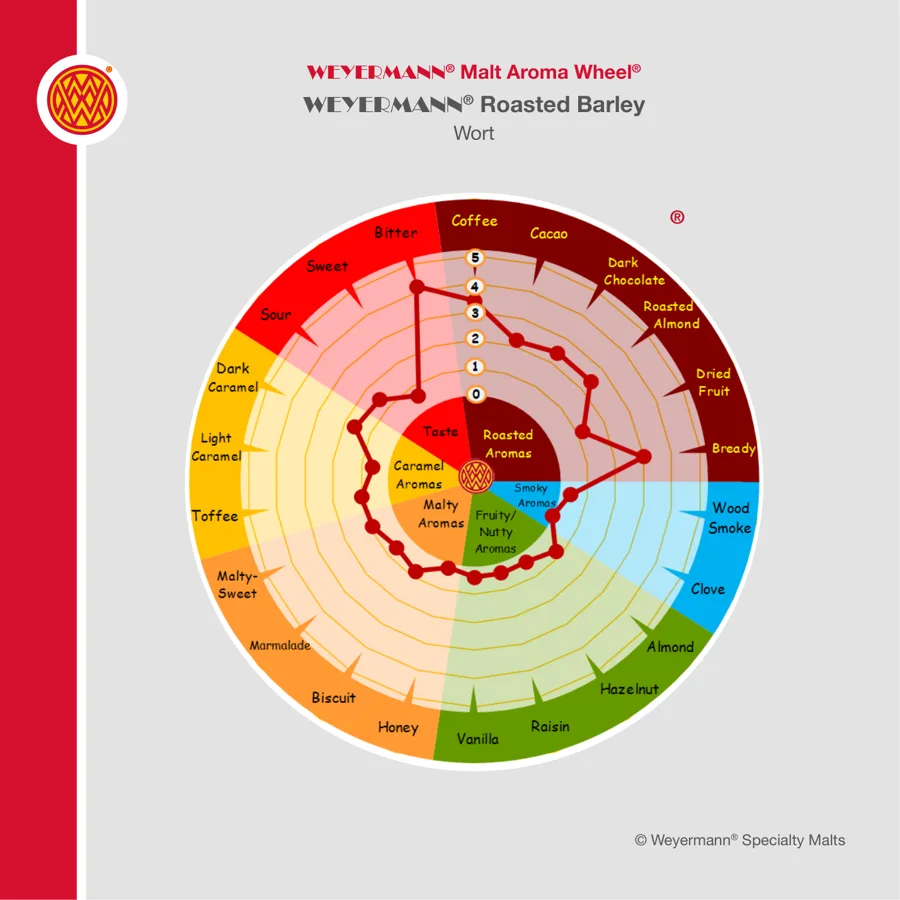
The aroma wheel below the opening section puts roasted barley at the intense end, with coffee leading. Weyermann's own description is short: typical, intense roast with coffee notes. In the glass that means a dry, almost burnt coffee finish with a firm grip. It is less chocolate and more espresso than the roasted malts.
Held to the light, a stout built on roasted barley often shows a ruby edge at the rim of the glass. That edge and the dry finish are what drinkers expect in a dry Irish stout. Too much and the grip becomes acrid, which is why dose matters more here than with the dehusked malts.
How much to use and how to mash it
For colour and dryness in red and Scottish ales, 0.5% to 2% is plenty. Porters often take 2% to 5%. Dry stouts commonly go above the 5% guide, into the 7% to 10% range, which is the special recipe case the sheet allows for. Go higher in steps and taste each batch.
Mash it in with the rest of the grist. The thing to watch is pH. Roasted barley is acidic. At 8% or more on soft water the mash can drop below 5.2. Check the pH ten to fifteen minutes after mashing in, not at the end, so you still have time to correct it with a little calcium carbonate or sodium bicarbonate. Our mash pH guide explains the targets.
Styles it suits and a worked dry stout grist
Weyermann lists it for the Scottish ales from light to export, Irish red ale, American, Baltic, robust and imperial porters, plus Irish, sweet, tropical and imperial stouts.
A worked dry Irish stout for 1,000 litres of 10.5 °P wort at about 75% brewhouse efficiency:
- Pale ale malt: 133.2 kg (72%)
- Flaked barley: 37.0 kg (20%)
- Weyermann Roasted Barley: 14.8 kg (8%)
That is 185 kg and 100%. Bitter to around 35 IBU and ferment with a clean Irish or English ale yeast. Serve it with low carbonation or on a nitrogen mix if your bar has one.
Using roasted barley in India
The sheet's 24 month shelf life assumes dry storage between 0 and 30 °C. Indian summers break that, so store bags off the floor in the coolest room you have and reseal opened bags at once. Roasted grain pulls moisture from monsoon air and goes soft. Soft roasted barley tastes dull and mills into dust.
Flaked barley can be harder to find here than the roasted barley itself. If you cannot get it, replace it with more pale malt and accept a slightly thinner body. Rice and maize adjuncts lighten body rather than build it, so they are not a like for like swap. If roasted barley is out of stock, CARAFA Type 2 gives a similar colour with a softer roast. In a dry stout you will notice the difference. Choosing between them on purpose is grist design. Our roasted malts guide and the Weyermann malts guide lay out the options.
Common questions
Is roasted barley a malt?
No. It is barley roasted without being malted first, which gives it a sharper, drier roast than roasted malts of similar colour.
How much roasted barley goes in a dry stout?
Weyermann recommends up to 5% with higher use possible for special recipes. Dry stouts commonly run 7% to 10%.
What colour is Weyermann Roasted Barley?
1,000 to 1,300 EBC, which is 377.5 to 490.6 °L. That overlaps CARAFA Type 2.
Why did my stout mash pH drop?
Roasted barley is acidic. At high doses on soft water the mash can fall below 5.2, so check early and correct with a small carbonate addition.