Weyermann CARAFA SPECIAL: dark colour with less roast bite
CARAFA SPECIAL is Weyermann's dehusked roasted malt. It matches regular CARAFA for colour, type for type, but drinks much softer. Here is what the dehusking changes and how to use all three types.
What CARAFA SPECIAL is
CARAFA SPECIAL is the dehusked version of Weyermann's roasted barley malt. The grain is malted, then Weyermann strips away a large share of the husk and roasts it on a programme adapted to the naked kernel. The aim is simple: keep the roast aroma, lose most of the roast bitterness.
That makes it the malt for beers that should look black but drink clean. A Schwarzbier is the classic case. So is a Black IPA, where a harsh roast would fight the hops. If you want the drier, sharper finish of a stout, the husked CARAFA or roasted barley will serve you better.
The numbers and what the SPECIAL changes
- Type 1: 800 to 1,000 EBC (302.1 to 377.5 °L).
- Type 2: 1,050 to 1,250 EBC (396.3 to 471.7 °L).
- Type 3: 1,300 to 1,500 EBC (490.6 to 566 °L).
All three list extract of at least 65% on a dry basis, moisture no higher than 3.8%, enzyme activity none and a recommended addition of up to 5%.
Put that next to regular CARAFA and the colour bands match type for type. Dehusking changes the flavour, not the colour. Here is what does differ:
- Bitterness: less of the acrid, ashy edge, because much of the husk is gone and the roast is gentler.
- Dose ceiling: the Type 1 and Type 2 sheets allow up to 15% in special recipes such as Irish stout or Russian imperial stout. Regular CARAFA stays at 5%.
- Colour correction: the Type 2 sheet allows up to 0.5% to adjust colour in pale beers.
- Lautering: less husk means it adds little to the filter bed. At 5% that is irrelevant. At 15% your base malt has to carry the bed.
What it tastes like
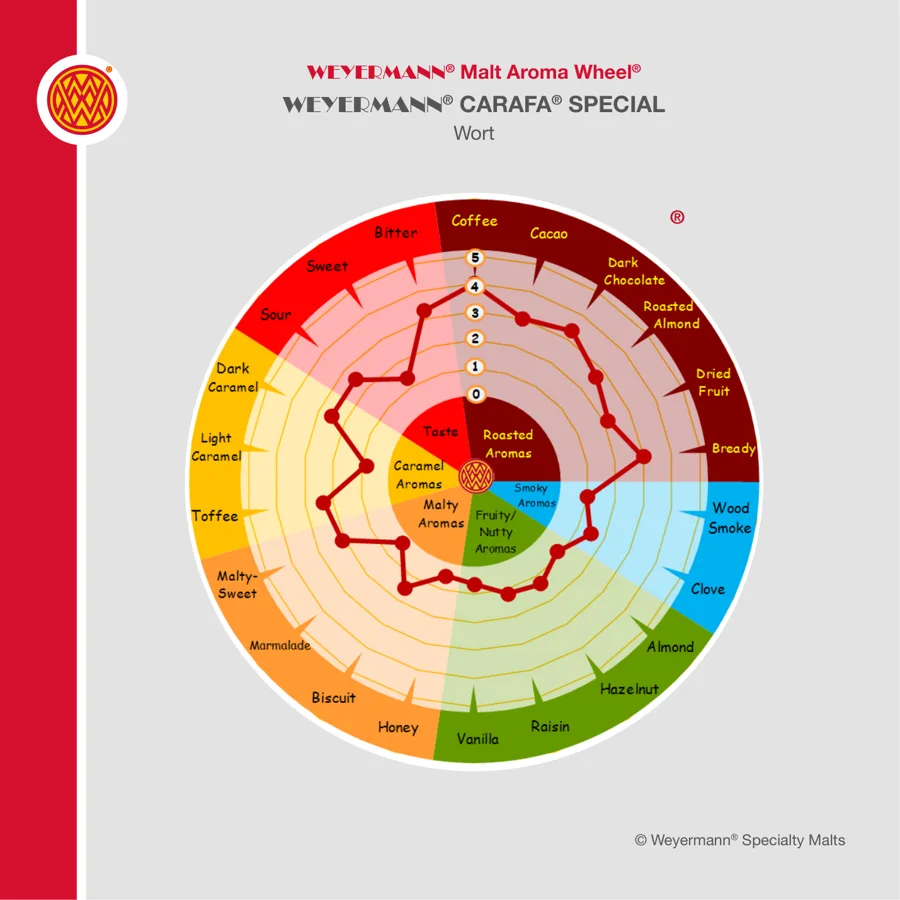
The aroma wheel below the opening section shows the profile: coffee, cocoa and dark chocolate, the same families as CARAFA. The telling difference is in Weyermann's own words. Regular CARAFA Type 3 is described as intensely roasted. CARAFA SPECIAL Type 3 is described as finely roasted, like the lighter types.
In the beer that shows up as roast you can smell more than you can feel. A Schwarzbier made with it should finish dry and clean with a hint of cocoa, never ashy. Try both series in a side by side hot steep and the husked one grips the back of the tongue while the SPECIAL does not.
How much to use and how to mash it
For most beers stay at or under 5%. Schwarzbier and Black IPA typically sit at 3% to 5%. Brown ales and Dunkel often need only 1% to 2%. For a pale beer that came out a shade too light, the 0.5% colour correction on Type 2 is a useful trick.
With no enzymes it can go in at any point. For the smoothest black lager we add it on top of the mash at mash-out, around 76 to 78 °C, give it ten minutes and then start the run-off. It still delivers the colour. Less contact time means even less roast extraction. Dark malt also pulls mash pH down, so check it, especially on soft water.
Styles it suits and a worked Schwarzbier grist
Weyermann ties each type to a different spread of styles. Type 1 covers Vienna lager, smoked Märzen, Munich Dunkel, Altbier, bitters, brown and black IPAs plus Oud Bruin. Type 2 covers Czech dark lager, Schwarzbier, Dunkelweizen, doppelbock, Baltic porter, Belgian dark strong ale and non-alcoholic malt drinks. Type 3 covers Schwarzbier, Black IPA, robust and imperial porters plus foreign extra and imperial stouts.
A worked Schwarzbier for 1,000 litres of 12 °P wort at about 75% brewhouse efficiency:
- Pilsner malt: 130.2 kg (62%)
- Munich malt: 67.2 kg (32%)
- CARAMUNICH: 4.2 kg (2%)
- CARAFA SPECIAL Type 2: 8.4 kg (4%)
That totals 210 kg and 100%. Ferment with a clean lager yeast at 9 to 11 °C and lager it cold for several weeks.
Using CARAFA SPECIAL in India
Storage rules match any roasted malt. The 24 month shelf life on the sheet assumes dry storage between 0 and 30 °C, so in a hot Indian storeroom expect less. Keep bags off the floor and away from walls and reseal opened bags at once. Dehusked kernels mill cleanly, but a damp bag will smear in the rollers.
When it is out of stock, you have two honest swaps. Regular CARAFA of the same type gives the same colour with more bite, so drop the dose a little and move it to mash-out. SINAMAR, the liquid colour made from CARAFA SPECIAL, covers colour alone; see our SINAMAR guide. Neither swap is free: change the roast source and the balance of body and dryness shifts too. That balance is what separates a recipe from a grist designed on purpose. The Weyermann malts guide shows where this malt sits in the full range.
Common questions
What does SPECIAL mean in CARAFA SPECIAL?
Most of the husk is removed and the roast programme is adapted. That keeps the roast aroma while cutting much of the roast bitterness.
Is CARAFA SPECIAL darker than CARAFA?
No. The colour bands match type for type, from 800 to 1,000 EBC for Type 1 up to 1,300 to 1,500 EBC for Type 3.
Can I use more than 5% CARAFA SPECIAL?
The Type 1 and Type 2 sheets allow up to 15% in special recipes such as Irish stout or Russian imperial stout. For most beers 5% or less is plenty.
Which type should I use for a Schwarzbier?
Weyermann lists Type 2 and Type 3 for Schwarzbier. Type 2 at 3% to 5% of the grist is a common starting point.