Weyermann CARAFA Type 1, 2 and 3: roasted malt for dark beers
CARAFA is Weyermann's husked roasted malt, sold in three strengths. Here is what separates Type 1, 2 and 3, how much of each to use and where it goes in the mash.

What CARAFA is and how it is made
CARAFA is Weyermann's family of roasted barley malts. The grain is malted first, then taken to a roasting drum and pushed far beyond any kiln temperature until the kernel is black right through. Nothing enzymatic survives that. What you get instead is a very large amount of colour and a strong roast aroma, which is why CARAFA is a seasoning in the grist and never a base.
There are three strengths. Type 1 is the lightest roast, Type 3 the darkest, Type 2 sits in the middle. All three keep their husk. That matters more than it sounds: Weyermann sells a second series, CARAFA SPECIAL, with most of the husk taken off and a different roast programme, to soften the bitter edge. If you want that edge in your beer, the husked malt on this page is the one you want.
The three types side by side
- Type 1: 800 to 1,000 EBC (302.1 to 377.5 °L).
- Type 2: 1,050 to 1,250 EBC (396.3 to 471.1 °L).
- Type 3: 1,300 to 1,500 EBC (490.6 to 566 °L).
Everything else on the sheet is shared. Extract is at least 65% on a dry basis, moisture is no more than 3.8% and the recommended addition is up to 5% of the grist. Enzyme activity is listed as none.
On brew day those numbers translate like this. The colour band tells you how hard each kilo works: Type 3 gives roughly half as much colour again as Type 1 for the same weight. The extract figure is dry basis, so for recipe software convert it to as-is: 65 x (1 - 0.038) gives about 62.5%, well under a pale base malt. The zero enzyme line means the base malt does all the converting. And the 5% ceiling is smaller than it looks. On a 1,000 litre brew of around 13 °P the whole grist weighs about 230 kg, so 5% is 11.5 kg, less than half of one 25 kg bag.
What it tastes like
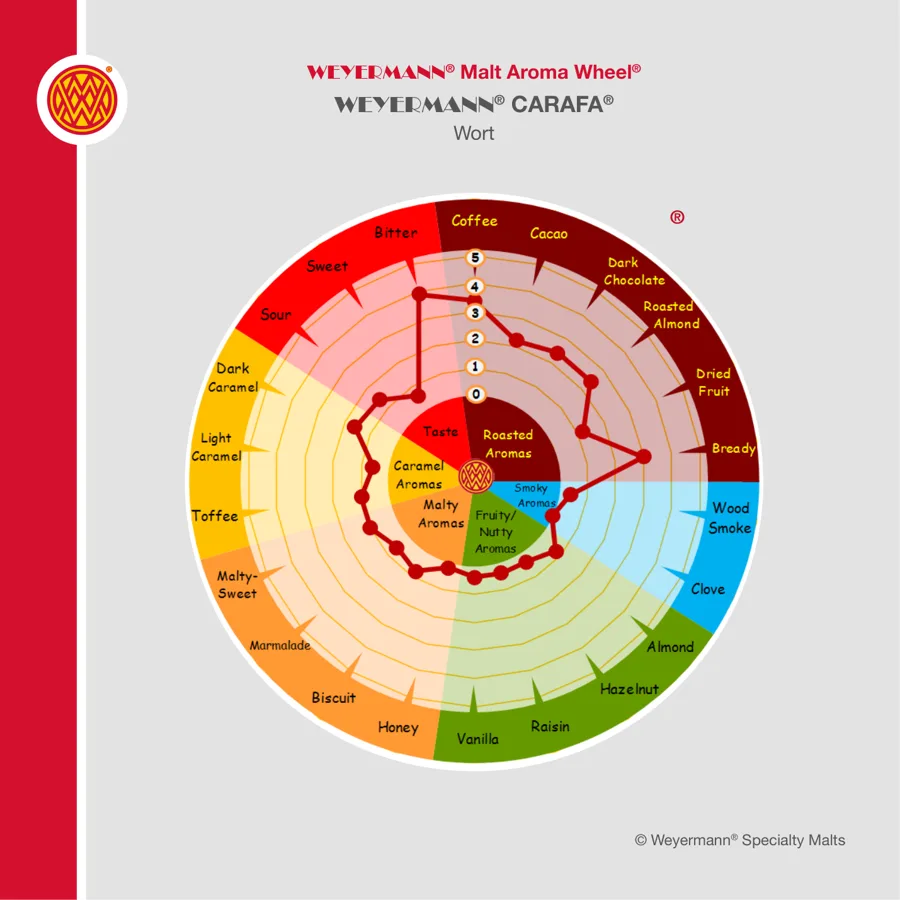
The aroma wheel below the opening section shows where CARAFA sits: firmly on the roast side, with coffee, cocoa and dark chocolate carrying most of the weight. Weyermann describes the types in steps. Type 1 is finely roasted, Type 2 simply roast aromatic, Type 3 intensely roasted. All three share the coffee, cocoa and dark chocolate notes.
In the glass the difference between the types is mostly how dry and sharp the finish gets. Type 1 reads as cocoa and soft coffee. Type 3 heads towards espresso grounds and a firm, drying bitterness that the husk helps carry. The easiest way to learn them is a hot steep: 50 g of each in 400 ml of water held at 65 °C for 20 minutes, then strained and tasted side by side. Ten minutes of that teaches more than any description.
How much to use and how to mash it
Stay within the 5% Weyermann recommends. Most porters and stouts land between 2% and 5%; brown ales and dark wheat beers often need only 1% to 2% for colour. Because there are no enzymes, CARAFA can sit anywhere in the grist. The base malt converts the starch around it.
You have two choices for when it goes in. Milled and mashed in with everything else, it gives the fullest roast. Added on top of the mash at mash-out, just before lautering, it gives the colour with a softer, rounder bitterness, because it spends less time in hot water. Many brewers use the second method for dark lagers and the first for stouts.
Watch your mash pH. Roasted malts are acidic and pull pH down, sometimes below 5.2 on soft water. Our guide to mash pH covers the correction.
Styles it suits and a worked porter grist
Weyermann lists each type against different styles. Type 1 goes into Dunkelweizen, Weizenbock, Altbier, brown ales, British strong ale and the sweet, oatmeal and tropical stouts. Type 2 suits dark mild, English porter plus Irish and American stout. Type 3 is for American porter, foreign extra stout, imperial stout and Altbier.
A worked English porter for 1,000 litres of 13 °P wort, assuming about 75% brewhouse efficiency:
- Pale ale malt: 172.5 kg (75%)
- Munich malt: 27.6 kg (12%)
- CARAMUNICH: 18.4 kg (8%)
- CARAFA Type 2: 11.5 kg (5%)
That is 230 kg and 100%. Bitter it to around 30 IBU with an English ale yeast. Want it softer? Move half the CARAFA to mash-out before you change the recipe.
Using CARAFA in India
The sheet promises a shelf life of at least 24 months unopened, stored dry between 0 and 30 °C. Plenty of Indian storerooms pass 30 °C from March to June, so treat that figure as the best case. Keep bags on pallets, off the wall, in the coolest room you have. Once a bag is open, fold it tight or tip it into a lidded food-grade drum. Roasted malt leaves the drum at very low moisture and pulls water out of monsoon air quickly. Slack malt mills badly and tastes stale.
When your type is out of stock, swap within the family and adjust for colour. Replacing Type 2 with Type 1 needs about a quarter more weight for the same shade. CARAFA SPECIAL of the same type gives the same colour with less bite. Roasted barley gives a sharper one. Getting the colour right is easy. Getting the colour, body and roast right together is grist design. That takes practice. For more on importing specialty malt, see sourcing malt and hops in India or the Weyermann malts guide.
Common questions
What is the difference between CARAFA Type 1, 2 and 3?
Roast depth and colour. Type 1 is 800 to 1,000 EBC, Type 2 is 1,050 to 1,250 EBC and Type 3 is 1,300 to 1,500 EBC. The extract, moisture limit and 5% maximum are the same for all three.
Is CARAFA the same as CARAFA SPECIAL?
They share colour bands, type for type. CARAFA keeps its husk, while CARAFA SPECIAL has most of the husk removed and a different roast programme, which gives a softer roast bitterness.
Does CARAFA need to be mashed?
It has no enzymes, so it relies on the base malt in the mash. Many brewers add it at mash-out instead of at mash-in to soften the roast.
How much CARAFA should I use?
Weyermann recommends up to 5% of the grist. Porters and stouts usually sit between 2% and 5%, while brown ales and dark wheat beers often need only 1% to 2%.