Weyermann Pale Rye malt: spice, body and a lautering challenge
Pale Rye malt is one of the most rewarding grains to brew with and one of the most awkward. Here is what the Weyermann spec sheet says, how far you can push it and how to keep the wort running.

What rye malt is
Weyermann's Pale Rye malt is made from German quality rye, malted and kilned pale. Like wheat, rye is a naked grain: it threshes free of its husk, so it adds nothing to the filter bed in a lauter tun. Rye is also rich in gums, mostly pentosans along with some beta-glucan, that make wort thick and sticky.
Brewers put up with that because rye does something no barley malt can. It gives a dry, bready, faintly spicy flavour and a smooth, almost oily mouthfeel. Weyermann's datasheet describes it as velvety-soft. It is the grain behind German Roggenbier and Finnish Sahti. It also turns up in many American rye IPAs and hazy pale ales.
The spec sheet numbers
From the Weyermann datasheet (crop 2025):
- Colour: 4 to 10 EBC (2 to 4.2 °L). A wide band. At low use it barely changes colour; at 50% it can add a warm gold.
- Extract: at least 81% dry basis. Higher than barley base malts, so a rye beer can come in over gravity if you plan it as barley.
- Moisture: 6% maximum. Higher than the barley malts allow. Rye has less margin in humid storage.
- Enzyme activity: high. Conversion is not the issue; flow is.
- Recommended addition: up to 60%, with a condition attached: an adapted, intensive mash.
That condition is the most important line on the sheet. Take it literally.
Flavour and the aroma wheel
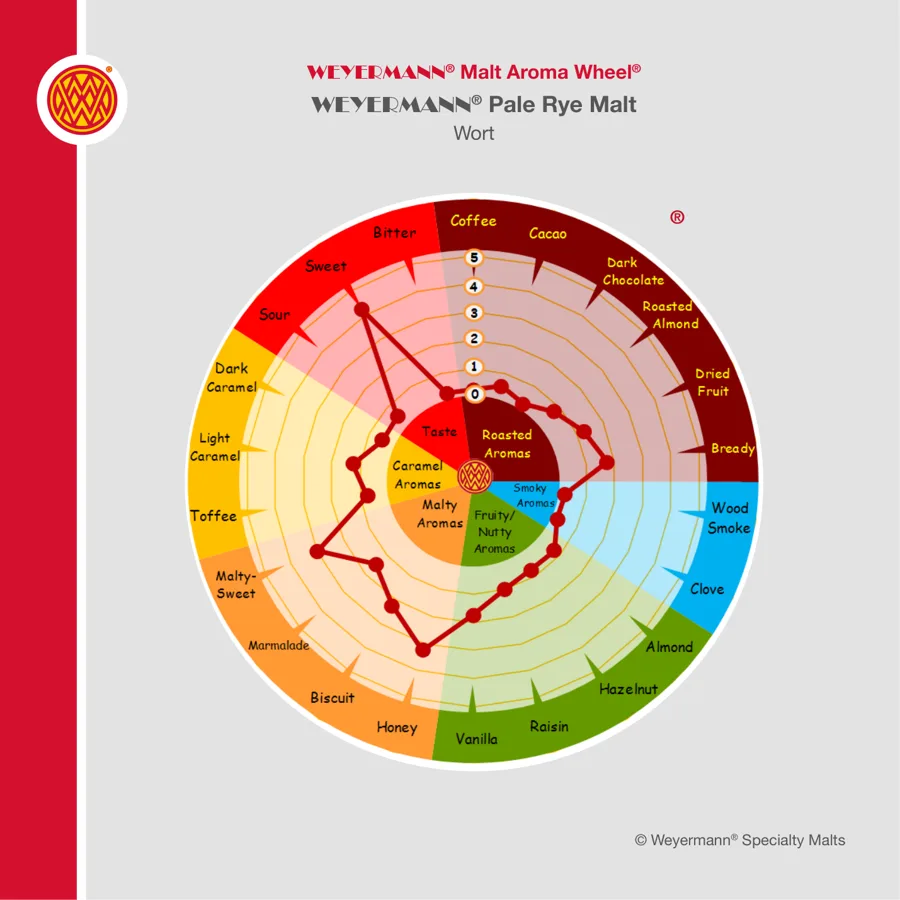
Weyermann describes a typical rye aroma that is malty-sweet, with bread and honey in the background. On the aroma wheel on this page the bready group is strongest. Most brewers also describe a peppery or spicy edge; at 15 to 25% it reads as a dry, crisp finish under the hops.
The mouthfeel is the other half. Rye beers feel fuller and silkier than their gravity suggests, which is why a little rye helps a low-alcohol pale ale avoid tasting thin.
How to mash rye without a stuck lauter
Up to about 15% rye, most brewhouses manage with a normal single infusion and a slow runoff. Above that, build the intensive mash Weyermann asks for:
- Gum rest: 40 to 45 °C for 15 to 20 minutes, which lets the malt's own enzymes break down some of the gums before conversion.
- Protein and saccharification: step to 62 to 64 °C, then 72 °C until iodine-normal.
- Mash out at 76 to 78 °C to thin the wort.
- Rice hulls: 3 to 5% of grist weight at 30% rye or more.
The floor detail: watch the differential pressure gauge on the lauter tun, or the wort clarity from the grant if you have no gauge. When it rises fast, stop runoff, underlet with hot liquor and let the bed float before starting again. Forcing it compacts the bed for good. Our guide to mash pH covers the other variable worth checking.
A worked grist: Rye IPA, 1,000 litres
For about 14 °P, assuming roughly 68% of malt weight as extract:
- Pilsner malt: 165 kg (75%)
- Pale Rye malt: 44 kg (20%)
- CARAMUNICH Type 1: 11 kg (5%)
- Total: 220 kg (100%)
Add about 7 kg of rice hulls. At 20% rye you want the gum rest. Bitter to around 50 to 60 IBU and dry hop generously. The rye's dryness keeps a big IPA from tasting sweet.
Why 20% and not 30? Above that point the spicy note starts to compete with the hops and runoff times climb. Finding where your own brewhouse tips over is part of grist design, which is where planning on paper saves a wasted brew.
Rye malt in India
The 6% moisture limit matters here. Rye malt starts wetter than barley malt and has the least room to absorb monsoon humidity before it turns slack. Slack rye mills into a gummy meal that makes the lautering problem worse. Keep bags sealed, on pallets, in the coolest dry store you have; Weyermann's two-year shelf life assumes a dry place between 0 and 30 °C.
Order rye in small quantities. Most brewpubs use it for one or two beers a year. An open bag that sits through a Mumbai or Kochi monsoon will not brew like a fresh one.
There is no direct substitute. For body, wheat malt does the job. For a dry, bready edge, Spelt malt is the nearest relative in Weyermann's range, though milder. See also Pale Wheat malt.
Common questions
How much rye malt can I use?
Weyermann recommends up to 60%, with an adapted, intensive mash. Most rye IPAs use 15 to 25%.
Why does rye cause a stuck mash?
Rye has no husk and is rich in gums that thicken wort. Use a rest at 40 to 45 °C, rice hulls and a slow runoff.
What does rye malt taste like?
Bready and malty-sweet with honey, plus the dry, spicy edge most brewers associate with rye. It also adds a smooth mouthfeel.
What colour is Weyermann Pale Rye malt?
4 to 10 EBC, or 2 to 4.2 degrees Lovibond.