Weyermann Pale Wheat malt: the heart of a Hefeweizen
Pale wheat malt is the base of every Bavarian Hefeweizen and a useful 10% in almost anything else. It also behaves differently in the mash. That is where most first wheat beers go wrong.

Wheat, malted pale
Weyermann's Pale Wheat malt is made from German quality wheat, malted and kilned lightly. Two things separate it from barley malt. Wheat has no husk to speak of, so it adds nothing to the filter bed in your lauter tun. It is also richer in protein and in the gummy cell-wall material that raises wort viscosity.
Those same properties are why brewers want it. The protein builds foam and body. The lack of husk means less tannin. Wheat beer's soft, full palate and tall white head come straight from this malt. Our broader guide to wheat malt in brewing covers the other wheat products.
The spec sheet, read for brew day
From the Weyermann datasheet (crop 2025):
- Colour: 3 to 5 EBC (1.6 to 2.3 °L). About as pale as a Pilsner malt.
- Extract: at least 82% dry basis. Higher than the barley base malts, which lifts brewhouse yield as the wheat share rises.
- Moisture: 5.5% maximum.
- Protein: 10 to 13%; Kolbach index 37.5 to 47%. More protein than barley malt: good for foam, a risk for haze in a beer meant to be clear.
- Viscosity (8.6% wort): 2.2 mPa·s. Compare 1.65 for Weyermann's Vienna malt. Thicker wort runs off more slowly.
- Enzyme activity: high.
- Recommended addition: up to 80%. Weyermann notes that even 10% gives fuller body and better foam stability.
What it tastes like
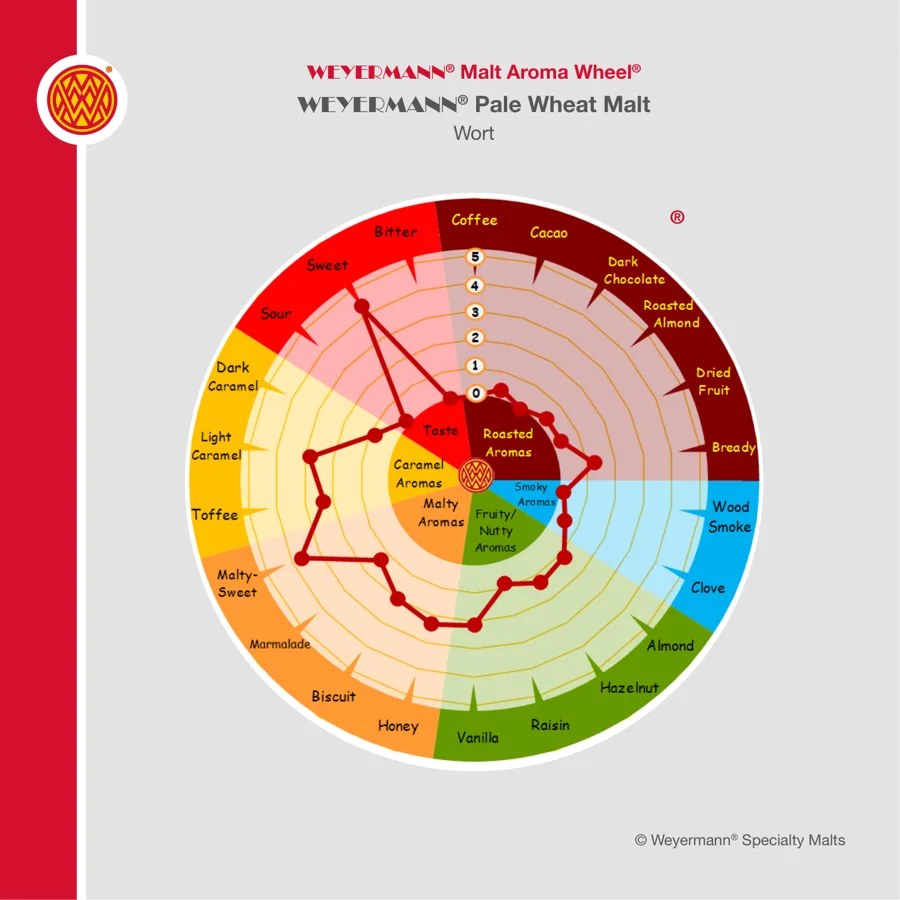
Weyermann's sensory notes name bread and nut first, then biscuit, toffee and a light caramel touch. On the aroma wheel on this page the bready group dominates. In a Hefeweizen the yeast's banana and clove sit on top of that, so the malt reads as soft white bread.
In a hazy IPA or a Witbier it does a different job. It thickens the palate and carries the haze, while the flavour stays out of the way. In a Berliner Weisse or a Gose it supplies the soft grain under the acidity, so the beer tastes of bread and lemon rather than vinegar.
Mashing a high-wheat grist
Pale wheat has high enzyme activity, so conversion is not the problem. Runoff is.
- Use rice hulls. At 50% wheat or more, add 2 to 4% of the grist weight as rice hulls. They are easy to source in India and cost little. Rinse them first.
- Mill wheat tighter. Wheat kernels are smaller and harder than barley. A mill set for barley leaves some wheat uncracked.
- Consider a ferulic acid rest. For more clove in a Hefeweizen, rest at about 43 to 45 °C for 15 minutes before the main rest.
- Main rest at 63 to 66 °C, then mash out at 76 to 78 °C to thin the wort before you lauter.
The floor detail: when a wheat bed compacts, the instinct is to open the outlet valve wider. That pulls the bed down harder and makes it worse. Throttle back, let the wort rise over the bed and rake gently if your tun allows it.
A worked grist: Hefeweizen, 1,000 litres
For about 12.5 °P, assuming roughly 70% of malt weight as extract (wheat's higher extract helps):
- Pale Wheat malt: 111 kg (60%)
- Pilsner malt: 74 kg (40%)
- Total: 185 kg (100%)
Add about 5 kg of rice hulls on top. Bitter lightly to 12 to 15 IBU. Ferment with a Weizen yeast at 18 to 20 °C; warmer pushes banana, cooler leans to clove.
Moving from this two-malt grist to a Dunkelweizen or a Weizenbock means juggling colour, body and the yeast's esters at once. That is where a grist built by design, not by copying, starts to pay off. For the darker version, see Dark Wheat malt.
Pale wheat in India
Wheat beer is a staple of the Indian brewpub tap list, so pale wheat is often the malt you order in the largest volume after your base. That makes storage worth getting right. Weyermann quotes a two-year shelf life for unopened bags stored dry between 0 and 30 °C. In a humid coastal city, open bags pick up moisture fast. Slack wheat malt mills into flour rather than grits, which makes the lauter problem above worse.
If pale wheat runs out, there is no true swap for a Hefeweizen. For 10% foam additions, unmalted flaked wheat or flaked oats will do the job, though they need the enzymes of a barley base to convert. Locally milled wheat flour is not a substitute; it turns a mash to glue.
Common questions
How much wheat malt can I use?
Weyermann recommends up to 80% for Pale Wheat malt. Hefeweizen grists usually sit at 50 to 70%.
Why is my wheat beer mash stuck?
Wheat has no husk and makes thicker wort. Add rice hulls, mash out at 76 to 78 °C and run off slowly.
Does wheat malt help foam in other beers?
Yes. Weyermann notes that adding as little as 10% gives fuller body and better foam stability.
What colour is Weyermann Pale Wheat malt?
3 to 5 EBC, or 1.6 to 2.3 degrees Lovibond.