Weyermann Dark Wheat malt: for Dunkelweizen and Weizenbock
Dark Wheat malt gives Dunkelweizen its colour and its bakery-shop depth without the roast. It has only medium enzymes, so it needs a partner in the grist.

What Dark Wheat malt is
Weyermann's Dark Wheat malt starts from the same German quality wheat as its pale wheat malt but is kilned much darker. The heat builds colour and Maillard flavour, as it does for Munich barley malt. It costs some enzyme activity along the way.
The result is a wheat malt that does two jobs at once. It adds the soft body and foam wheat is known for, plus the amber colour and toasted-bread depth a Dunkelweizen needs. Weyermann calls it aromatic and mild. For the pale version and the basics of brewing with wheat, read our guide to Pale Wheat malt first.
The numbers and what they change
From the Weyermann datasheet (crop 2025):
- Colour: 15 to 20 EBC (6.1 to 8 °L). Roughly four times the colour of pale wheat malt; similar to Munich Type 1.
- Extract: at least 81% dry basis. Slightly below pale wheat malt but above the barley base malts.
- Moisture: 5% maximum.
- Protein: 10.5 to 14%; Kolbach index 37.5 to 48%. A touch more protein than pale wheat malt, which helps foam and adds haze.
- Viscosity (8.6% wort): 2.2 mPa·s. The same thick wort as pale wheat.
- Enzyme activity: medium.
- Recommended addition: up to 50%.
The last two lines go together. Medium enzymes are why Weyermann stops at 50%. Above that, conversion slows and a high-protein, huskless mash gets harder to lauter.
Flavour on the aroma wheel
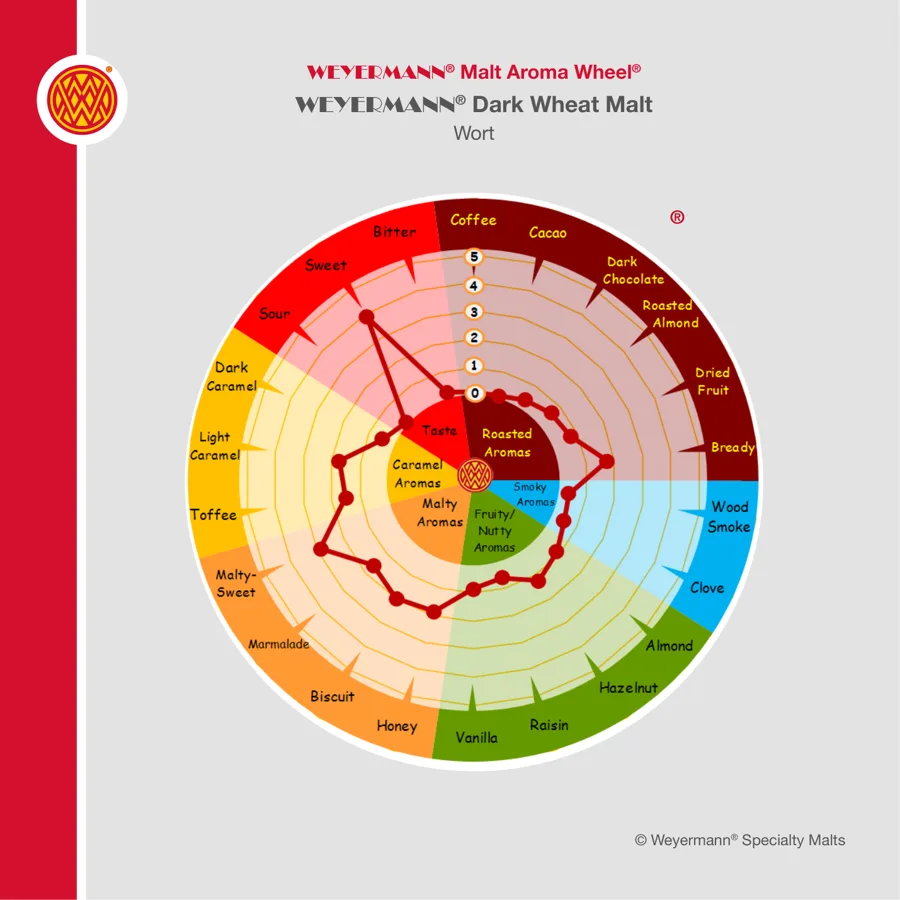
Weyermann's sensory list starts with bread and nut, then moves to pastry, honey, toffee and caramel. On the aroma wheel on this page the baked and sweet groups are both strong. The pastry note is what people remember: a Dunkelweizen brewed with it tastes faintly of brioche or a fruit bun, which sits well against the yeast's banana.
There is no roast. If a Dunkelweizen tastes of coffee, the brewer used too much roasted malt for colour. A good one is the colour of strong tea, smells of banana bread and finishes soft, with the wheat keeping it from feeling heavy.
How much to use and how to mash
Pair it with a high-enzyme partner. Pale wheat malt and Pilsner malt both have high activity and keep conversion quick.
- Dunkelweizen: 25 to 50% Dark Wheat, with pale wheat and Munich making up the rest of the wheat and barley share.
- Weizenbock: 30 to 50%, with more Munich for depth.
- Amber or brown ales: 5 to 15% for body and a bakery note.
Mash at 64 to 67 °C, with an optional ferulic acid rest near 44 °C for clove. Mash out at 76 to 78 °C. Add rice hulls once the total wheat passes about half the grist.
A worked grist: Dunkelweizen, 20 litres
For about 13 °P (OG 1.052) at normal homebrew efficiency:
- Dark Wheat malt: 2.00 kg (40%)
- Pale Wheat malt: 1.00 kg (20%)
- Munich malt Type 1: 1.50 kg (30%)
- CARAMUNICH Type 2: 0.40 kg (8%)
- CARAFA SPECIAL Type 1: 0.10 kg (2%)
- Total: 5.00 kg (100%)
Total wheat is 60%, inside the usual Weizen range. The dehusked CARAFA SPECIAL adds colour without the burnt edge. Bitter to 12 to 15 IBU and ferment with a Weizen yeast at 18 to 20 °C.
Notice that four of the five malts affect colour. Change one and the others need to move. Working that out before brew day, rather than finding out in the glass, is the grist design skill most brewers pick up slowly and painfully.
Dark wheat in an Indian brewery
Dunkelweizen works well in India's cooler months and pairs nicely with tandoori and smoky grilled dishes. Dark Wheat malt is usually a small-volume order, so the bag you open may sit for weeks. Reseal it tightly every time. Weyermann's two-year shelf life applies to unopened bags kept dry between 0 and 30 °C; an open bag in monsoon air does not get that.
The floor detail we would watch: the high protein in this malt shows up as chill haze if the beer is meant to be filtered. A Dunkelweizen is supposed to be cloudy, so this matters only when you use Dark Wheat in a clear amber ale.
Out of stock? Replace it with pale wheat malt plus Munich Type 2 at about the same total weight. You keep the colour, body and most of the flavour, though the pastry note softens.
Common questions
Can I use Dark Wheat malt as my only malt?
No. Weyermann recommends up to 50%, because its enzyme activity is medium. Pair it with pale wheat or Pilsner malt.
What colour is Weyermann Dark Wheat malt?
15 to 20 EBC, or 6.1 to 8 degrees Lovibond.
Does Dark Wheat malt taste roasted?
No. It tastes of bread, pastry, honey and toffee. Roast comes from roasted malts.
What is a substitute for Dark Wheat malt?
Pale wheat malt plus a share of Munich Type 2 gives similar colour and body.