Weyermann Oak Smoked Wheat malt: a gentler smoke for Grodziskie and more
Oak Smoked Wheat malt brings a gentle, cigar-box smoke and the body of wheat. It is the malt for Polish Grodziskie and for any wheat beer that wants a wisp of smoke rather than a bonfire.

Wheat, smoked over oak
Weyermann makes this malt from German quality wheat, kilned over oak smoke. Oak gives a drier, more restrained smoke than the beechwood used for Beech Smoked Barley malt. Because the grain is wheat, it brings the wheat package with it: high protein, foam, body and no husk.
Its best-known use is Piwo Grodziskie, a pale, light, highly carbonated smoked wheat beer from Grodzisk Wielkopolski in western Poland. Historic versions were brewed almost entirely from oak-smoked wheat malt. The style nearly disappeared in the 1990s and has since been revived by craft brewers.
The spec sheet
From the Weyermann datasheet (crop 2025):
- Colour: 4 to 6 EBC (2 to 2.7 °L). Pale; a Grodziskie made from it is straw gold.
- Extract: at least 81% dry basis. Wheat's higher extract; plan your gravity accordingly.
- Moisture: 5.5% maximum.
- Protein: 10.5 to 13.5%; Kolbach index 37.5 to 47%.
- Viscosity (8.6% wort): 2.2 mPa·s. Thick, like any wheat malt.
- Wort pH: 5.75 to 6.15 (laboratory congress wort). The mash will need the usual adjustment towards 5.2 to 5.6.
- Enzyme activity: high. Recommended addition: up to 80%.
The 80% limit is a practical one. Above it, a huskless, viscous mash is very hard to lauter.
What it tastes like
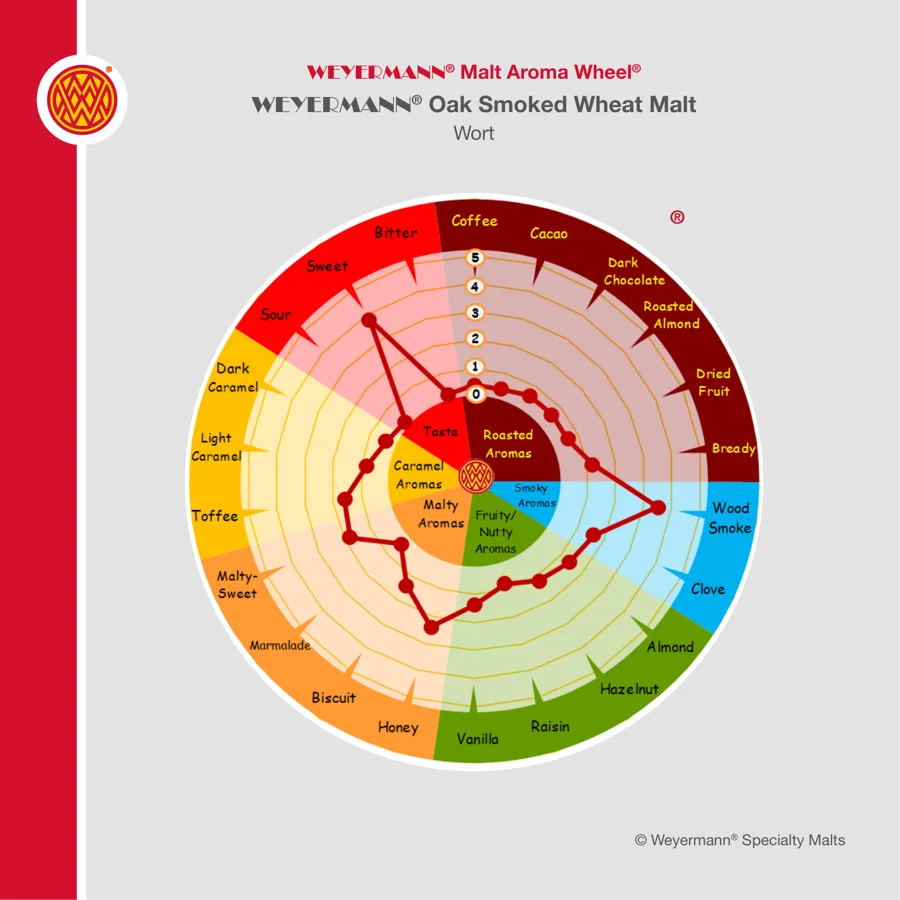
Weyermann's description compares the smoke to fine cigars, backed by light toffee and biscuit. On the aroma wheel on this page the smoky group is present but not overwhelming, with the bready and sweet groups close behind.
In the glass it reads as dry woodsmoke and a faint tobacco-leaf note. It is much less meaty than beech smoke. Even at high percentages a Grodziskie should taste refreshing rather than heavy. The high carbonation helps: it lifts the smoke out of the glass and scrubs the palate between sips, so a beer under 3% ABV still feels lively and complete.
How much to use and how to mash
- 5 to 15%: a quiet smoky edge in a Weissbier, Witbier or a sour wheat beer such as Lichtenhainer.
- 30 to 50%: clearly smoked wheat beer.
- 60 to 80%: Grodziskie territory.
Mash at 63 to 66 °C for 60 minutes, then mash out at 76 to 78 °C. At high percentages, add 3 to 5% rice hulls and run off slowly. Let a bed that starts to pack down rest, underlet with hot liquor and start again gently. Check mash pH: the malt starts high, so expect to add some acid or acidulated malt.
A worked grist: Grodziskie, 1,000 litres
Grodziskie is a small beer, around 7.5 to 8 °P and 2.5 to 3.3% ABV. For 8 °P, assuming roughly 70% of malt weight as extract:
- Oak Smoked Wheat malt: 90 kg (75%)
- Pilsner malt: 30 kg (25%)
- Total: 120 kg (100%)
Add about 5 kg of rice hulls. The Pilsner share keeps the grist inside Weyermann's 80% limit and gives the bed some husk. Bitter to 20 to 30 IBU with a noble or Polish hop. Ferment with a clean ale yeast at 16 to 18 °C, then carbonate high, around 3.5 volumes or more. Traditionally Grodziskie was served clear.
The floor detail: check that your kegs and taps can handle that carbonation. A standard brewpub tap set for about 2.5 volumes will pour foam. Use a longer line or a flow-control tap.
Building a full-flavoured beer at 3% ABV means every kilogram of grist has to earn its place. That is grist design in its purest form.
Oak smoked wheat in India
A Grodziskie fits Indian conditions well: light, refreshing and low enough in alcohol for a long lunch in the heat. It goes with grilled fish, chicken tikka and smoky street food. It is also an easy way to get a smoked beer onto a taproom list without scaring people.
Like all wheat malts it is sensitive to humidity once opened. Keep it sealed, on pallets and away from unsmoked malt; Weyermann's two-year shelf life assumes a dry place between 0 and 30 °C.
If it runs out, a blend of pale wheat malt with 10 to 20% Beech Smoked Barley malt gives smoked wheat character, though the smoke is sweeter and meatier. Brew a small test batch first if you plan to sell the substitute under the Grodziskie name, because regulars will taste the difference.
Common questions
What is Grodziskie?
A light, pale, highly carbonated Polish smoked wheat beer, around 2.5 to 3.3% ABV, traditionally brewed with oak-smoked wheat malt.
How much Oak Smoked Wheat malt can I use?
Weyermann recommends up to 80%. Grodziskie grists usually sit near that limit.
How does oak smoke differ from beech smoke?
Oak smoke is drier and more restrained, closer to cigar box. Beech smoke is sweeter and meatier.
Does Oak Smoked Wheat malt need a lot of rice hulls?
At 60% or more, add 3 to 5% rice hulls by weight to keep the lauter running.