Weyermann Isaria 1924 malt: brewing with a 100-year-old barley
Isaria 1924 is a heritage malt with old-barley numbers: more protein, lower extract and medium enzymes. We show what that means in the mash tun and give a 1,000 litre Kellerbier.

A barley from 1924
Isaria is a German malting barley that was officially approved for brewing in 1924. Weyermann calls it the oldest German malting barley variety. Brewers used it for traditional unfiltered lagers. The maltster holds the trademark on the ISARIA 1924 name.
The use list is traditional German: Zoigl, Franconian Landbier, Kellerbier, Märzen, Festbier, Munich Dunkel and bocks. The Weyermann malts guide shows the other heritage malts, including Barke Pilsner.
The spec sheet: an old barley in numbers
From the 2025 crop datasheet:
- Colour 7 to 9 EBC (3.1 to 3.8 °L). Darker than a Pilsner malt, closer to a light Vienna. Expect a golden to light amber wort.
- Extract at least 78%, moisture at most 5%. About 2.5 points below a modern Pilsner malt. For a 200 kg grist, that can mean several kilograms more malt for the same gravity.
- Protein 11 to 13%, Kolbach index 31 to 43%. Higher protein than modern malts and a wide modification range. The bottom of that range is noticeably less modified.
- Enzyme activity medium, saccharification up to 15 minutes.
- Friability at least 75%, glassy kernels at most 5%, viscosity at most 1.58 mPa s. The friability and glassy kernel figures are the ones to watch at the mill.
What it tastes like
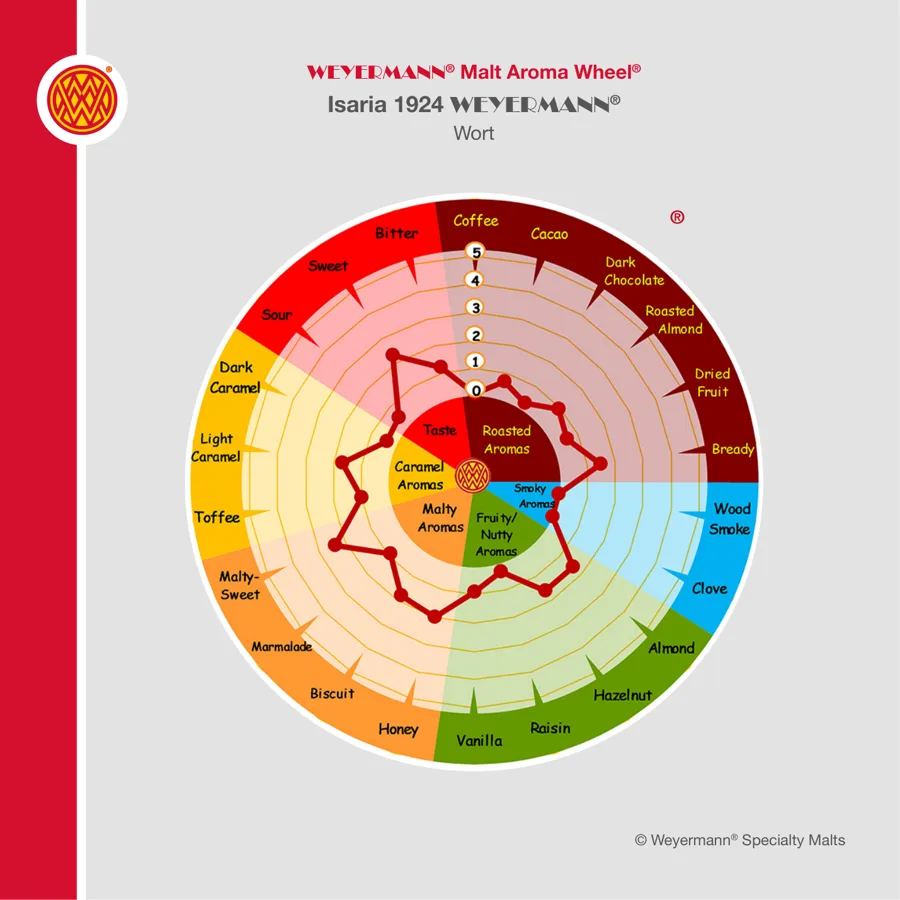
Weyermann describes a malty-sweet taste, a soft aroma like biscuit and a soft mouthfeel. On the wheel below, scored on wort by a trained panel, the trace is rounder and more even than on the Pilsner malts, with biscuit and bread crust reaching out and sweet taste lower.
In an unfiltered lager that gives a soft, bready malt with a gentle sweetness, the kind of beer that tastes better from a stone mug than from a frosted glass. It also pairs well with food that has some char: tandoori chicken, seekh kebab or a smoky baingan bharta. The malt picks up the char without competing with it.
How much to use and how to mash it
Weyermann says up to 100% is possible. With medium enzyme activity and a variable Kolbach, mash it with care.
- Read the certificate of analysis. If the Kolbach is near 31%, a short rest at 50 to 52 °C helps. Above 40%, skip it.
- Give conversion time. Rest at 63 °C, then 72 °C. Confirm with iodine before mash-out.
- Consider decoction. These styles were brewed that way. Boiling part of the mash also helps a less modified malt give up its extract.
Up to 5% glassy kernels means some hard, poorly modified grains. They crack badly at a gap set for friable malt. Before each new lot we check the roller gap with a feeler gauge and look at the grist: husks should be torn open but mostly whole, with few uncracked kernels. Some brewers condition the malt with a fine water spray before milling to keep the husk tougher.
A Franconian Kellerbier for a 1,000 litre brewpub
For 1,000 litres of cast wort at about 12.5 °P:
- Weyermann Isaria 1924 malt: 190 kg (95%)
- Weyermann CARAMUNICH Type 1: 10 kg (5%)
Total 200 kg. Bitter to 25 to 30 IBU, ferment at 9 to 11 °C, lager for three to four weeks and serve unfiltered. The higher protein gives a natural haze, which suits the style. Keep the beer cold from tank to tap, because protein haze in an unfiltered beer is fine while a warm, oxidised one is not.
Every number on that sheet changed the plan: grist weight, mill gap, mash steps and filtration. That is the whole job of reading a spec sheet.
Using it in India
The sheet promises at least 24 months unopened with dry storage between 0 and 30 °C. Keep it in a cool, dry room on pallets and use opened bags quickly. Damp malt makes the glassy-kernel problem worse, because the husk softens while the hard grains stay hard.
If it is out of stock, there is no true substitute. A blend of about 80% Pilsner malt and 20% Vienna gets close on colour with a cleaner, less bready flavour. Lower the grist weight to suit the higher extract of the modern malts, or the beer will finish stronger than planned.
Common questions
What is Isaria 1924?
A malt from Isaria, a German barley variety approved for brewing in 1924. Weyermann malts it as a heritage malt for traditional German lagers.
Why is the extract lower than modern malts?
Older barley varieties were bred for different goals. Isaria has higher protein (11 to 13%) and its malt gives at least 78% extract, against 80.5% for Weyermann's Pilsner malt.
Does Isaria 1924 need a special mash?
It has medium enzyme activity and a wide Kolbach range, so give conversion time, check the lot certificate for a protein rest and consider a decoction.
What can I use instead?
There is no exact substitute. A blend of Pilsner and Vienna malt gets close on colour but tastes cleaner.