Weyermann Chocolate Wheat malt: dark wheat for dunkels and porters
Chocolate Wheat is roasted wheat malt with no husk at all. It gives dark beers a smooth chocolate note and deep colour. Here are the numbers, the dose and a Dunkelweizen to try it in.

What Chocolate Wheat malt is
Chocolate Wheat is wheat malt taken to a roasting drum and roasted gently until it turns very dark. Wheat has no husk, so there is nothing to carry the ashy bitterness that husked roasted barley malts can show. The result behaves a lot like a dehusked roast malt such as CARAFA SPECIAL, with a softer roast and more chocolate.
Weyermann sells it for top-fermented beers. It is the natural choice when you want a dark beer with wheat character, a Dunkelweizen being the obvious one, but it also works in porters and stouts as a smoother alternative to roasted barley malt.
The numbers and what they mean on brew day
- Colour: 900 to 1,200 EBC (339.8 to 452.9 °L).
- Extract: at least 65%, dry basis.
- Moisture: 4.0% maximum.
- Enzyme activity: none.
- Recommended addition: up to 5%.
The colour sits between CARAFA Type 1 and Type 2, so a little goes a long way: 2% in a wheat beer is enough to take it from gold to chestnut brown. On an as-is basis the extract is about 62.4% (65 x 0.96). The moisture ceiling is slightly higher than for the barley roast malts, so check it on arrival if your supplier gives you a certificate. No enzymes means the wheat and barley base malts do the converting.
What it tastes like
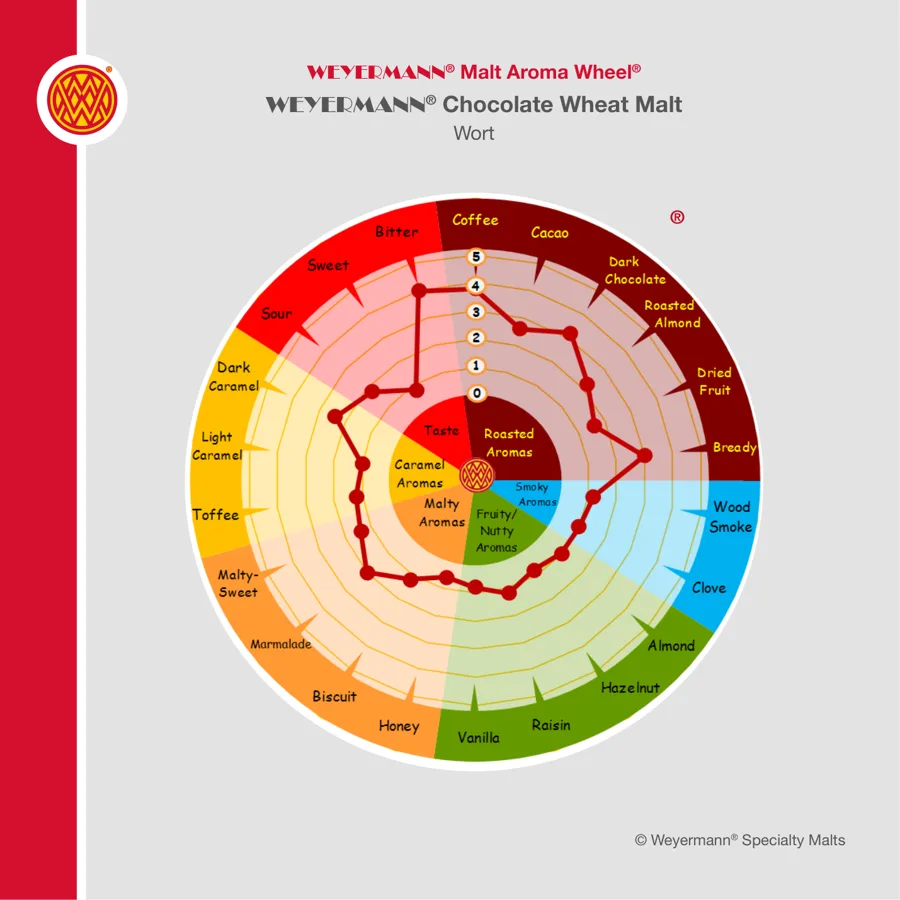
The aroma wheel below the opening section shows the balance: dark chocolate leads, with a mild roast behind it and touches of coffee and bread. Weyermann calls the chocolate intense and the roast mild. That matches what you taste.
In a Dunkelweizen it sits under the banana and clove from the yeast, adding a cocoa note and a slightly drier finish. In a porter it reads as milk chocolate rather than espresso. If you want bite, it is the wrong malt. If you want depth without grip, it is often the right one.
One more practical point: because the roast is mild, Chocolate Wheat is forgiving. A recipe that comes out a touch too dark rarely tastes burnt, which is not true of roasted barley at the same colour.
How much to use and how to mash it
Stay within the 5% guide. For a Dunkelweizen, 1% to 3% is usually enough. Porters and stouts can use the full 5%, often alongside a little CARAFA SPECIAL or roasted barley for structure.
Mash it in with everything else; it needs the base malt to convert any starch around it. Dark malt pulls mash pH down, so check it after mashing in. The bigger practical issue is lautering. A Dunkelweizen grist is often more than half wheat. Wheat has no husk to build a filter bed. Add rice hulls at around 2% to 5% of the grist weight to keep the run-off moving. Our guide to wheat malt in brewing covers the wheat side in more detail.
Styles it suits and a worked Dunkelweizen grist
Weyermann lists Baltic, American, chocolate and imperial porters, extra, foreign extra and imperial stouts, quadrupel, Altbier, Black IPA, Dunkelweizen and Weizenbock.
A worked Dunkelweizen for a 20 litre homebrew of 13 °P wort, at about 70% efficiency:
- Pale wheat malt: 2.75 kg (55%)
- Munich malt: 1.90 kg (38%)
- CARAMUNICH: 0.25 kg (5%)
- Chocolate Wheat malt: 0.10 kg (2%)
That totals 5.00 kg and 100%, plus a handful of rice hulls outside the grist. Use a Bavarian weizen yeast and keep fermentation steady; the yeast does as much for this beer as the malt.
Using Chocolate Wheat in India
The sheet's 24 month shelf life applies to unopened bags stored dry between 0 and 30 °C, which many Indian storerooms exceed in summer. Store bags on pallets, away from walls. Reseal opened bags immediately. Dark malt pulls moisture from humid air quickly and loses its crispness.
Rice hulls are easy to get in India, but rinse them before use to remove dust and any off aromas. If Chocolate Wheat is unavailable, CARAFA SPECIAL Type 1 at a similar weight gives close colour with a similar smoothness, although you lose the wheat bread note. Swaps like that are where grist design matters: the colour is easy to match, the balance of chocolate, body and roast is not. The Weyermann malts guide shows the full roasted range.
Common questions
Does Chocolate Wheat malt need a husk to lauter?
It has no husk, but at 1% to 5% it hardly affects lautering. The wheat base malt in a Dunkelweizen is the bigger issue, which is why rice hulls help.
Is Chocolate Wheat the same as chocolate malt?
No. Chocolate malt is usually roasted barley malt. Chocolate Wheat is roasted wheat malt, which has no husk and gives a smoother roast.
How much Chocolate Wheat should I use?
Weyermann recommends up to 5%. Dunkelweizen usually needs 1% to 3%, while porters and stouts can use more.