Weyermann CARAWHEAT: caramel malt from wheat
CARAWHEAT is a fully caramelised wheat malt in the amber to light brown range. Here is what its numbers mean, where it belongs in a grist and how to keep it from slowing your lauter.

Caramel malt, but from wheat
Most caramel malts start as barley. CARAWHEAT starts as German wheat. Weyermann stews the green wheat malt so that the starch in each grain turns to sugar, then roasts it until the whole kernel is caramelised. What comes out is a golden brown, intensely aromatic grain with no enzyme power left.
Wheat has no husk. That shapes how the malt behaves in the mash tun and the flavour it gives: softer and more bready than a barley crystal malt of similar colour. If wheat in general is new ground, start with our wheat malt guide.
The numbers that matter
- Colour: 110 to 140 EBC (41.9 to 53.2 Lovibond). A mid to dark caramel. Small additions move colour quickly.
- Extract: 68% minimum, dry basis. Lower than most malts, because the roasting has used up some of the extract. Budget for it in your gravity calculation.
- Moisture: 6.5% maximum.
- Maximum addition: up to 15%.
- Enzyme activity: none.
The extract figure is the one people forget. Swap barley crystal for CARAWHEAT at the same weight and your original gravity will come in slightly low. Add a little base malt to compensate.
What it tastes like
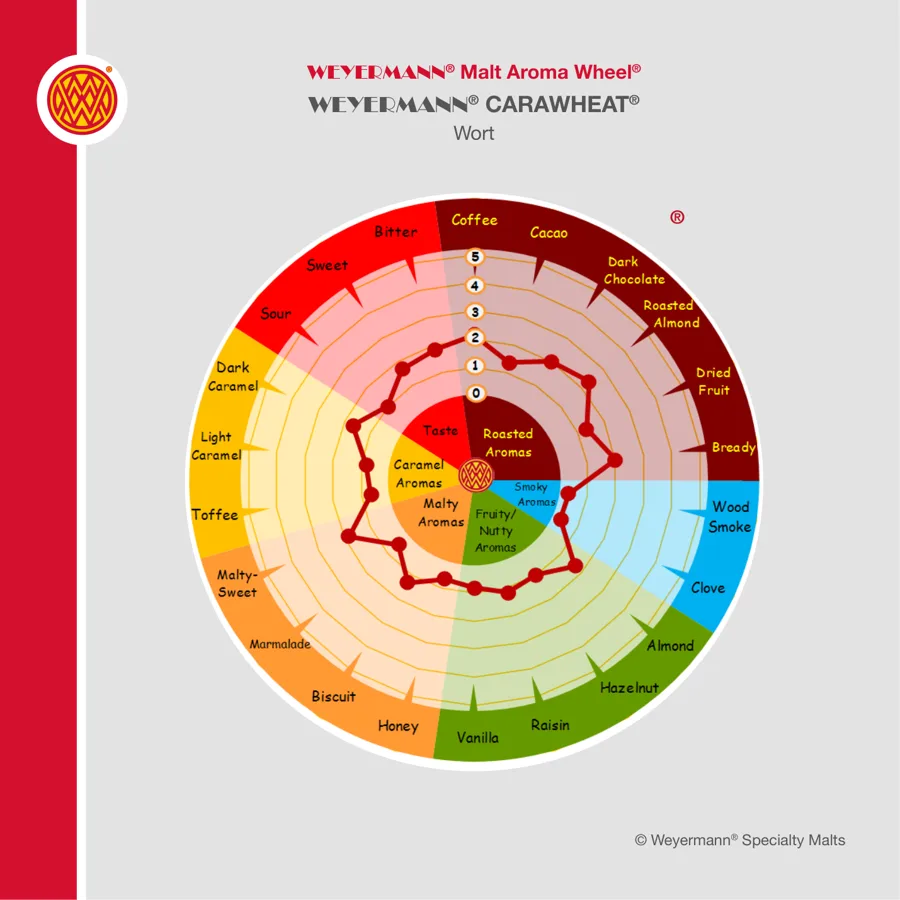
Look at the aroma wheel above. Weyermann's own words are light caramel, almond, bread and pastry. We find it reads as the crust of a freshly baked loaf, with toffee underneath. It is less sticky-sweet than barley caramel malt of the same colour, which is why it sits so well in wheat beers that should stay drinkable.
In a hazy IPA it does something useful: a small dose gives the pale, juicy base a bready backbone without the cloying crystal character that fights tropical hops.
How much to use and how to mash it
CARAWHEAT needs no conversion, so it goes into the mash with everything else. Mash temperature affects the base malt, not this one.
- 2 to 5%: amber tint and a bread crust note in a hefeweizen or a hazy IPA.
- 5 to 10%: the amber and dark wheat beers, where you want obvious caramel.
- 10 to 15%: weizenbock and wheat wine, where the malt has to carry high gravity.
Here is the brewhouse detail. A wheat-heavy grist has little husk to form a filter bed. Every percent of CARAWHEAT is huskless too. If your lauter already runs slowly on a 50% wheat grist, watch the run-off rate and the pressure across the bed when you add CARAWHEAT on top. Rice hulls at 1 to 2% of the grist are a common fix. Raking slowly and keeping the run-off gentle at the start saves you from a stuck bed.
A worked grist: dunkelweizen, 20 litres
For a 20 litre homebrew batch at around 12.5 °P, assuming about 72% efficiency.
- Pale wheat malt: 2.53 kg (55%)
- Munich malt: 1.38 kg (30%)
- CARAWHEAT: 0.46 kg (10%)
- Pilsner malt: 0.23 kg (5%)
- Total: 4.60 kg (100%)
Ferment with a weissbier yeast warm enough to give banana and clove. Expect a chestnut beer with a bread crust finish. Scale the total for your own system; the ratios are the recipe. For a lighter amber weizen, halve the CARAWHEAT and move the difference to pale wheat malt.
Notice what this grist is balancing: the wheat for texture, the Munich for malt depth and CARAWHEAT for colour and crust. Getting those three to agree on purpose, rather than by copying a recipe, is the skill a brewer builds over many batches.
Using CARAWHEAT in India
Unopened, Weyermann quotes at least 24 months of shelf life, stored dry between 0 and 30 °C. Indian summers break the top of that range. Store sacks raised on pallets, out of direct sun and away from walls that sweat in the monsoon.
Wheat kernels are smaller and harder than barley. If you mill on a two-roll mill set for barley, check the crush: some wheat may pass through unbroken, which means lost extract and colour. A tighter gap for a separate wheat pass helps.
If you run out, a barley caramel malt of similar colour gives close colour with a sweeter, less bready flavour. For the wider range see the Weyermann malts guide and for a lighter caramel option try CARAHELL.
Common questions
Does CARAWHEAT have any enzymes?
No. It is fully caramelised, so it needs a base malt in the mash to convert. It adds colour, body and flavour only.
How much CARAWHEAT can I add?
Weyermann recommends up to 15%. Most wheat beers use 2 to 10%, with the top end kept for weizenbock and wheat wine.
Will CARAWHEAT slow my lauter?
It can add to the problem because wheat has no husk. In a grist already heavy with wheat, rice hulls and a gentle start to the run-off help.
Can I use CARAWHEAT in an IPA?
Yes. A small dose adds a bready backbone to hazy and juicy IPAs without the heavy sweetness of some barley crystal malts.