The Greatest Beer Run Ever: a little beer, a lot of madness and a whole lot of heart
In 1967 John "Chickie" Donohue, a merchant seaman from New York, carried a duffel bag of Pabst Blue Ribbon to his friends fighting in Vietnam. Craft Beer School mentor Chatty Girija watched the film of his story one evening with a glass in hand. She found it was never really about the beer.

A long day ended with a beer and a film about a beer
It was one of those long work-from-home days. The laptop had demanded enough attention, the emails had multiplied like yeast and my brain was officially calling last orders.
I finally shut everything down, settled into the sofa, switched on the warm yellow lights and poured myself a glass of golden yellow beer. A little aimless scrolling, a little searching for something to watch and there it was on Prime Video: The Greatest Beer Run Ever.
Perfect. Beer in hand, television on. What could possibly go wrong?
Well, quite a lot, as it turns out. Especially when somebody decides that the best way to support American soldiers fighting in Vietnam is to travel halfway across the world carrying a duffel bag full of beer cans.
And this, believe it or not, is a true story.
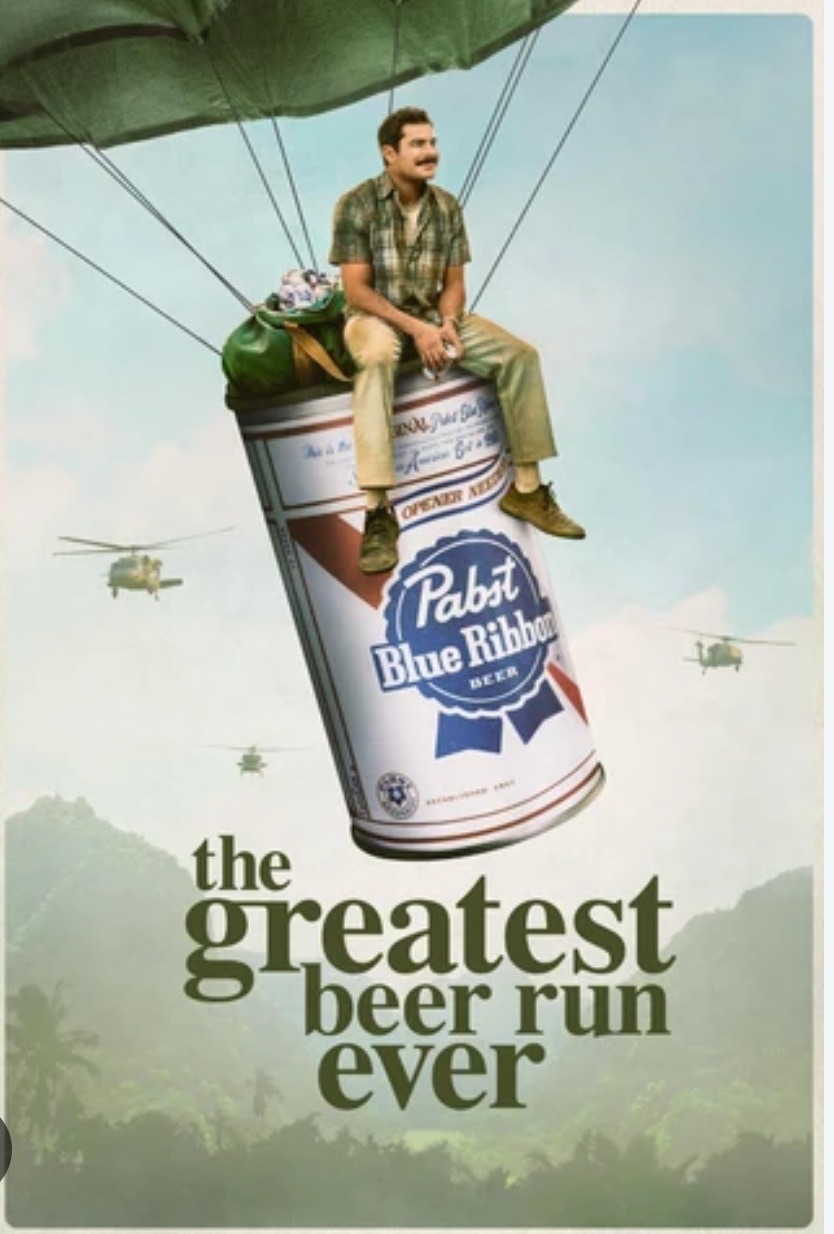
A beer run. To a war zone. Seriously?
Set in 1967, the film tells the extraordinary story of John "Chickie" Donohue, a New Yorker who makes an impulsive promise at his neighbourhood bar. He will go to Vietnam, find his friends serving in the war and bring them each a beer.
Not a medal. Not a letter from the President. Not a care package of essential supplies. A BEER!
The idea comes from George Lynch, known as the Colonel, who declares: "Somebody ought to go over to 'Nam, track down our boys from the neighborhood and bring them each a beer!"
And Chickie, displaying the kind of judgement that makes mothers nervous and makes movies memorable, simply agrees: "You get me a list of the guys and what units they're with and the next time I'm over there, I'll bring them all a beer."
His friend Bobby Pappas has perhaps the most sensible response in the entire film: "You got a good heart, Chickie. It's your brain I worry about."
Bobby, I think many of us have met a Chickie. Some of us have probably been one after two beers.
Pabst Blue Ribbon became the most unlikely peace ambassador
The beer Chickie carries is Pabst Blue Ribbon, or PBR, an American lager with a history dating back to 1844 in Milwaukee, Wisconsin. Its name comes from the blue ribbons that were tied around its bottles between 1882 and 1916.
A humble American beer, with no grand claims or complicated personality. Just the sort of beer you could imagine sharing with your neighbourhood friends.
But in this story, PBR becomes much more than a beer can. It becomes a little piece of home travelling into a place where home feels impossibly far away.
Think about it. Somewhere between the bullets, the uncertainty and the sheer madness of war, a familiar face turns up carrying a beer. You would probably first ask him whether he had completely lost his mind. Then you would hug him. And then, I suspect, ask where he had kept the beer.
When the bullets are real, a beer becomes personal
As Chickie moves through Vietnam, the adventure he imagined begins to collide with the reality of war. The laughter becomes uncomfortable. The danger becomes real. The boys he came looking for are no longer just names on a list. They are young men living through something he cannot possibly understand from the comfort of his neighbourhood bar.
And yet, something beautiful happens.
Rick Duggan tells Chickie what his visit means to the men. The fact that he showed up makes them realise that there are actually people back home who care about them.
That moment stayed with me.
Because the beer was never really the point. It was the thought behind it. The friendship. The effort. The mad determination to make somebody feel remembered.
And here is where I think the magic of beer lies.
There is a little bit of beer in all of us
I don't mean that everybody needs to drink beer. I mean that little human instinct to loosen up, laugh a little, share a little and find common ground, even when life gives us every reason not to.
Watch the characters in this film. The tough ones, the frightened ones, the angry ones, the ones trying to make sense of a war they are living through. Beneath the uniforms, the bravado and the fear, there is still a person who wants a friend, a familiar face, a laugh, a moment of normality.
Even when the bullets are flying at point-blank range, that little bit of humanity refuses to disappear.
Beer somehow becomes the common language. It doesn't recognise ranks, political opinions, social standing or which side of the table you occupy. It invites people to sit down, share a moment and remember that they are human beings first.
Beer cannot negotiate peace. It cannot stop a bullet or bring someone home. But it can make people connect in ways that speeches and slogans sometimes cannot.
And perhaps that is why beer has been welcomed, accepted and loved across cultures and generations. The world may disagree about almost everything, but the simple pleasure of sharing a drink has a rather remarkable ability to travel across boundaries.
We need more Chickies and perhaps a little more beer in the world
We need more Chickies who teach us the virtues of life without standing on a podium. People who don't preach friendship, loyalty, compassion or courage. They simply practise them.
People who show up. Who remember. Who make the effort. Who do something ridiculously kind, even if their friends question their brains.
I have always believed beer is a cheerful catalyst. It has given me reasons to explore, meet people, start conversations, discover possibilities and find purpose. It doesn't solve life's problems, but sometimes it makes the problems seem a little less impossible. More importantly, it reminds us to be curious, sensitive, compassionate and human.
Chickie went to Vietnam thinking he was delivering beer. He ended up discovering something about war, friendship, humanity and himself.
And that, to me, is the greatest beer run ever.
By the time the credits rolled, my glass was empty. I was sitting under those same yellow lights, thinking about how one ordinary can of Pabst Blue Ribbon had travelled so far, carried so much affection and become part of such an extraordinary story.
Maybe the world doesn't need more people telling us how to live. Maybe it needs more people willing to show up for each other.
And if they happen to bring beer along, I certainly wouldn't complain.
Here's to Chickie. Here's to PBR. Here's to friendship, humanity and a world that could do with a little less ammunition and a little more conversation.
And here's to peace. May it always be on tap.
Cheers! #beerineverything
References
- The Greatest Beer Run Ever, directed by Peter Farrelly, Apple Original Films, 2022.
- Donohue, J. "Chickie" and Molloy, J. T. The Greatest Beer Run Ever: A Memoir of Friendship, Loyalty and War. William Morrow, 2020.
- Pabst Blue Ribbon. pabstblueribbon.com
Chatty Girija spent more than 30 years in advertising, hosts the Cheers Chatty Beer Podcast and teaches at Craft Beer School.
Common questions
Is The Greatest Beer Run Ever a true story?
Yes. It is based on John "Chickie" Donohue, who travelled from New York to Vietnam in 1967 to bring beer to friends from his neighbourhood who were serving there.
Which beer does Chickie carry in the film?
Pabst Blue Ribbon, an American lager first brewed in Milwaukee, Wisconsin, whose name comes from the blue ribbons once tied around its bottles.
Where can I watch it?
It is an Apple Original film from 2022 that streams on Apple TV+. In India it can also be watched through Prime Video, which is where Chatty found it.