Weyermann Pale Ale malt: a fuller base for ales
Pale ale malt is kilned a little harder than Pilsner malt, which buys colour and bread crust flavour. We read Weyermann's sheet, mash it the simple way and give a brewpub pale ale.

What Pale Ale malt is
Weyermann Pale Ale malt is a base malt made from German brewing barley and kilned to a slightly higher colour than a Pilsner malt. It is meant for ales and other top-fermented beers. Weyermann notes it suits an isothermal mash, meaning a single rest at one temperature. That is the British tradition and most brewpubs work the same way.
The style list is long: pale ale in every accent (American, Belgian, juicy, hazy, session), all the IPAs, bitters, milds, brown ale, porter, stout and barley wine, plus India Pale Lager. The Weyermann malts guide places it between the Pilsner malts and the kilned Vienna and Munich malts.
The spec sheet and what it means
From the 2025 crop datasheet:
- Colour 5.5 to 7.5 EBC (2.5 to 3.3 °L). Roughly twice the colour of Pilsner malt. A pale ale on 90% of this malt sits at golden before any caramel malt goes in.
- Extract at least 79%, moisture at most 5%. A point and a half below Pilsner malt, a small cost in malt per brew.
- Protein 9 to 12%, Kolbach index 37 to 43%. Well modified. No protein rest needed.
- Saccharification up to 20 minutes, enzyme activity high.
- Friability at least 78%, glassy kernels at most 3%, viscosity at most 1.69 mPa s. A little slower to lauter than Pilsner malt, which matters if you run oats or wheat with it.
What it tastes like
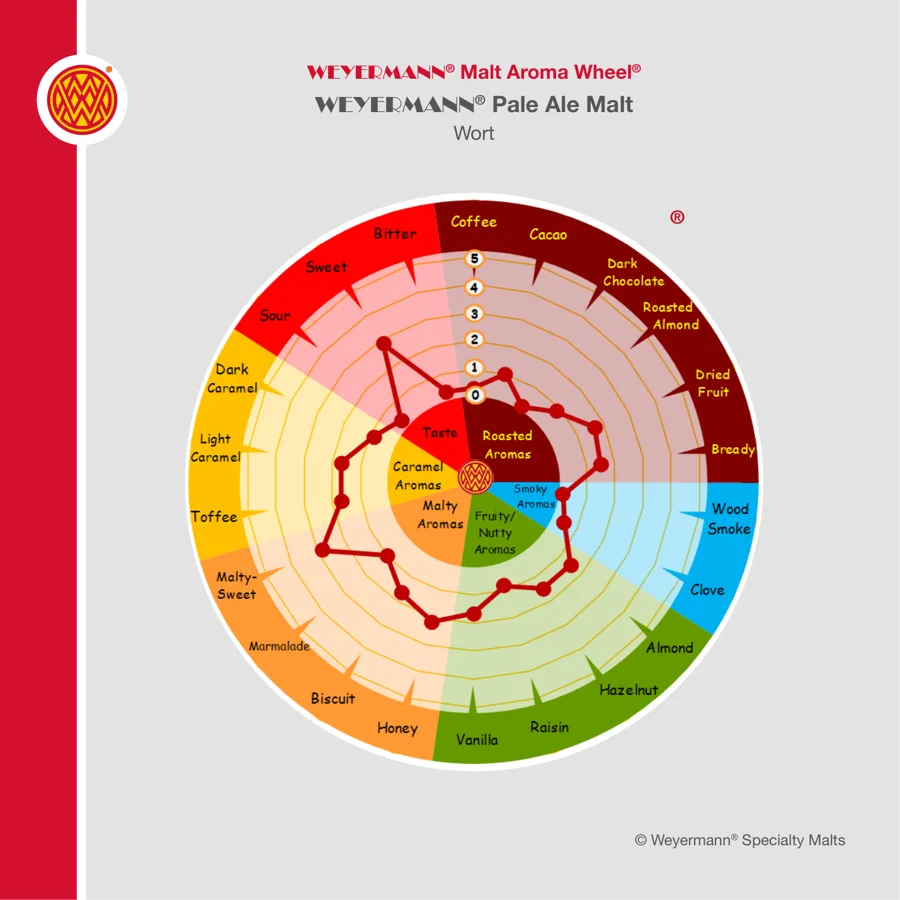
Weyermann describes fine bread notes with a hint of dried fruit and honey. On the wheel below, scored on wort by a trained panel, the trace reaches out on bread crust and sweet taste, with dried fruit, honey and biscuit all above the centre. It is a fuller, rounder profile than the Pilsner malts.
In a pale ale that reads as bread crust and a faint fruitiness under the hops. It gives a hazy IPA something to stand on. In a bitter it does much of the work a darker British malt would.
How much to use and how to mash it
Up to 100% of the grist, with high enzyme activity, so it will carry wheat, oats or a little sugar without trouble.
A single infusion at 65 to 67 °C for 60 minutes suits most ales. Go lower (64 °C) for a dry IPA and higher (68 °C) for a fuller bitter or a hazy beer. At 3 litres of water per kg, the strike water for a 66 °C mash is roughly 66 + (0.41 / 3) x (66 minus grain temperature). In a Chennai summer, with grain sitting at 30 °C, that comes to about 71 °C. In a cool Bengaluru winter morning with grain at 20 °C it is about 72.3 °C. The formula ignores heat lost to the tun, so note your own correction and keep it. A degree too hot at mash-in is the commonest reason a pale ale finishes fuller than planned.
An American pale ale for a 1,000 litre brewpub
For 1,000 litres of cast wort at about 12.5 °P:
- Weyermann Pale Ale malt: 180 kg (90%)
- Weyermann CARAMUNICH Type 1: 10 kg (5%)
- Weyermann Pale Wheat malt: 10 kg (5%)
Total 200 kg. Mash at 66 °C, bitter to around 35 to 40 IBU and put most of the hops late or in the whirlpool. Ferment with a clean American ale yeast at 18 to 20 °C and dry hop near the end of fermentation.
The caramel malt is the lever brewers most often get wrong. Five per cent here gives colour and a little sweetness. Ten per cent starts to fight the hops. Knowing where that line sits for your beer, before the brew rather than after, is grist design.
Using it in India
The datasheet gives at least 24 months unopened if stored dry between 0 and 30 °C. An ale brewery here may keep this malt longer than any other, so rotate stock strictly, keep it off the floor in the coolest dry room and reseal opened bags. Slack malt mills poorly and turns bready flavour stale.
If it is out of stock, Pilsner malt with 5 to 10% Vienna malt comes close on colour and flavour. Pilsner malt alone gives a lighter, cleaner ale.
Common questions
Can I use Pale Ale malt for lagers?
Yes. Weyermann lists India Pale Lager. For a classic pale lager, Pilsner malt gives a lighter colour and cleaner flavour.
What is an isothermal mash?
A mash held at one temperature, usually 65 to 67 °C for ales, instead of a series of steps. Weyermann says this malt suits it.
How is Pale Ale malt different from Pilsner malt?
It is kilned to a higher colour (5.5 to 7.5 EBC against 2.5 to 4.5) and tastes more of bread with hints of dried fruit and honey.