Weyermann Diastatic Barley malt: extra enzymes for adjunct-heavy mashes
Diastatic Barley malt is a pale malt with very high enzyme power. Weyermann aims it at whisky and grain spirit, but it has a clear place in an Indian brewhouse that mashes a lot of rice or maize.

What diastatic malt is for
Every base malt carries the amylase enzymes that turn starch into sugar. Diastatic malt is malted and kilned to keep far more of them, so a small amount can convert starch from grain that has no enzymes of its own. Weyermann lists its uses as whisky, grain and wheat spirits and vodka, plus bakery and flour milling work, with breweries mentioned among the special applications.
For brewers the case is simple. If your grist is heavy with cooked rice, maize or unmalted barley, an ordinary base malt can run short of enzymes. Diastatic malt makes up the shortfall. The Weyermann malts guide shows the full base malt family it sits in.
The spec sheet and what it means
From the 2025 crop datasheet:
- Diastatic power 300 WK (Windisch-Kolbach units, the European measure of total amylase activity). Weyermann rates the enzyme activity as very high.
- Colour 2.5 to 4 EBC (1.4 to 2 °L). As pale as a Pilsner malt, so it adds no colour.
- Moisture at most 7%. Higher than the 5% on Weyermann's Pilsner malt, which fits gentler kilning that spares enzymes. It also means less headroom in storage.
- Extract at least 78%.
- Protein 9 to 12.5%, Kolbach index 38 to 45%. Well modified. The upper end adds free amino nitrogen, which helps yeast on a low-nitrogen adjunct wort.
- Saccharification up to 15 minutes, viscosity at most 1.65 mPa s, friability at least 78%, glassy kernels at most 3%.
Weyermann gives a rate of up to 60%. For brewing you will rarely need anything like that.
What it tastes like
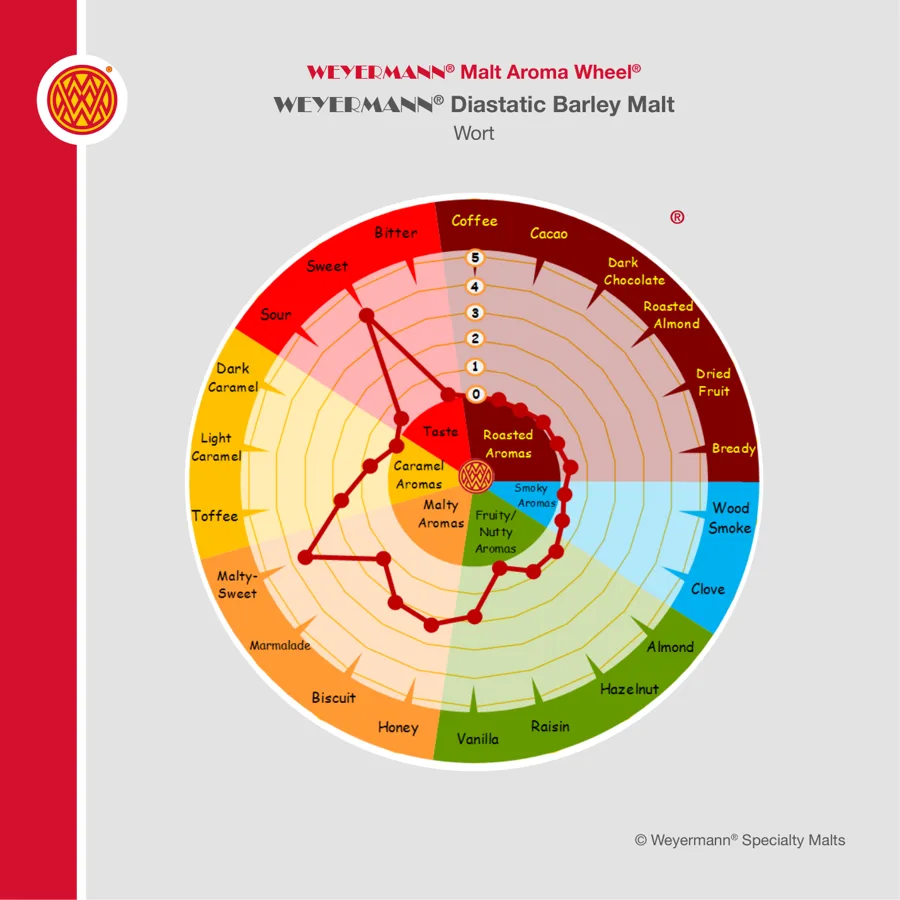
The sensory note is malty sweet with a little honey. On the wheel below, scored on wort by a trained panel, sweet taste reaches high and malty-sweet sits well out. The roasted, smoky and caramel sectors stay near zero. Used at 10 to 20% of a grist it is close to invisible in the finished beer, which is what you want from an enzyme source.
How to use it in an adjunct mash
Rice and maize starch gelatinise at higher temperatures than barley starch, so they need cooking before the enzymes can reach them. The classic method is a double mash:
- In the cereal cooker, mix the rice with a portion of the malt (some brewers use the diastatic malt here) and water. Hold at about 70 °C so the malt enzymes thin the starch, then bring it to the boil for 20 to 30 minutes.
- Meanwhile, mash the rest of the malt in the main tun at about 45 to 50 °C.
- Pump the boiling cereal mash across. It lifts the whole mash toward 63 to 65 °C for conversion. Adjust with direct heat or hot water if you fall short.
- Rest, then raise to 72 °C, check with iodine and mash out at 76 to 78 °C.
The cooker transfer is where adjunct brews go wrong. Pump it too fast and you overshoot the rest. Too slowly and the cooker cools. Our guide to rice and maize adjuncts covers the cooker itself.
A rice lager for a 1,000 litre brewpub
For 1,000 litres of cast wort at about 11 °P:
- Weyermann Pilsner malt: 76.5 kg (45%)
- Weyermann Diastatic Barley malt: 25.5 kg (15%)
- Broken rice: 68 kg (40%)
Total 170 kg. Bitter lightly, to 12 to 18 IBU, ferment at 9 to 11 °C and lager cold. The result is a pale, dry lager with a cleaner finish than an all-malt beer.
How far you can push the rice depends on your malt's enzymes, the rice quality and your mash schedule. Working that out from numbers rather than by trial is the part of grist design brewers most often learn the hard way.
Using it in India
Weyermann quotes a minimum 24 month shelf life unopened when stored dry between 0 and 30 °C. A malt that starts at up to 7% moisture has less margin in a humid store. Enzyme activity is what you bought, so store it in the coolest dry room you have and use it within a few months of opening.
If it is out of stock, raise the share of a high-enzyme Pilsner malt and cut the rice back toward 25 to 30%. Some brewers add exogenous enzymes instead. Check your state's rules and your own label claims first, since rules on additives vary by state and change.
Common questions
What is diastatic malt?
A pale malt made to keep a very high level of starch-converting enzymes. Weyermann's version is rated at 300 WK.
Do I need diastatic malt for a rice lager?
Not always. A good Pilsner malt can convert a moderate share of rice. Diastatic malt gives a safety margin when rice or maize makes up a large part of the grist.
Will it make my beer taste different?
Very little at 10 to 20% of the grist. Weyermann describes it as malty sweet with a hint of honey and it adds almost no colour.
How much can I use?
Weyermann gives a rate of up to 60%. In brewing, 10 to 20% is usually enough to support a heavy adjunct share.